Product Design, Manufacturing & Innovation Resources
Lar » Distância euclidiana

Distância euclidiana

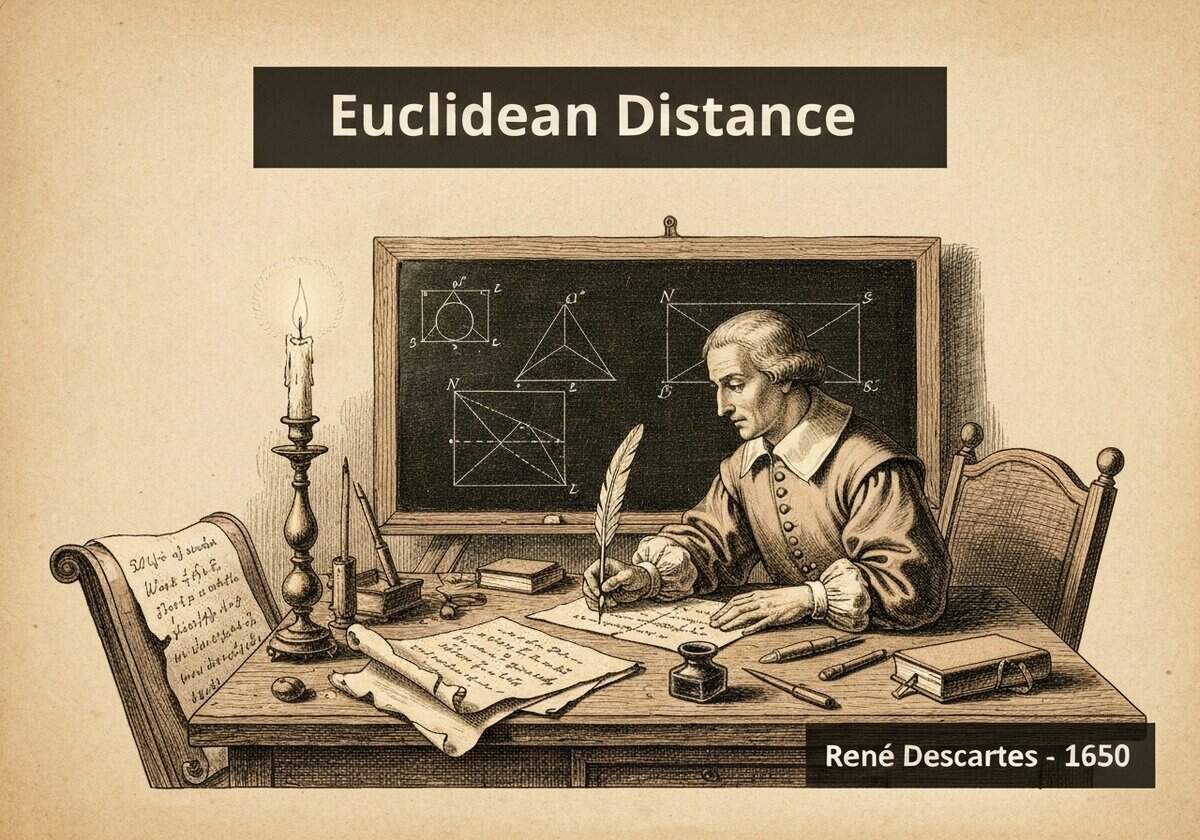
1650
  • René Descartes
Analytic geometry workspace with Euclidean distance calculations and historical context.

(Imagem gerada apenas para fins ilustrativos)

O Pythagorean theorem provides the basis for the distance formula in Cartesian coordinates. The distance [latex]d[/latex] between two points [latex](x_1, y_1)[/latex] and [latex](x_2, y_2)[/latex] in a plane is given by [latex]d = \sqrt{(x_2 – x_1)^2 + (y_2 – y_1)^2}[/latex]. This formula is a direct application of the theorem to a right triangle whose legs are the differences in the x and y coordinates.

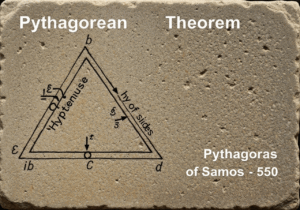
The Euclidean distance formula is a direct and powerful application of the Pythagorean theorem within the framework of a Coordenada cartesiana sistema. Ele fornece um método simples para calcular a distância em linha reta entre quaisquer dois pontos em um plano (ou em um espaço de dimensão superior). Para dois pontos, P1 em [latex](x_1, y_1)[/latex] e P2 em [latex](x_2, y_2)[/latex], a fórmula é [latex]d = sqrt{(x_2 – x_1)^2 + (y_2 – y_1)^2}[/latex].

A dedução desta fórmula é visualmente intuitiva. Os dois pontos podem ser vistos como vértices de um triângulo retângulo. O comprimento do cateto horizontal deste triângulo é a diferença absoluta nas coordenadas x, [latex]|x_2 – x_1|[/latex]. O comprimento do cateto vertical é a diferença absoluta nas coordenadas y, [latex]|y_2 – y_1|[/latex]. A distância em linha reta entre P1 e P2 é a hipotenusa deste triângulo. Aplicando o teorema de Pitágoras ([latex]c^2 = a^2 + b^2[/latex]), obtemos [latex]d^2 = (x_2 – x_1)^2 + (y_2 – y_1)^2[/latex]. Extraindo a raiz quadrada de ambos os lados, obtemos a fórmula da distância. A operação de elevar ao quadrado elimina convenientemente a necessidade de sinais de valor absoluto.

Este conceito, nascido da união da geometria grega antiga com a geometria analítica do século XVII desenvolvida por René Descartes e Pierre de Fermat, é fundamental para quase todos os campos científicos e técnicos. Ele permite que problemas geométricos sejam traduzidos em problemas algébricos e resolvidos sistematicamente. A fórmula também se generaliza perfeitamente para três ou mais dimensões. Para dois pontos no espaço 3D, [latex](x_1, y_1, z_1)[/latex] e [latex](x_2, y_2, z_2)[/latex], a distância é [latex]d = sqrt{(x_2 – x_1)^2 + (y_2 – y_1)^2 + (z_2 – z_1)^2}[/latex]. Essa forma generalizada, conhecida como norma euclidiana ou norma L2, é um pilar da álgebra linear, da ciência da computação (especialmente em aprendizado de máquina para 'k-vizinhos mais próximos' e algoritmos de agrupamento) e da física.

UNESCO Nomenclature: 1204
Geometria

Tipo

Sistema abstrato

Interrupção

Fundamentais

Uso

Uso generalizado

Precursores

  • o teorema de Pitágoras
  • Desenvolvimento do sistema de coordenadas cartesianas por René Descartes
  • o conceito de representar pontos geométricos com coordenadas algébricas

Aplicações

  • ciência da computação (por exemplo, algoritmo k-vizinhos mais próximos em aprendizado de máquina)
  • geographic information systems (SIG)
  • robótica e navegação autônoma
  • análise e agrupamento de dados
  • video game development (calculating distances between objects)

Patentes:

NA

Ideias de Inovação Potencial

  • a machine learning algorithm for anomaly detection that identifies outliers in a dataset by finding points that are a significant euclidean distance from the centroid of the main cluster
  • a logistics optimization software for drone delivery that calculates the most efficient 3d flight paths between warehouses and destinations, minimizing total euclidean distance traveled
  • a recommendation engine for streaming services that suggests new content by finding users whose viewing history is ‘closest’ to yours in a high-dimensional feature space
  • a genomic analysis tool that clusters different species by calculating the ‘genetic distance’ between their dna sequences represented as points in a multi-dimensional space
  • a smart city traffic management system that reroutes vehicles based on the real-time euclidean distance to congestion points, not just road distance
  • a search engine for chemical compounds that finds molecules with similar properties by searching for the nearest neighbors in a database where molecules are represented by their structural feature vectors
  • a wildfire prediction model that assesses risk by calculating the distance from a potential ignition source to the nearest cluster of dry fuel
  • an realidade aumentada interior design app that allows users to check if furniture will fit by calculating the 3d diagonal distance (hypotenuse) required to move it through a doorway
  • a facial recognition system that identifies individuals by comparing the euclidean distance between key facial feature vectors of a new image and a database
  • a network security tool that detects intrusions by identifying data packets that are statistical outliers based on their distance from normal traffic patterns in a feature space
Related to: distance formula, euclidean distance, cartesian coordinates, analytic geometry, pythagorean theorem, coordinate system, machine learning, gis, mathematics, geometry.

Contexto histórico

Distância euclidiana

-400
-550
1635
1650
1736
1750
1763-12-23
-350
-500
150
1640
1650
1747
1758
1777

(Caso a data seja desconhecida ou irrelevante, por exemplo, "mecânica dos fluidos", é fornecida uma estimativa aproximada de seu surgimento notável)

10º ano aniversário

Imagens em tamanho real e downloads estão disponíveis apenas, 100% gratuitos, para membros registrados.