
Você sabia que em 1950, Toyota A fábrica japonesa produzia apenas 2.500 carros por ano? Enquanto isso, a Ford produzia quase 8.000 carros por dia na fábrica de Rouge, em Dearborn, Michigan. Essa grande diferença destaca o impressionante crescimento da indústria japonesa, que se tornou líder mundial. O conceito de Lean no Japão começou com ideias culturais focadas em reduzir o desperdício e aumentar a produtividade.
Aprender sobre a história da produção enxuta japonesa significa analisar a abordagem de produção da Toyota. Essa abordagem mudou a forma como as indústrias enxergam a manufatura. Sakichi Toyoda iniciou esse processo com suas inovações. Seus sucessores, então, o desenvolveram para criar a... Sistema de Produção Toyota (TPSEste sistema é a base dos métodos Lean atuais.
A transição dos antigos métodos de produção em massa para os processos eficientes do Lean foi uma grande mudança. Ela não apenas transformou a maneira como as coisas eram feitas, mas também impactou o mundo. Os métodos Lean são hoje utilizados em diversas áreas, incluindo saúde e desenvolvimento de software. Esses métodos são fundamentais para as práticas empresariais modernas.
O termo "Manufatura Enxuta" foi usado pela primeira vez em 1988. Desde então, a Manufatura Enxuta tem sido um importante motor de eficiência econômica e de novas ideias. A Manufatura Enxuta concentra-se nas necessidades do cliente, elimina o desperdício e busca a melhoria contínua.
Principais conclusões
- Em 1950, a produção da Toyota era significativamente menor que a da Ford, evidenciando as ineficiências iniciais.
- As origens do Lean no Japão estão intimamente ligadas ao desenvolvimento do Sistema de Produção Toyota (TPS).
- As inovações de Sakichi Toyoda foram fundamentais para o início do movimento Lean no Japão.
- Princípios Lean Priorizar o valor para o cliente, a minimização do desperdício e a melhoria contínua.
- Initially coined in 1988, Manufatura enxuta evolved to influence various global industries beyond manufacturing.
As raízes do Lean na cultura japonesa
The evolution of lean culture in Japan has deep roots in its history and culture. It began to take shape early in the 20th century. This was a time of big changes and challenges. The nation’s work ethic, philosophy, and economic growth helped lean methods grow.
O panorama econômico do Japão no início do século XX
No início do século XX, o Japão passava por rápidas transformações, migrando da agricultura para a indústria. Essa mudança foi impulsionada pelas influências ocidentais após o Japão ter entrado em contato com países ocidentais. A Segunda Guerra Mundial marcou o início do Serviço de Treinamento na Indústria (TWI). liderado pessoas como Channing Rice Dooley e Walter Dietz trouxeram programas essenciais para o Japão. Esses programas, como... Trabalho Instrução e relações de trabalho, aumento da produção industrial e preparação do terreno para práticas de produção enxuta.
A influência da ética e filosofia de trabalho japonesas
The Japanese work ethic is all about discipline and getting better bit by bit. This started with kaizen, the practice of making little changes for improvement. The TWI’s principles, which promoted better productivity, played a big part. Also, kata, which means using specific routines, shows how organized Japanese workplaces are. This organized approach helped Japan use Just-in-Time e Jidoka bons métodos, mesmo quando foi difícil no início.
O foco do Japão na limpeza e na organização também contribuiu para o sucesso dos princípios Lean. Isso se reflete no trabalho comunitário e na limpeza das escolas pelos alunos. Embora se atenha aos dois últimos "S" do Lean, 5S method was hard, Japanese companies did it better than many in the West. In the end, the strong work ethic and philosophy in Japan have been key to lean culture’s success there.
O Nascimento do Lean: O Sistema de Produção Toyota
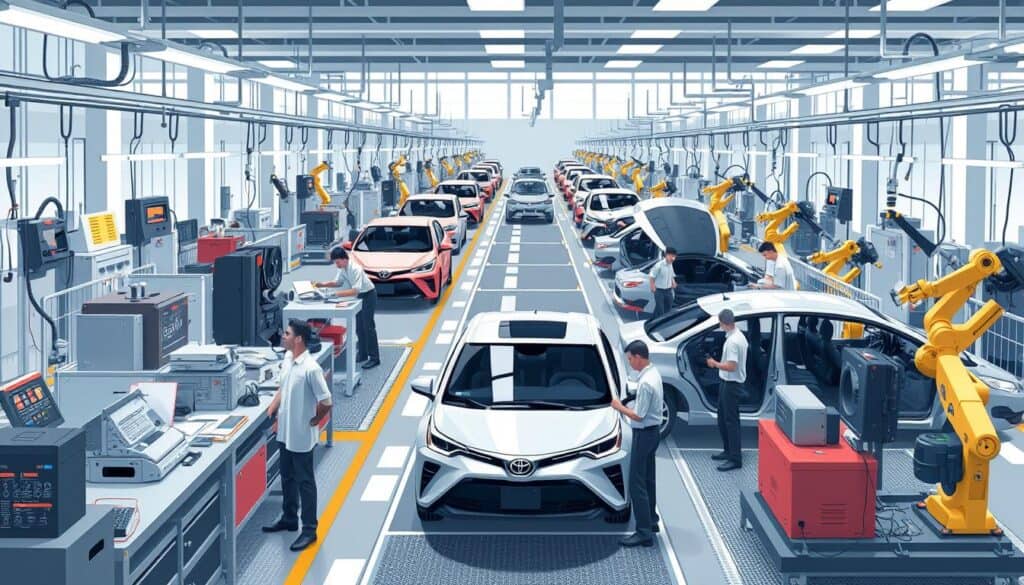
O início da manufatura enxuta remonta a Sakichi Toyoda, Eiji Toyoda e Taiichi Ohno. Eles desenvolveram o Sistema Toyota de Produção (TPS). Esse sistema tem como foco a redução de desperdícios e o aumento da eficiência.
Sakichi Toyoda e as primeiras inovações
Sakichi Toyoda promoveu mudanças significativas no mundo têxtil. Ele criou teares automáticos que, desde o início, demonstraram os princípios da produção enxuta. Seu pensamento era focado em aprimorar processos e gerar novas ideias. Essa mentalidade contribuiu para moldar o Sistema Toyota de Produção posteriormente.
Just-in-Time e Jidoka: Os Pilares do TPS
Duas ideias principais do Sistema Toyota de Produção são o Just-in-Time (JIT) e o Jidoka. O JIT mantém os materiais prontos somente quando necessários. Essa abordagem reduz os custos de estoque e o desperdício. O Jidoka combina automação com intervenção humana. Ele interrompe a produção quando há um problema. Isso evita erros e garante a qualidade.
O papel de Eiji Toyoda e Taiichi Ohno
Eiji Toyoda e Taiichi Ohno desempenharam papéis importantes no aprimoramento do TPS. Taiichi Ohno introduziu a ideia dos "7 desperdícios" e criou sistemas como Kanban e Just-in-Time. O método Kanban de Ohno mudou a forma como o fluxo de produção é gerenciado.
| Princípios | Desenvolvedores | Principais inovações |
|---|---|---|
| Sistema de Produção Toyota | Sakichi Toyoda | Automação, Jidoka |
| Manufatura Enxuta | Eiji Toyoda, Taiichi Ohno | Just-in-Time, Kanban |
| Gestão Lean Moderna | Vários Colaboradores | Melhoria contínuaAdaptação |
Para mais informações sobre o japonês termos magros:

The Evolution of Lean Methodology
The journey of lean methodology started with global changes in making things. It goes from the Arsenal in Venice with its ship designs in 1104 to Marc Brunel’s work in the early 1800s. He used machines to make identical parts. This slowly set the stage for lean practices over the years.
From TPS to Lean Manufacturing
The Toyota Production System (TPS) played a big role in creating lean manufacturing. It took ideas like tempo takt from the German aircraft makers and continuous flow from Ford. In the early 1950s, Toyota mixed high-quality production and short lead times. This mix became key for today’s lean methods.
William Edwards Deming also helped Toyota by introducing a quality circle (PDCA) and ways to control processes. This led to better efficiency and steady quality at Toyota.
“The contribution of TPS goes beyond automotive manufacturing, highlighting concepts of waste reduction and mapeamento do fluxo de valor that cater to a broad range of industries.” – Dr. James P. Womack
Adoption and Adaptation in Western Industries
Lean manufacturing started to catch on in the West around the late 20th century. The book “The Machine that Changed the World” by Womack and Jones, in 1990, explained Toyota’s methods clearly. This helped other industries learn from Toyota. The NUMMI venture between General Motors and Toyota in 1984 showed how well lean principles could work in the U.S. It made that factory one of GM’s best.
Many industries in the West saw how cutting waste and boosting productivity could help. They began using lean methods more and more. The influence of TPS sparked a big change in many sectors, not just manufacturing. With folks like Joseph Juran improving quality management and Shigeo Shingo creating tools like poka-yoke, lean concepts took deep root in the West.
| Ano | Evento | Contribution to Lean |
|---|---|---|
| 1104 | Venetian Arsenal | Standardized designs for continuous flow |
| 1950 | Integration of Deming’s PDCA | Quality improvement at Toyota |
| 1984 | NUMMI Joint Venture | Successful lean principles implementation in the U.S. |
| 1990 | Publication of “The Machine that Changed the World” | Outlined lean manufacturing principles |
The path from TPS to lean manufacturing outlines a fascinating evolution. It shows how Western industries embraced and modified these ideas. They improved efficiency and productivity in many areas.
The Five Principles of Lean Manufacturing
To make production better, knowing the principles of lean manufacturing is key. These ideas come from the Toyota Production System (TPS). They help make sure every production step is valuable to the customer and cuts down waste.

Specifying Value
Defining value means understanding what customers really want. By seeing things from their view, companies can make their processes better. This focuses on what’s valuable, cutting out what isn’t needed.
Identifying the Value Stream
After figuring out the value, it’s time to look at the value stream. This is about seeing all the steps needed to create the product. It’s about separating helpful steps from those that are not. Doing this helps get rid of inefficiency in making the product.
Establishing Flow
To have a smooth production, establishing a produção enxuta flow is necessary. This method works on organizing the workflow. It aims to lower slowdowns and keep things moving without stops.
Implementing Pull Systems
Using pull systems means making items based on actual demand, not guesses. This helps keep stock low and saves resources. It makes production match what the market really wants.
Striving for Perfection
The goal is always to get better. Businesses that keep trying to improve can cut more waste and increase quality. This ongoing effort is at the heart of lean manufacturing. It leads to lasting success.
| Princípio | Descrição |
|---|---|
| Specifying Value | Focus on customer value to streamline processes. |
| Identifying the Value Stream | Map all steps to distinguish value-adding from non-value-adding activities. |
| Establishing Flow | Ensure seamless production movement by reducing bottlenecks. |
| Implementing Pull Systems | Align production with customer demand to minimize surplus. |
| Striving for Perfection | Adopt continuous improvement to enhance quality and reduce waste. |
Implementation of Lean in Japanese Companies
Japanese companies have seen great success by using lean management, especially in manufacturing. The Toyota Production System (TPS) is a key example. It shows how well lean principles work.
Case Studies: Toyota and Beyond
Toyota is a standout story in lean implementation since it started in 1937. Toyota introduced the Toyota Production System to its suppliers in 1965. This system proved its worth during the 1973 oil crisis, thanks to its efficiency. Lean management in Japan goes beyond Toyota. It reaches various sectors and focuses on getting employees to create value. But, in the service and healthcare sectors, lean principles are not as common as in manufacturing.

Challenges and Successes
Lean adoption faces several hurdles, though. These include getting the workforce on board, senior management commitment, and overcoming communication issues. For example, in healthcare and service industries, lean leadership struggles. It has not moved from solving specific problems to changing the whole organization. Yet, the success of lean in Japan shows the power of supporting employees in problem-solving. Toyota’s journey with lean shows that the right leadership can drive continuous improvement.
| Desafios | Success Factors |
|---|---|
| Workforce Adaptation | Employee Engagement |
| Lack of Senior Commitment | Dedicated Leadership |
| Communication Barriers | Comprehensive Training |
| Resistência à mudança | Continuous Improvement Culture |
The Pareto principle, or the 80-20 rule, is key in lean implementation. It says 80% of issues come from just 20% of defects. For companies like Toyota, success in lean means finding and fixing these key problems. Keeping lean methods in line with Japan’s culture of respect is vital for success.
More on Toyota’s principles:

Japanese Lean Culture and Practices
In Japan, lean culture focuses on Kaizen and making workers feel important. These methods boost ongoing improvement and help create a team that’s all about innovation and getting things done better.

Kaizen: Continuous Improvement
Kaizen means making things better together. It’s where everyone at a company, from top to bottom, works to make small, positive changes all the time. They look at every step of what they do to find ways to do things better, cut out waste, and get more done. This keeps the company strong against competition and quick to meet what customers want.
Empowerment of Workers
Lean culture in Japan really values giving power to workers. It’s all about letting every employee have a say in making things better. This way, everyone feels they matter and play a part in the company’s wins. It encourages people to take charge and keep improving how things are done.
Toyota is a great example of Kaizen and giving power to workers paying off. Their lean methods let them offer great prices in the U.S. market. By cutting out the fluff, they can deliver what customers want quicker and better.
| Princípio | Descrição | Impacto |
|---|---|---|
| Kaizen: Continuous Improvement | Incremental, ongoing enhancements to processes | Increased efficiency and productivity, cost reduction |
| Worker Empowerment | Involving all employees in improvement efforts | Improved morale, innovation, quicker problem-solving |
| Lean Practices | Principles like Just-in-Time and Jidoka | Reduction in waste, better market responsiveness |
To wrap it up, Kaizen and making workers feel empowered are key in Japan’s lean culture. They keep on improving and stay ahead in the game. By using these approaches, businesses are not just more efficient but also have teams that are driven and full of new ideas.
The Global Spread of Lean Ideology
Many sectors around the world have been transformed by lean ideology. This includes manufacturing, healthcare, and software development. It started with the Toyota Production System (TPS) in Japan. Now, lean principles are making big changes worldwide.

Lean Adoption in the United States
In the 1980s and 1990s, U.S. companies began embracing lean. Boeing and General Electric were at the forefront. Boeing saw a 50% cut in lead times, an 80% boost in on-time delivery, and a 30% rise in productivity. General Electric also saw big financial benefits from Lean Seis Sigma. This approach focuses on better processes and less waste.
Influence on Various Industries Worldwide
Lean has truly changed different industries. In healthcare, a U.S. hospital cut patient wait times by 40%. They also reduced how long patients stayed by 30%. A call center saw a 30% rise in productivity and halved their call handle time. GE Healthcare used Lean Six Sigma to reduce mistakes by half, cut cycle times by 30%, and improve customer happiness by 20%. This saved over $250 million.
Lean principles have now reached construction and education in the 2010s. This shows how versatile and effective the methodology is. The global embrace of lean helps companies get better, cut costs, and quickly meet market needs.
Modern Applications of Lean in Japan
In Japan today, the use of modern lean applications has grown a lot. This is thanks to new technologies. Things like AI, IoT, and digital tools have changed how lean methods work. They make these methods better for today’s fast industry.
With these tech advances, companies can collect and analyze data in real time. This leads to better decisions, more efficiency, and less waste.
Technology and Lean Integration
Combining technology with lean practices has made Japanese industries more efficient and automated. Companies, such as Toyota, are at the forefront. They use AI and IoT to make the Toyota Production System better.
They monitor machines in real time, maintain them before issues arise, and control quality automatically. This mix of modern tech and lean rules boosts how well operations work. It also makes sure products are of high quality and made precisely.
Lean in the Service Industry
Lean principles aren’t just for manufacturing anymore. They’re making a big difference in service industries in Japan too. Fields like finance, healthcare, and retail have seen improvements. Thanks to lean methods, they are more efficient and pleasing to customers.
By reducing waste and focusing on what adds value, these services work better. They use resources wisely and make customers happier. Lean methods have proven they work well across different types of businesses today.
Perguntas frequentes
Qual é a história do Lean japonês e suas origens?
A história do lean no Japão se concentra em aprimorar processos e reduzir o desperdício. Teve início na cultura japonesa e se desenvolveu com o Sistema de Produção Toyota (TPS). O TPS priorizou a redução do desperdício e a otimização da produção, transformando a maneira como empresas do mundo todo pensam e trabalham.
De que forma o cenário econômico do início do século XX no Japão influenciou as práticas de produção enxuta?
A economia japonesa passou por grandes transformações no início do século XX. Esse período ensinou o Japão a ser disciplinado e a sempre buscar maneiras de fazer as coisas melhor. Essa mentalidade ajudou a moldar a forma como o Japão faz negócios, com foco na eficiência e na melhoria contínua.
Quem foram as figuras-chave por trás do Sistema de Produção Toyota?
Sakichi Toyoda, Eiji Toyoda e Taiichi Ohno foram os grandes nomes por trás do Sistema Toyota de Produção. Eles trouxeram novas ideias como o Jidoka, que identifica erros automaticamente, e o Just-in-Time, que consiste em usar os recursos de forma inteligente.
Como a manufatura enxuta evoluiu a partir do Sistema de Produção Toyota?
A manufatura enxuta surgiu do Sistema de Produção Toyota. Ela adaptou as regras para se adequarem a muito mais do que apenas a fabricação de automóveis. Hoje, empresas em todo o mundo utilizam essas ideias para trabalhar melhor, desperdiçar menos e deixar os clientes mais satisfeitos em diversas áreas.
Qual o papel do Kaizen na cultura lean japonesa?
Kaizen, ou melhoria contínua, é um conceito fundamental na cultura lean japonesa. Trata-se de buscar constantemente pequenas maneiras de aprimorar os processos. Todos os colaboradores são incentivados a apresentar e testar novas ideias. Isso mantém as empresas em constante evolução e na vanguarda do setor.
Como a ideologia lean se espalhou globalmente?
O pensamento Lean teve origem no Japão, mas hoje é utilizado em todo o mundo, especialmente nos Estados Unidos. Diversos tipos de trabalho, desde a fabricação de produtos até o atendimento ao público e o desenvolvimento de software, utilizam os princípios do Lean para aumentar a eficiência. A disseminação global do Lean demonstra sua eficácia em diferentes profissões e contextos.
Como a metodologia lean é aplicada nas indústrias japonesas modernas?
Hoje, as indústrias japonesas utilizam métodos Lean com novas tecnologias, como IA e IoT, para obterem ainda mais eficiência. Os conceitos Lean também migraram para o setor de serviços, demonstrando sua eficácia em diversas áreas. Isso resulta em melhores serviços e clientes mais satisfeitos.
Glossário de termos utilizados
Internet of Things (IoT): Uma rede de dispositivos interconectados, equipados com sensores, software e outras tecnologias que lhes permitem coletar e trocar dados pela internet, facilitando a automação, o monitoramento e o controle de diversos processos e sistemas.
Just In Time (JIT): Uma estratégia de produção que visa reduzir os custos de estoque, recebendo mercadorias somente quando necessárias no processo de fabricação, minimizando assim o desperdício e aumentando a eficiência.
Just-In-Time (JIT): Uma estratégia de produção que reduz os custos de estoque, programando a chegada de materiais e componentes para que cheguem precisamente quando necessários no processo de fabricação, minimizando o desperdício e aumentando a eficiência.
Plan Do Check Act (PDCA): Um modelo de melhoria contínua que consiste em quatro etapas iterativas: planejar um objetivo, executar o plano, avaliar os resultados em relação às expectativas e tomar medidas corretivas para aprimorar o desempenho e os processos.
Takt Time: O tempo máximo permitido para produzir um produto de forma a atender à demanda do cliente é calculado dividindo-se o tempo de produção disponível pela produção necessária. Ele ajuda a sincronizar o ritmo de produção com a demanda, garantindo um fluxo de trabalho eficiente e a alocação adequada de recursos.
Toyota Production System (TPS): Uma metodologia de fabricação que enfatiza a redução de desperdícios, a melhoria contínua e o fluxo de produção eficiente, utilizando técnicas como Just-In-Time e Jidoka para aprimorar a qualidade e a eficiência operacional.
Value Stream Mapping (VSM): Uma ferramenta visual utilizada para analisar e otimizar o fluxo de materiais e informações em um processo, identificando atividades que agregam valor e atividades que não agregam valor, visando melhorar a eficiência e reduzir o desperdício.
































