Did you know Pressure Swing Adsorption (PSA) can purify gases over 99%? This technique is key in many fields where distillation is not possible. It’s used for hydrogen recovery, CO2 removal, and air cleaning. With materials like zeolites and activated carbon, PSA switches between adsorbing and desorbing gases. This happens under varying pressures, leading to top-notch results.
PSA stands out as industries look for greener, cheaper gas separation methods. It’s great for creating nitrogen for food packaging or getting pure oxygen for healthcare. PSA’s wide use, from treating power plant emissions to processing natural gas, shows its importance.
Key Takeaways
- Pressure Swing Adsorption is an efficient gas separation technique widely used across industries.
- PSA technology can achieve gas purities exceeding 99%.
- It is highly energy-efficient, surpassing in many cases traditional methods like distillation.
- PSA units are compact or even portable, and easily integrable into existing systems.
- This technology is versatile, catering to needs such as CO2 removal, nitrogen generation, and oxygen production.
We’ll explore Pressure Swing Adsorption more in the next sections. You’ll learn about its industrial uses, benefits, and new versions boosting its use.
Understanding Pressure Swing Adsorption
The Pressure Swing Adsorption (PSA) process separates gases in various industries. It uses special materials that absorb gas under pressure. This makes PSA a powerful and flexible tool.
Principle of Operation
PSA works in repetitive cycles, by adsorbing gases at high pressures into a specific material. Then, the pressure is lowered to desorb them. This way, different gases can be separated efficiently.
PSA is great for getting almost pure nitrogen and oxygen in scales from portable devices to industrial plants.
Key Components
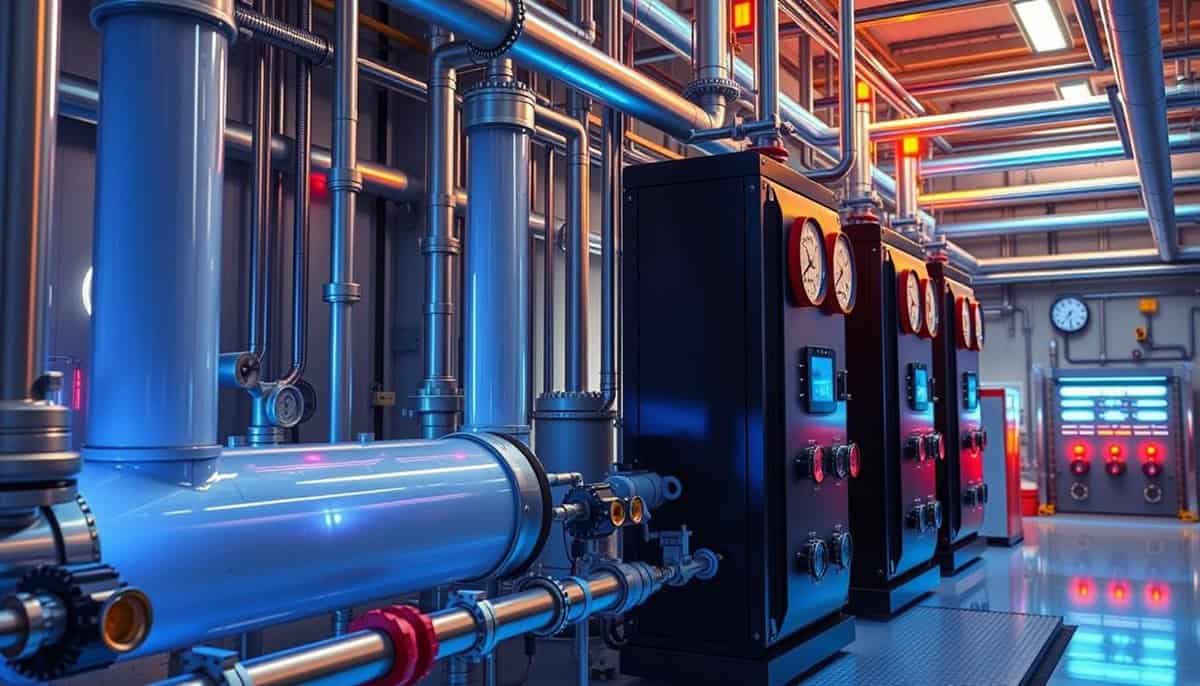
PSA systems have key parts like adsorbent vessels and control systems. These parts work together to separate gases well. A typical setup for making nitrogen includes an air compressor and filters.
- Air compressor
- Dryer
- Filters to remove impurities and dusts
- Air receiver
- Nitrogen generator
- Nitrogen receiver
An important feature is the air factor. It shows how much compressed air is needed for making nitrogen. A lower air factor means the system is more efficient and costs less to run. The equipment goes through a cycle that constantly produces pure nitrogen.
PSA vs. Cryogenic Distillation
PSA has advantages over cryogenic distillation because it works at room temperature. This saves a lot of energy. It’s also cheaper, less complicated, and starts faster than the cryogenic method.
| Parameter | PSA Technology | Cryogenic Distillation |
|---|---|---|
| Operating Temperature | Near-ambient | Very low |
| Energy Efficiency | High | Moderate |
| Initial Setup Cost | Low to Moderate | High |
| System Complexity | Medium | High |
| Start-up Speed | Fast (minutes/hours) | Slow (hours/days) |
Application of PSA in Industrial Processes
Pressure Swing Adsorption (PSA) is key in many industries for separating gases efficiently. It was developed in the 1960s by Air Liquide and Exxon. Its main job is to create pure gases needed for hydrogen recovery, making nitrogen, and producing oxygen. The system uses cycles, automated valves, and gas storage to work well and recover gases effectively.
Linde has been a one of the leaders in using PSA, creating over 500 plants worldwide. These plants range in size, from a few hundred to over 400,000 Nm³/h in capacity.
Hydrogen Recovery
Hydrogen recovery is a major use of PSA, especially in oil refineries and the petrochemical sector. Gas companies offers units that produce very pure hydrogen, up to 99.9999 mol-%. This purity is vital for cracking, cleaning out smells, and removing sulfur. The systems work at pressures from 10 to 40 bar. They have at least four adsorber vessels for good efficiency and reliability.
During operation, the PSA process has several steps: adsorption, releasing pressure, regeneration, and repressurization. This brings high recovery rates and boosts the system’s efficiency.
Nitrogen Generation
PSA is also used to make nitrogen for the food packaging and electronics sectors. It’s able to make very pure nitrogen, more than 99.9%, which is crucial for keeping food and electronics safe and lasting longer. The technology uses special adsorbents, like zeolites, to effectively pull nitrogen from the air. These systems are made for constant use and reliability, guaranteeing a steady nitrogen supply.
Oxygen Production
Producing oxygen with PSA is critical for medical oxygen therapy and activities like treating wastewater. Oxygen systems can reach over 95% purity, meeting strict medical and environmental standards. The technology’s quick cycling between adsorption and desorption phases makes it ideal for places that need ongoing, reliable oxygen.
PSA technology is a flexible and expandable choice for obtaining high-purity gases. It has a crucial role in various industrial actions.
The rest of this article is reserved for members
To limit scraping bots (currently 40,000 hits per day!),
we had to restrict access to full articles and tools to registered members only.
to access all the rest.
FAQ
What is Pressure Swing Adsorption (PSA)?
Pressure Swing Adsorption (PSA) is a way to separate gases. It uses pressure and materials like zeolites and activated carbon. This method picks gases from a mix due to their molecular features.
What is the principle of operation for PSA?
PSA works by adsorbing gases at high pressure. Then, it releases them at lower pressure. Adsorbent materials play a key role here.
What are the key components of a PSA system?
A PSA system has adsorbent vessels and switching valves. It also includes pressure configurations and a control system.
How does PSA compare to cryogenic distillation?
PSA doesn’t need low temperatures like cryogenic distillation. It works at almost room temperature. This makes it save more energy and offer advantages.
What are the industrial applications of PSA?
PSA is used for hydrogen recovery and nitrogen generation. It also makes oxygen for medical purposes and wastewater treatment, among others.
What benefits does PSA offer?
PSA systems save energy and costs. They are scalable. This means they work well for both small units and big facilities.
What adsorbent materials are used in PSA systems?
Key materials in PSA include zeolites and activated carbon. Zeolites are good for separating nitrogen and oxygen. Activated carbon removes hydrocarbons and smells.
What are some advanced variations of PSA technology?
New PSA types include Double Stage for higher purity, Rapid PSA for fast cycles. There’s also Vacuum Swing Adsorption (VSA). VSA uses vacuum to increase efficiency and save energy.
External Links on Gas Purification and Separation
International Standards
(hover the link to see our description of the content)
Glossary of Terms Used
Metal-Organic Framework (MOF): a porous crystalline material composed of metal ions or clusters coordinated to organic ligands, forming a network structure. These materials are used for gas storage, separation, and catalysis due to their high surface area and tunable properties.
Molecular Sieve: a porous material that selectively adsorbs molecules based on size and shape, allowing smaller molecules to pass while retaining larger ones, commonly used in gas separation, drying, and purification processes.
Pressure Swing Adsorption (PSA): a separation process that utilizes pressure changes to selectively adsorb specific gases onto solid adsorbents, allowing for the purification or separation of gas mixtures, commonly used in oxygen and hydrogen production.