Product Design, Manufacturing & Innovation Resources
집 » 화염 사면체 모델

화염 사면체 모델

1960
  • Walter M. Haessler
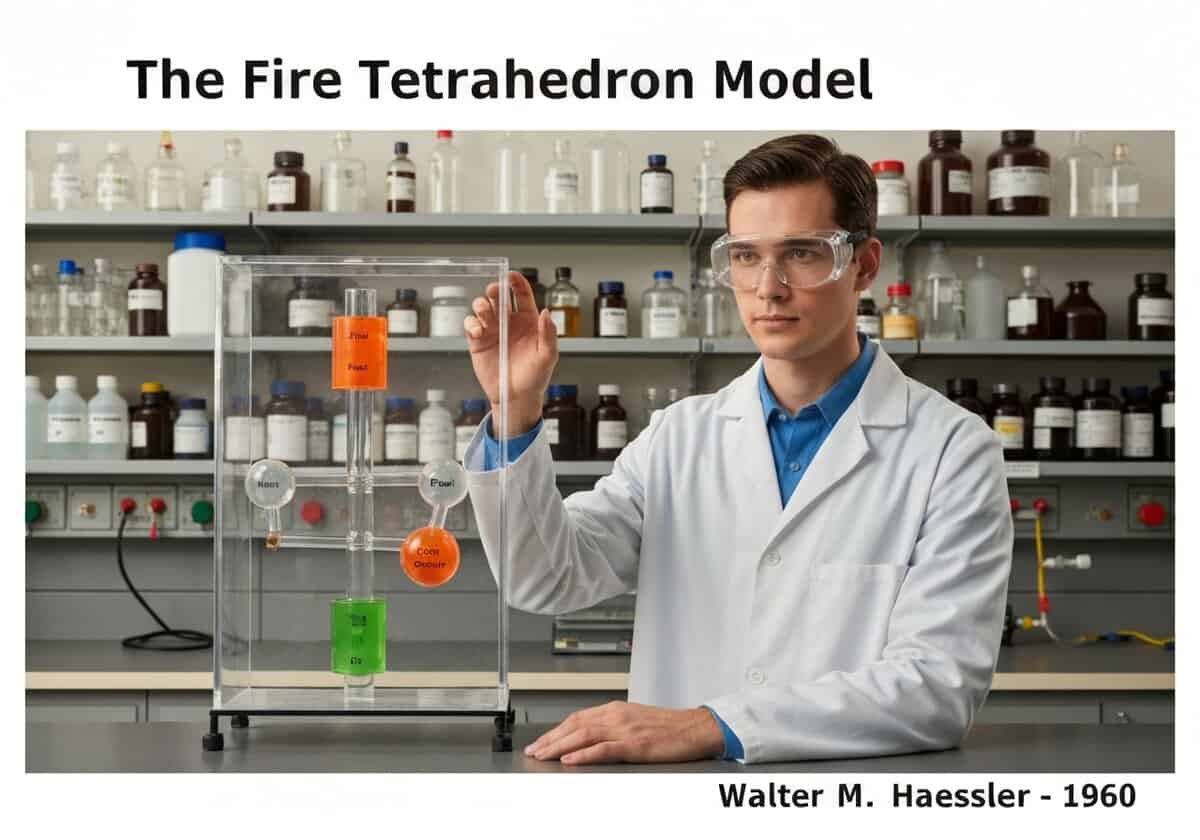
화학공학에서 화재 사면체 모형을 실험실에서 시연하는 모습.

(설명을 위한 생성된 이미지입니다)

혁신.세계 fire triangle: a sustained chemical chain reaction. This fourth element represents the process where the heat produced by the combustion reaction is sufficient to sustain the fire by creating further flammable vapors and radicals. This model better explains flaming combustion.
While the fire triangle is sufficient for explaining the initiation of combustion, the fire tetrahedron provides a more complete model for understanding sustained, flaming fires. It incorporates the three elements of the triangle—heat, fuel, and an oxidizing agent—and adds a fourth face: the uninhibited chemical chain reaction. In a flaming fire, the initial heat causes the fuel to pyrolyze, releasing flammable vapors. These vapors mix with the oxidizer and combust, releasing more heat. A portion of this newly generated heat radiates back to the fuel, causing it to release more vapors, thus creating a self-sustaining cycle. This cycle involves highly reactive, short-lived molecules called free radicals (e.g., H•, O•, OH•). The fire tetrahedron model highlights that a fire can be extinguished not only by removing heat, fuel, or oxygen but also by interrupting this chemical chain reaction. This is the principle behind many modern extinguishing agents, such as dry chemical powders and halocarbon clean agents. These agents work by chemically interfering with the free radicals, effectively poisoning the fire and stopping the chain reaction, even if sufficient heat, fuel, and oxygen are still present.

메모: while this 4th element does make complex cases more comprehensive -chemical powders and halocarbon clean agents-, it can still be viewed a classic 3 triangle case, where this 4th element is just adding or suppressing the root cause of one of the 3 others.

UNESCO Nomenclature: 3305
화학공학

유형

추상 시스템

분열

점진적

용법

널리 사용됨

전구체

  • the fire triangle model
  • discovery of free radicals in chemical reactions
  • nikolay semyonov’s work on chain reaction theory
  • development of halon and other chemical extinguishing agents

응용 프로그램

  • development of chemical fire extinguishers (e.g., halon, dry chemical)
  • advanced firefighting strategies
  • fire investigation and analysis
  • 화학 공정 safety
  • research in combustion chemistry

특허:

NA

잠재적 혁신 아이디어

  • catalytic fire suppression systems that actively neutralize combustion radicals
  • smart fire retardant materials that release chain-inhibiting agents when a specific temperature is reached
  • aerosol-based suppressants for enclosed spaces that disrupt the fire’s chemistry
  • ai models that predict fire behavior based on the kinetics of its chemical chain reactions
  • targeted 음향학 waves designed to disrupt the molecular interactions in a flame’s chain reaction
  • nanoparticle agents that provide a massive surface area for radical recombination
  • genetically engineered microorganisms that consume fuel sources and release flame-inhibiting gases
  • laser-based systems to analyze and disrupt the formation of key free radicals in industrial flames
  • quantum computing simulations to design more effective and environmentally friendly chemical suppressants
  • self-healing materials for aerospace that release inhibitors to stop combustion upon impact or damage
Related to: fire tetrahedron, chemical chain reaction, combustion, free radicals, extinguishment, halon, fire safety, flaming combustion, 열분해, flame inhibition.

역사적 맥락

화염 사면체 모델

1960
1960
1960
1960
1960
1962
1963
1960
1960
1960
1960
1960
1960
1962-10-09
1964

(날짜를 알 수 없거나 관련이 없는 경우, 예를 들어 "유체역학"의 경우, 주목할 만한 등장 시기를 대략적으로 추정하여 제공합니다.)

10년차 기념일

고화질 이미지 및 다운로드는 등록된 회원에게만 100% 무료로 제공됩니다.

> 로그인 <