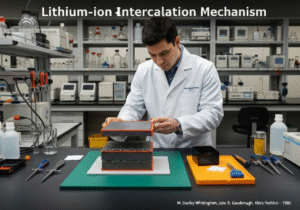
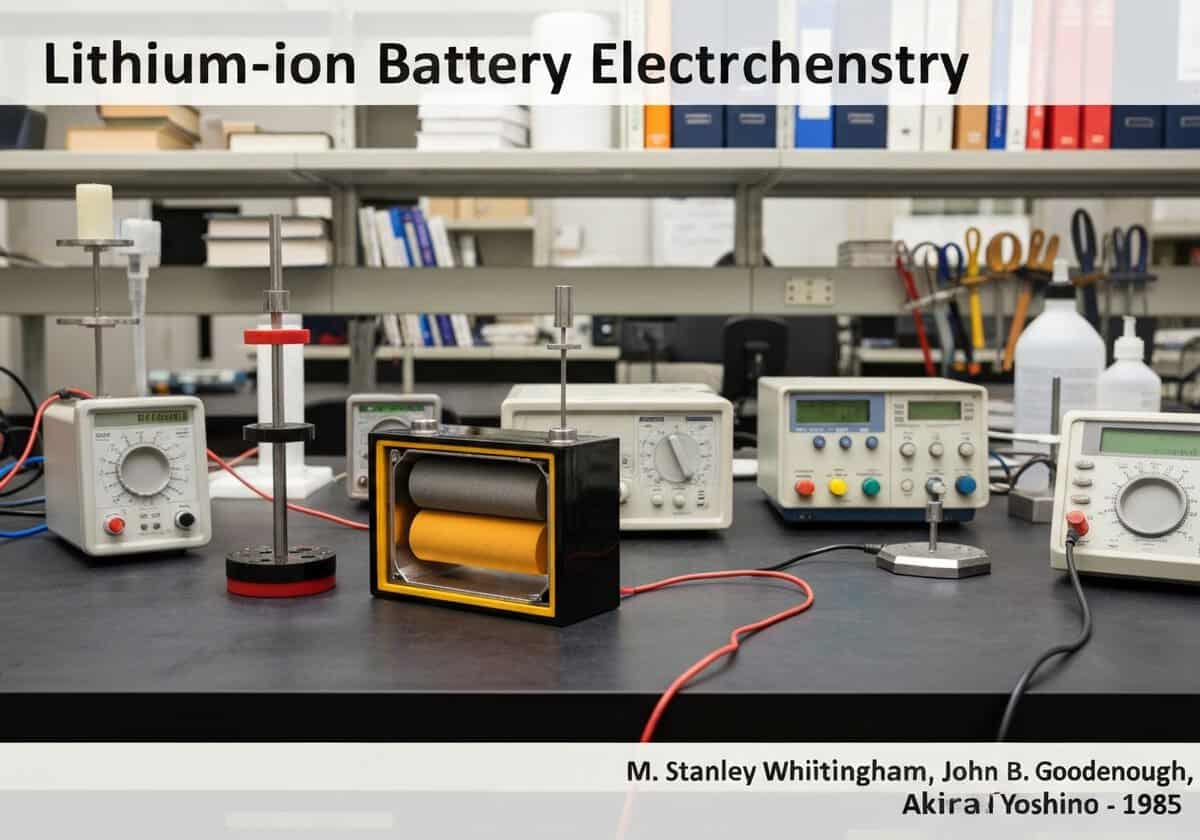
리튬 이온(Li-ion) 배터리는 충전식 배터리로, 리튬 방전 시에는 이온이 음극(애노드)에서 전해질을 통해 양극(캐소드)으로 이동하고, 충전 시에는 다시 음극으로 이동합니다. 이 태양전지는 양극 소재로 리튬 화합물을, 음극 소재로는 일반적으로 흑연을 사용합니다. 리튬의 높은 반응성 덕분에 높은 에너지 밀도를 구현할 수 있습니다.

(설명을 위한 생성된 이미지입니다)
리튬 이온(Li-ion) 배터리는 충전식 배터리로, 리튬 방전 시에는 이온이 음극(애노드)에서 전해질을 통해 양극(캐소드)으로 이동하고, 충전 시에는 다시 음극으로 이동합니다. 이 태양전지는 양극 소재로 리튬 화합물을, 음극 소재로는 일반적으로 흑연을 사용합니다. 리튬의 높은 반응성 덕분에 높은 에너지 밀도를 구현할 수 있습니다.
The operation of a Li-ion battery is based on the concept of intercalation, where ions are reversibly inserted into a host material without significantly changing the host’s structure. During discharge, lithium atoms at the graphite anode are ionized, releasing an electron and a lithium ion ([latex]Li rightarrow Li^+ + e^-[/latex]). The electrons travel through the external circuit, providing power, while the lithium ions migrate through the electrolyte and separator to the cathode. At the cathode, they are intercalated into the crystal structure of the cathode material (e.g., Lithium Cobalt Oxide, [latex]LiCoO_2[/latex]). The overall reaction for a [latex]LiCoO_2[/latex] cathode and graphite ([latex]C_6[/latex]) anode is: [latex]Li_x C_6 + Li_{1-x} CoO_2 leftrightarrow C_6 + LiCoO_2[/latex]. The process is reversed during charging. The choice of materials for the anode, cathode, and electrolyte is crucial for the battery’s performance, including its energy density, power density, 수명, and safety. John Goodenough’s contribution in the 1980s was identifying [latex]LiCoO_2[/latex] as a suitable cathode material, which significantly increased the potential voltage compared to earlier designs by M. Stanley Whittingham. Akira Yoshino later developed a safer anode using petroleum coke and then graphite, creating the first commercially viable and safe Li-ion battery.
리튬 이온 배터리 전기화학
(날짜를 알 수 없거나 관련이 없는 경우, 예를 들어 "유체역학"의 경우, 주목할 만한 등장 시기를 대략적으로 추정하여 제공합니다.)

고화질 이미지 및 다운로드는 등록된 회원에게만 100% 무료로 제공됩니다.
> 로그인 <