Product Design, Manufacturing & Innovation Resources
Maison » Électrochimie des batteries lithium-ion

Électrochimie des batteries lithium-ion

1985
  • M. Stanley Whittingham
  • John B. Goodenough
  • Akira Yoshino
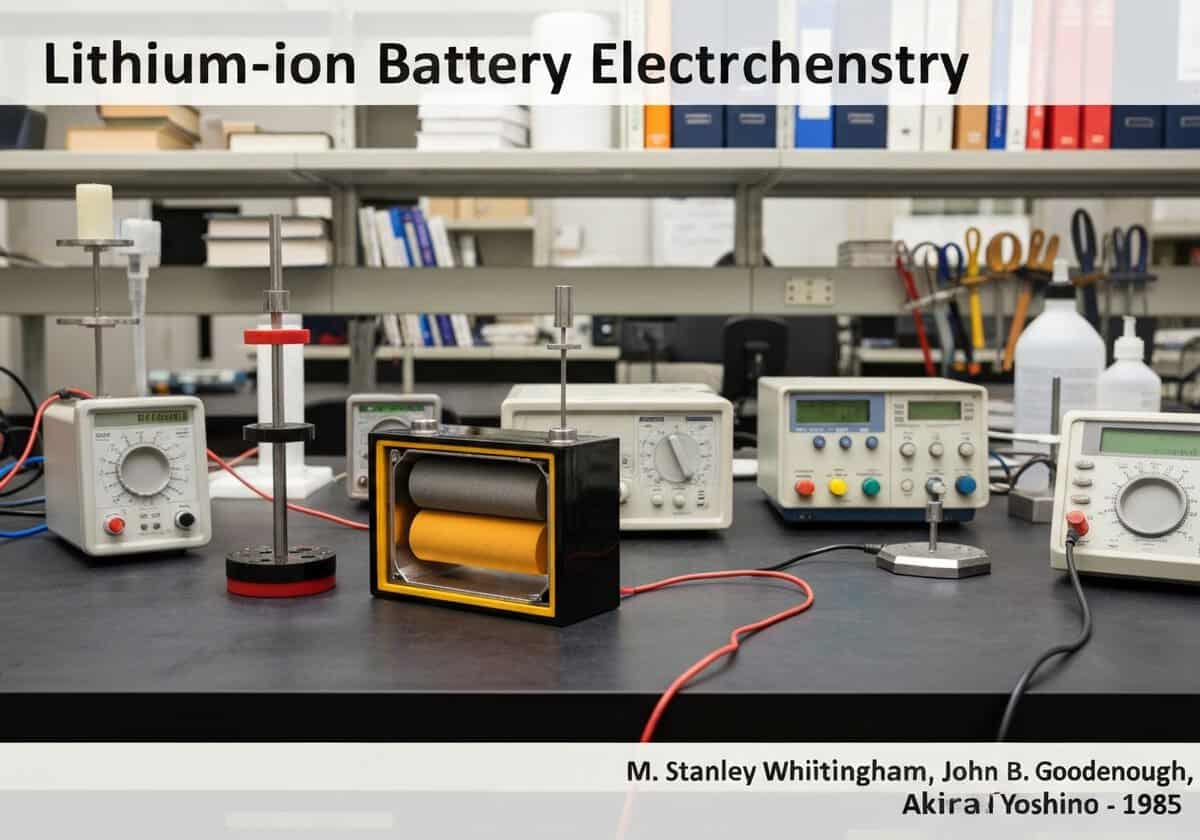
Composants d'une batterie lithium-ion dans un laboratoire d'essais électrochimiques.

(Image générée à titre d'illustration uniquement)

Une batterie lithium-ion (Li-ion) est une batterie rechargeable où lithium ions move from the negative electrode (anode) through an electrolyte to the positive electrode (cathode) during discharge, and back when charging. It utilizes an intercalated lithium compound as the cathode material and typically graphite as the anode. The high reactivity of lithium allows for high energy density.

The operation of a Li-ion battery is based on the concept of intercalation, where ions are reversibly inserted into a host material without significantly changing the host’s structure. During discharge, lithium atoms at the graphite anode are ionized, releasing an electron and a lithium ion ([latex]Li rightarrow Li^+ + e^-[/latex]). The electrons travel through the external circuit, providing power, while the lithium ions migrate through the electrolyte and separator to the cathode. At the cathode, they are intercalated into the crystal structure of the cathode material (e.g., Lithium Cobalt Oxide, [latex]LiCoO_2[/latex]). The overall reaction for a [latex]LiCoO_2[/latex] cathode and graphite ([latex]C_6[/latex]) anode is: [latex]Li_x C_6 + Li_{1-x} CoO_2 leftrightarrow C_6 + LiCoO_2[/latex]. The process is reversed during charging. The choice of materials for the anode, cathode, and electrolyte is crucial for the battery’s performance, including its energy density, power density, durée de vie, and safety. John Goodenough’s contribution in the 1980s was identifying [latex]LiCoO_2[/latex] as a suitable cathode material, which significantly increased the potential voltage compared to earlier designs by M. Stanley Whittingham. Akira Yoshino later developed a safer anode using petroleum coke and then graphite, creating the first commercially viable and safe Li-ion battery.

UNESCO Nomenclature: 2203
- Chimie physique

Taper

Procédé chimique

Perturbation

Révolutionnaire

Usage

Utilisation généralisée

Précurseurs

  • discovery of lithium by johan august arfwedson (1817)
  • développement de la pile voltaïque by alessandro volta (1800)
  • concept de chimie d'intercalation
  • recherches sur les batteries au lithium dans les années 1970

Applications

  • smartphones et ordinateurs portables
  • véhicules électriques (VE)
  • systèmes de stockage d'énergie à l'échelle du réseau
  • outils électriques sans fil
  • dispositifs médicaux
  • applications aérospatiales

Brevets:

  • US4357215A
  • JP2667902B2

Idées d'innovations potentielles

  • électrolytes solides pour améliorer la sécurité et la densité énergétique
  • anodes en silicium pour une capacité supérieure
  • batteries lithium-soufre pour une densité énergétique théoriquement plus élevée
  • électrodes améliorées au graphène pour une charge plus rapide
  • systèmes de gestion de batterie (BMS) alimentés par l'IA pour des performances et une durée de vie optimisées
  • procédés de recyclage pour récupérer des matériaux précieux comme le cobalt et le lithium
  • matériaux de batterie auto-réparateurs
  • transparent and flexible batteries for portable électronique
  • sodium-ion batteries as a low-cost alternative
  • batteries structurelles intégrées au châssis du véhicule
En rapport avec : lithium-ion, batterie, électrochimie, intercalation, anode, cathode, électrolyte, densité énergétique, rechargeable, véhicules électriques.

Contexte historique

Électrochimie des batteries lithium-ion

1980
1980
1984
1985
1986
1990
1993-01-01
1980
1980
1980
1984
1986
1986
1991
1994

(si la date est inconnue ou non pertinente, par exemple « mécanique des fluides », une estimation arrondie de son émergence notable est fournie)

10e année anniversaire

Les images en pleine résolution et les téléchargements sont uniquement disponibles, et 100% gratuits, pour les membres inscrits.