Product Design, Manufacturing & Innovation Resources
집 » 네오디뮴 자석

네오디뮴 자석

1984
  • General Motors
  • Sumitomo Special Metals
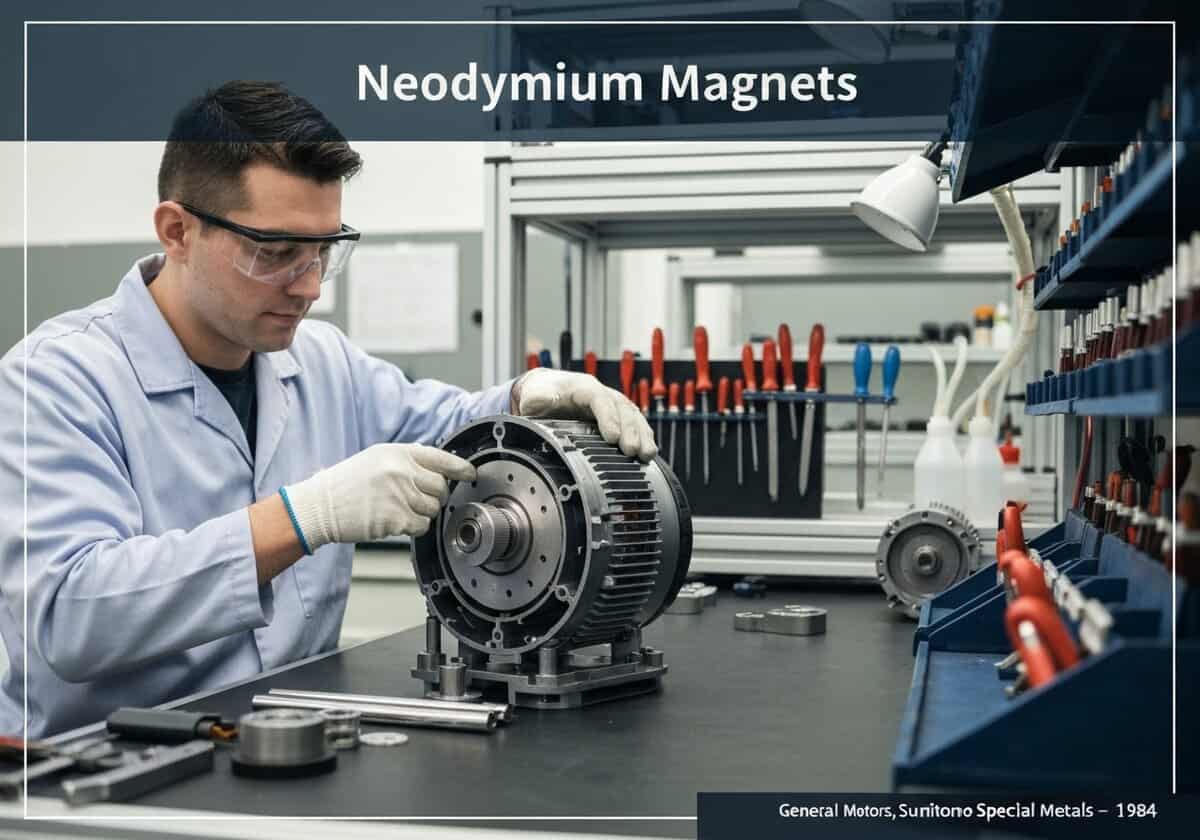
고체 물리학에서 전기 모터 조립에 사용되는 네오디뮴 자석.

(설명을 위한 생성된 이미지입니다)

Neodymium magnets are the strongest type of permanent magnet commercially available. They are a ternary alloy of neodymium, iron, and boron, with the stoichiometric formula Nd2Fe14B. Their immense magnetic strength results from the material’s high magnetic anisotropy and saturation magnetization, derived from its tetragonal crystal structure. However, they are brittle, susceptible to corrosion, and have a low curie temperature.
The exceptional performance of 네오디뮴 magnets stems from the specific roles played by each constituent element within its unique crystal structure. The compound forms a tetragonal crystal lattice with the formula [latex]Nd_2Fe_{14}B[/latex]. In this structure, iron (Fe) atoms provide a very high saturation magnetization, meaning the material can hold a strong magnetic field. Neodymium (Nd), a rare-earth element, is crucial for providing an extremely high magnetocrystalline anisotropy. This means that the crystal has a preferred axis of magnetization, making it very difficult to demagnetize. The boron (B) atoms do not contribute directly to the magnetism but are essential for stabilizing this specific tetragonal phase, preventing the formation of other, less magnetically favorable iron-neodymium compounds.

제조 방법에는 크게 두 가지가 있습니다. 소결 방식 네오디뮴-철-브롬 magnets are produced by powder metallurgy. The raw 합금 is milled into a fine powder, which is then aligned in a strong magnetic field, pressed, and heated (sintered) to fuse the particles together. This process creates the strongest, highest-grade magnets but results in a hard, brittle product. Bonded NdFeB magnets are made by mixing the magnetic powder with a polymer binder, which can then be injection-molded or compression-molded into complex shapes. Bonded magnets are weaker than their sintered counterparts but offer greater design flexibility and corrosion resistance. To improve performance at higher temperatures, small amounts of other rare earths like dysprosium (Dy) or terbium (Tb) are often added to increase the material’s coercivity.

UNESCO Nomenclature: 2211
고체물리학

유형

물리적 장치

분열

혁명가

용법

널리 사용됨

전구체

  • discovery of 강자성
  • 알니코 자석 및 사마륨-코발트 자석과 같은 초기 영구 자석의 개발
  • 결정 구조에 대한 이해와 자기적 특성과의 관계
  • 분말 야금 및 소결 기술의 발전

응용 프로그램

  • 무선 공구, 하이브리드 및 전기 자동차에 사용되는 전기 모터
  • 보이스 코일 모터용 하드 디스크 드라이브
  • wind turbine generators
  • 헤드폰과 스피커 같은 오디오 장비
  • 자기공명 imaging (mri) scanners
  • 자기부상 시스템

특허:

  • US Patent 4,496,395
  • US Patent 4,770,723

잠재적 혁신 아이디어

  • miniaturized medical implants with magnetic actuation
  • highly efficient, compact maglev transportation systems
  • next-generation data storage using heat-assisted magnetic recording (hamr) with ndfeb tips
  • 의복 devices for haptic feedback using tiny, powerful magnetic actuators
  • advanced magnetic refrigeration systems that are more energy-efficient than gas-compression
  • self-healing materials with embedded magnetic particles that align to close cracks
  • wireless power transfer systems with enhanced range and efficiency
  • magnetic filtration systems for purifying water or industrial fluids
  • compact, high-torque robotic joints for advanced automation
  • energy harvesting devices that convert ambient vibrations into electricity using magnetic induction
Related to: neodymium magnet, NdFeB, permanent magnet, magnetic anisotropy, saturation magnetization, general motors, Sumitomo, sintering, hard disk drive, 모터.

역사적 맥락

네오디뮴 자석

1980
1980
1980
1984
1986
1986
1991
1980
1980
1980
1984
1985
1986
1990
1993-01-01

(날짜를 알 수 없거나 관련이 없는 경우, 예를 들어 "유체역학"의 경우, 주목할 만한 등장 시기를 대략적으로 추정하여 제공합니다.)

10년차 기념일

고화질 이미지 및 다운로드는 등록된 회원에게만 100% 무료로 제공됩니다.

> 로그인 <