Product Design, Manufacturing & Innovation Resources
집 » 탄소 나노튜브

탄소 나노튜브

1991
  • Sumio Iijima
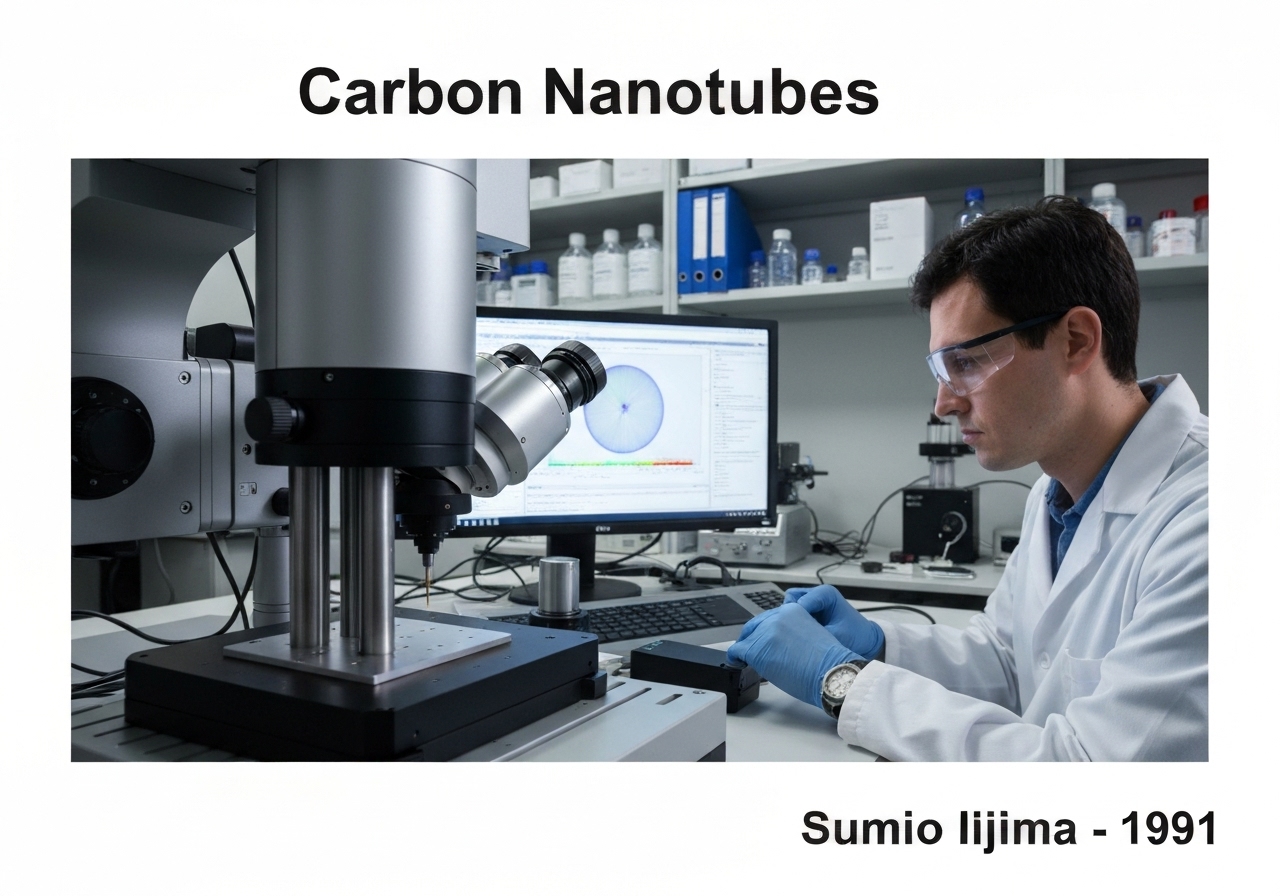
재료과학 실험실에서 원자력 현미경을 이용해 탄소 나노튜브를 조작하고 있는 연구원.

(설명을 위한 생성된 이미지입니다)

탄소 나노튜브(CNT)는 단일층 탄소 원자(그래핀) 시트가 말려 올라간 원통형 분자입니다. 단일벽 탄소 나노튜브(SWCNT) 또는 다중벽 탄소 나노튜브(MWCNT)로 나뉩니다. CNT는 탁월한 인장 강도(~100 GPa), 높은 전기 전도성 및 열 전도성을 비롯한 놀라운 특성을 지니고 있습니다. CNT의 전자적 특성(금속성 또는 반도체성)은 키랄성, 즉 그래핀 격자가 말려 올라간 각도에 따라 달라집니다.

탄소의 구조 나노튜브 is key to its remarkable properties. A single-walled carbon nanotube (SWCNT) can be conceptualized by taking a sheet of 그래핀 and rolling it into a seamless cylinder. The way the sheet is rolled is defined by a chiral vector, [latex]vec{C}_h = nvec{a}_1 + mvec{a}_2[/latex], where [latex]vec{a}_1[/latex] and [latex]vec{a}_2[/latex] are the graphene lattice vectors and (n, m) are integers. This chiral vector dictates the nanotube’s diameter and its electronic properties. If n = m, the nanotube is called “armchair” and is always metallic. If n – m is a multiple of 3, the nanotube is a narrow-gap semiconductor or quasi-metallic. Otherwise, it is a moderate-gap semiconductor. This extreme sensitivity of electronic properties to subtle structural changes is a unique feature of CNTs.

Multi-walled carbon nanotubes (MWCNTs) consist of multiple concentric cylinders of graphene, nested like Russian dolls. They are generally easier and cheaper to produce than SWCNTs but have more complex properties due to inter-wall interactions. Their mechanical strength is exceptional. The strong sp² carbon-carbon bonds make CNTs one of the stiffest and strongest materials ever discovered, with a Young’s modulus over 1 TPa and tensile strength up to 100 GPa, far exceeding that of steel. Their thermal conductivity along the tube axis can also surpass that of diamond. These properties make them ideal reinforcement agents in 복합 재료. However, challenges remain in achieving uniform dispersion within a matrix and in producing CNTs with a single, selected chirality on a large scale, which has limited their application in electronics where purity is paramount.

UNESCO Nomenclature: 2211
고체물리학

유형

재료

분열

혁명가

용법

틈새/전문 분야

전구체

  • 1985년 풀러렌(C60)의 발견
  • 탄소나노튜브의 존재 및 안정성에 대한 이론적 예측
  • 아크 방전 및 레이저 어블레이션 합성 기술 개발
  • 고해상도 투과 전자 현미경(HRTEM) 이미징 기술의 발전

응용 프로그램

  • 고강도 복합재료(예: 자전거 프레임, 자동차 부품)의 첨가제
  • 터치스크린 및 전자제품용 전도성 필름
  • 원자력 현미경(AFM) 프로브 사용 팁
  • 전자 기기 냉각용 열 인터페이스 재료
  • components in 슈퍼커패시터 and batteries

특허:

  • US 5,747,161
  • US 6,683,783

잠재적 혁신 아이디어

  • space elevator tether material
  • ballistic transistors for ultra-fast computing
  • artificial muscles based on cnt yarn
  • field emission displays
  • nanoscale wires for next-generation integrated circuits
  • membranes for highly efficient water 담수화
  • scaffolds for nerve cell regeneration
  • hydrogen storage materials for 연료 전지 vehicles
  • super-black coatings for optical instruments
  • thermal cloaking materials
Related to: carbon nanotube, cnt, swcnt, mwcnt, graphene, chirality, tensile strength, sumio iijima, composite material, 나노기술.

역사적 맥락

탄소 나노튜브

1984
1986
1986
1991
1994
1997
2002
1984
1985
1986
1990
1993-01-01
1995
2000
2004

(날짜를 알 수 없거나 관련이 없는 경우, 예를 들어 "유체역학"의 경우, 주목할 만한 등장 시기를 대략적으로 추정하여 제공합니다.)

10년차 기념일

고화질 이미지 및 다운로드는 등록된 회원에게만 100% 무료로 제공됩니다.

> 로그인 <