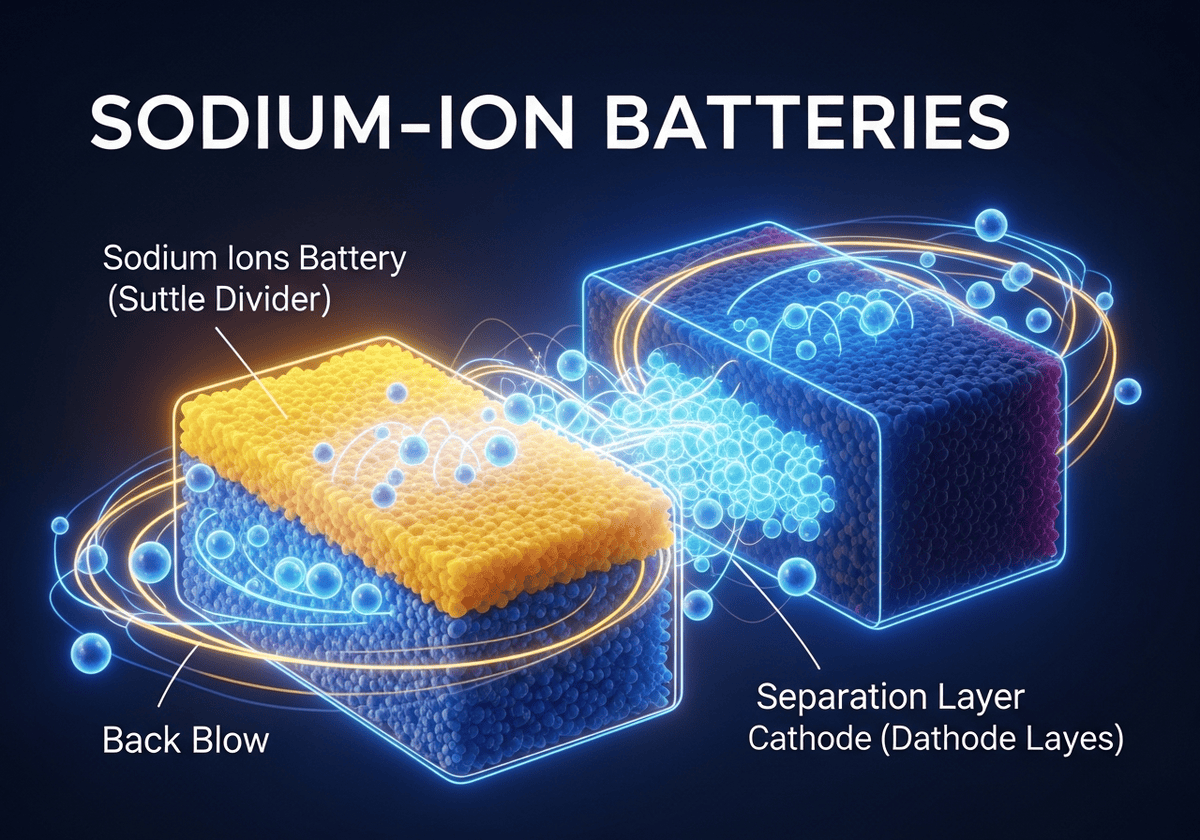
钠离子电池是一种电化学储能电池,它用钠离子代替锂离子作为电荷载体,在充放电循环期间于阴极和阳极之间穿梭。其工作原理与锂离子电池类似,都是通过嵌入和脱出反应实现的,但由于钠离子的离子半径更大、还原电位更低、地壳丰度更高,因此钠离子电池的工作原理也与锂离子电池类似。
阴极材料技术主要分为三大类:
- 层状过渡金属氧化物
- 普鲁士蓝类似物
- 包括NASICON型磷酸盐和硫酸盐在内的多阴离子化合物
每种正极材料在比容量、电压平台、反复钠化下的结构稳定性以及合成成本方面都存在不同的权衡;没有一种正极材料像 NMC 和 LFP 在锂离子电池领域那样获得市场整合。
在阳极方面,石墨的钠插层能力微乎其微,因此并不适用,研究方向是将从生物质或树脂前体中提取的硬碳作为当前的实用标准,而金属钠阳极则是能量较高但容易产生树枝状突起的前沿领域。电解质配方--醚或碳酸盐溶剂中的 NaPF6 或 NaClO4 盐、离子液体或新出现的固态钠导体--关键性地决定了固态电解质的相间化学性质,而这种化学性质制约着第一周期的库仑效率、速率能力和日历老化。.
下面列出的出版物和专利涉及正极和负极材料合成、电解质工程、SEI表征、电池规格设计、形成协议优化以及系统级技术经济建模。
以成本为导向的电池买家面临三种选择,每种选择都有一页介绍。 锂 是拥有最深厚供应链的现任企业。 固态电池 追求更高的密度和安全性。 氧化还原液流电池 当任务是长时间静置存储时,这种方法是最佳选择。有关电极纳米结构,请参见…… MXenes.
这是我们最新精选的有关钠离子电池的全球英文出版物和专利,涉及许多科学在线期刊,分类并侧重于钠离子电池、纳离子电池、钠离子阴极、层状氧化物阴极钠、普鲁士蓝模拟阴极、聚阴离子阴极钠、NASICON 阴极、硬碳阳极钠、软碳阳极钠、金属钠阳极、钠离子电解质、醚基电解质钠、钠盐电解质、NaPF6 电解质、钠离子、固体电解质和钠离子 SEI 层。.
Preparation and application of a deep eutectic solvent-induced polymer-structured solid electrolyte
Patent published on the 2026-11-19 in WO under Ref WO2026239319 by SHENZHEN JINTANG NEW ENERGY TECH CO LTD [CN] (Zhang Xinyue [cn], Peng Qihe [cn], Zhu Enhong [cn], Ji Xinghui [cn], Ma Ning [cn], Li Rui [cn], Lin Weijia [cn])
Abstract: A preparation method and application of a deep eutectic solvent (DES)-induced polymer-structured solid electrolyte includes obtaining a DES by mixing a lithium salt hydrogen bond acceptor and a hydrogen bond donor under heating conditions for a period of time; and preparing an aqueous precursor in a certain proportion that is then coated on a plate and cooled for a period of time. The precursor can then be immersed in the DES to obtain a DES-containing polymer solid electrolyte after a period of[...]
Our summary: A deep eutectic solvent is prepared by mixing a lithium salt with a hydrogen bond acceptor and donor. The resulting polymer-structured solid electrolyte exhibits good mechanical properties and high ionic conductivity. This method enhances the cyclic stability of lithium batteries through a cross-linked network structure.
deep eutectic solvent, polymer electrolyte, lithium batteries, ionic conductivity
Patent
Solid electrolyte material, electrode material, and battery
Patent published on the 2026-11-19 in WO under Ref WO2026239696 by PANASONIC INTELLECTUAL PROPERTY MAN CO LTD [JP] (Mizuno Keita, Kubo Takashi)
Abstract: A solid electrolyte material according to the present disclosure contains Li, M, B, and F. M is at least one element that is selected from the group consisting of Ti, Zr, Hf, Sn, and Pb. An electrode material 200 according to the present disclosure contains the solid electrolyte material according to the present disclosure and an active material. A battery 1000 according to the present disclosure is provided with a positive electrode 201, a negative electrode 203, and an electrolyte layer 202 th[...]
Our summary: The disclosure describes a solid electrolyte material containing Li, M, B, and F. It also details an electrode material that incorporates this solid electrolyte and an active material. Additionally, the battery design includes a positive electrode, a negative electrode, and an electrolyte layer featuring the solid electrolyte material.
solid electrolyte, electrode material, lithium battery, active material
Patent
All-solid-state battery
Patent published on the 2026-11-19 in US under Ref US20260369657 by SAMSUNG SDI CO LTD [KR] (Ishihara Hiroe [jp], Aihara Yuichi [jp], Watanabe Taku [jp], Fujiki Satoshi [jp])
Abstract: An embodiment provides a stacked all-solid-state secondary battery in which a plurality of battery units in which a positive electrode layer, a solid electrolyte layer, and a negative electrode layer are sequentially stacked are stacked along the stacking direction, wherein a buffer layer formed between the adjacent battery units.[...]
Our summary: This document describes a stacked all-solid-state secondary battery design. It features multiple battery units with positive and negative electrode layers separated by solid electrolyte layers. A buffer layer is included between adjacent battery units to enhance performance.
all-solid-state battery, stacked battery units, solid electrolyte layer, buffer layer
Patent
Composite solid electrolyte and method for producing same, cathode composite comprising same, all-solid-state battery comprising same
Patent published on the 2026-11-19 in US under Ref US20260369672 by UNIV INDUSTRY COOPERATION GROUP KYUNG HEE UNIV [KR] (Park Min Sik [kr], Hong Yoo Jin [kr])
Abstract: Provided are a composite solid electrolyte, a method of producing the same, a cathode composite including the same, and an all-solid-state battery including the same. The composite solid electrolyte may include a core part including a sulfide-based solid electrolyte; and a shell part coated on a surface of the core part and including a functional polymer, wherein the functional polymer includes a reaction product of a hydrophobic polymer and an ion-conductive material.[...]
Our summary: The content discusses a composite solid electrolyte and its production method. It describes a cathode composite that includes this electrolyte. Additionally, it mentions an all-solid-state battery that incorporates the cathode composite.
composite solid electrolyte, all-solid-state battery, cathode composite, sulfide-based solid electrolyte
Patent
Oxygen-generating electrode, electrochemical cell, and oxygen supply device
Patent published on the 2026-11-19 in WO under Ref WO2026240067 by NGK CORP [JP] (Nakamura Toshiyuki [jp], Terazawa Genta [jp], Mizukami Shunsuke [jp])
Abstract: Provided are: an oxygen supply device in which liquid leakage does not occur and which is capable of generating oxygen with high efficiency; and an oxygen-generating electrode and an electrochemical cell for achieving the oxygen supply device. The oxygen-generating electrode is for use in the oxygen supply device, and contains metal oxide particles, a metal-ion-conductive solid electrolyte, an oxygen-generating catalyst, and an electron-conductive auxiliary agent. The ratio Db/Da of the average [...]
Our summary: The oxygen supply device efficiently generates oxygen without liquid leakage. It utilizes an oxygen-generating electrode containing metal oxide particles and a solid electrolyte. The design ensures optimal performance through a specific ratio of particle diameters in its components.
Oxygen-generating electrode, electrochemical cell, oxygen supply device, metal oxide particles
Patent
Oxygen-generating electrode, electrochemical cell, and oxygen supply device
Patent published on the 2026-11-19 in WO under Ref WO2026240068 by NGK CORP [JP] (Nakamura Toshiyuki [jp], Terazawa Genta [jp], Mizukami Shunsuke [jp])
Abstract: Provided are: an oxygen-generating electrode which is free from leakage and is unlikely to cause damage to an electrochemical cell due to electrolysis of metal oxide particles; and an electrochemical cell. This oxygen-generating electrode is used in an oxygen supply device, and comprises metal oxide particles, a metal ion conductive solid electrolyte, and an electron conductive additive, wherein the coating rate, which is the portion of the surface of a metal oxide particle that is in contact wi[...]
Our summary: The content describes an oxygen-generating electrode designed to prevent leakage and damage in electrochemical cells. It includes metal oxide particles, a metal ion conductive solid electrolyte, and an electron conductive additive. The coating rate of the metal oxide particles is specified to be between 0.50 and 0.95.
Oxygen-generating electrode, electrochemical cell, metal oxide particles, solid electrolyte
Patent
Crosslinked Zwitterionic PVA-g-SBMA/PEDOT:PSS Networks for Mechanically Robust All-Solid-State Electrolytes
Published on 2026-01-28 by Chia-Wen Wei, Chia-Yu Chen, Shyh-Chyang Luo, Dmitry G. Belov, Szu-Nan Yang @MDPI
Abstract: Conventional lithium-ion batteries face issues like electrolyte leakage and interface instability. Solid-state lithium batteries with solid electrolytes address these, while solid-state polymer electrolytes (SPEs) offer safety and flexibility. This study primarily aimed to develop and synthesize a graft copolymer, PVA-g-SBMA, which was successfully synthesized by grafting [2-(methacryloyloxy)ethyl] dimethyl-(3-sulfopropyl)ammonium hydroxide (SBMA) onto poly(vinyl alcohol) (PVA). PVA provided exc[...]
Our summary: This study developed a graft copolymer, PVA-g-SBMA, by grafting SBMA onto PVA to enhance ionic conductivity and mechanical properties in solid-state electrolytes. The copolymer was crosslinked with PEDOT:PSS to form a robust network, improving film performance. The optimal system achieved a conductivity of 4.9 × 10⁻⁴ S/cm at room temperature with specific lithium salt concentrations.
Crosslinked, Zwitterionic, Solid-state, Electrolytes
Publication
Advances in Sodium Ion Batteries Based on Mixed Electrolytes of ILs and Organic Solvents
Published on 2026-01-28 by Sajjad Ghiyami, Claudio Mele @MDPI
Abstract: Sodium-ion batteries (SIBs) represent a topic of extreme interest in the research field, especially because the materials used are cheaper than those in lithium-ion batteries (LIBs). In SIBs, the choice of cathodes and electrolytes is very important because they will affect the energy density, cycling stability, and safety of the battery. This work focuses on the prospect of hybrid electrolyte cells that incorporate ionic liquids (ILs) into organic liquids in order to improve the safety and perf[...]
Our summary: This study explores the use of hybrid electrolytes combining ionic liquids and organic solvents in sodium-ion batteries. It highlights improvements in ionic conductivity, electrochemical stability, and thermal safety. The research suggests that these advancements could enhance the performance and lifecycle of sodium-ion battery technology for large-scale energy storage applications.
Sodium-ion batteries, hybrid electrolytes, ionic liquids, energy storage
Publication