Product Design, Manufacturing & Innovation Resources
Lar » Eletroquímica das baterias de íon-lítio

Eletroquímica das baterias de íon-lítio

1985
  • M. Stanley Whittingham
  • John B. Goodenough
  • Akira Yoshino
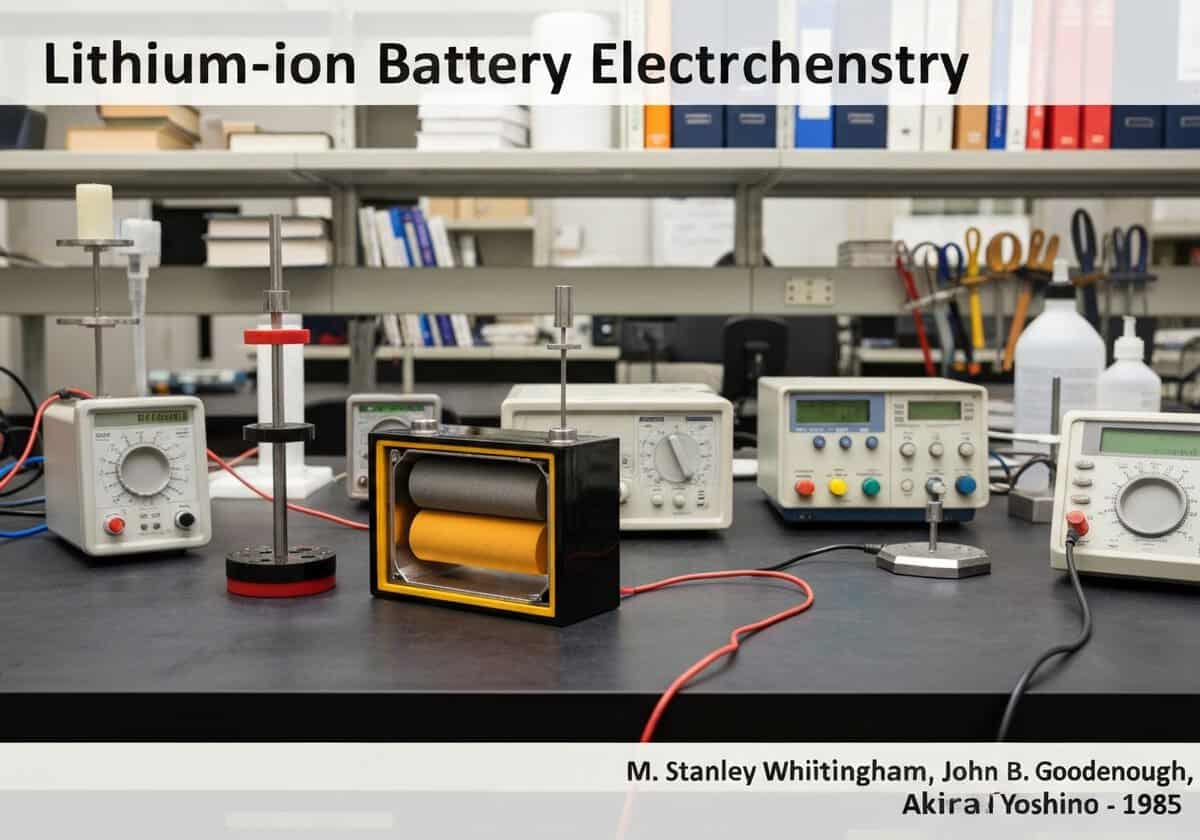
Componentes da bateria de íons de lítio em um laboratório para testes eletroquímicos.

(Imagem gerada apenas para fins ilustrativos)

Uma bateria de íon-lítio (Li-ion) é uma bateria recarregável onde lítio Os íons se movem do eletrodo negativo (ânodo) através de um eletrólito para o eletrodo positivo (cátodo) durante a descarga e retornam durante o carregamento. Utiliza um composto de lítio intercalado como material do cátodo e, tipicamente, grafite como ânodo. A alta reatividade do lítio permite uma alta densidade de energia.

The operation of a Li-ion battery is based on the concept of intercalation, where ions are reversibly inserted into a host material without significantly changing the host’s structure. During discharge, lithium atoms at the graphite anode are ionized, releasing an electron and a lithium ion ([latex]Li rightarrow Li^+ + e^-[/latex]). The electrons travel through the external circuit, providing power, while the lithium ions migrate through the electrolyte and separator to the cathode. At the cathode, they are intercalated into the crystal structure of the cathode material (e.g., Lithium Cobalt Oxide, [latex]LiCoO_2[/latex]). The overall reaction for a [latex]LiCoO_2[/latex] cathode and graphite ([latex]C_6[/latex]) anode is: [latex]Li_x C_6 + Li_{1-x} CoO_2 leftrightarrow C_6 + LiCoO_2[/latex]. The process is reversed during charging. The choice of materials for the anode, cathode, and electrolyte is crucial for the battery’s performance, including its energy density, power density, vida útil, and safety. John Goodenough’s contribution in the 1980s was identifying [latex]LiCoO_2[/latex] as a suitable cathode material, which significantly increased the potential voltage compared to earlier designs by M. Stanley Whittingham. Akira Yoshino later developed a safer anode using petroleum coke and then graphite, creating the first commercially viable and safe Li-ion battery.

UNESCO Nomenclature: 2203
Química física

Tipo

Processo Químico

Interrupção

Revolucionário

Uso

Uso generalizado

Precursores

  • discovery of lítio by johan august arfwedson (1817)
  • desenvolvimento do pilha voltaica por Alessandro Volta (1800)
  • conceito de química de intercalação
  • Pesquisa sobre baterias de lítio na década de 1970

Aplicações

  • smartphones e laptops
  • veículos elétricos (VEs)
  • sistemas de armazenamento de energia em escala de rede
  • ferramentas elétricas sem fio
  • dispositivos médicos
  • aplicações aeroespaciais

Patentes:

  • US4357215A
  • JP2667902B2

Ideias de Inovação Potencial

  • solid-state electrolytes to improve safety and energy density
  • silicon anodes for higher capacity
  • lithium-sulfur batteries for theoretical higher energy density
  • graphene-enhanced electrodes for faster charging
  • ai-powered battery management systems (bms) for optimized performance and lifespan
  • recycling processes to recover valuable materials like cobalt and lithium
  • self-healing battery materials
  • transparent and flexible batteries for vestível eletrônica
  • sodium-ion batteries as a low-cost alternative
  • structural batteries integrated into vehicle chassis
Relacionado a: íon-lítio, bateria, eletroquímica, intercalação, ânodo, cátodo, eletrólito, densidade de energia, recarregável, veículos elétricos.

Contexto histórico

Eletroquímica das baterias de íon-lítio

1980
1980
1984
1985
1986
1990
1993-01-01
1980
1980
1980
1984
1986
1986
1991
1994

(Caso a data seja desconhecida ou irrelevante, por exemplo, "mecânica dos fluidos", é fornecida uma estimativa aproximada de seu surgimento notável)

10º ano aniversário

Imagens em tamanho real e downloads estão disponíveis apenas, 100% gratuitos, para membros registrados.