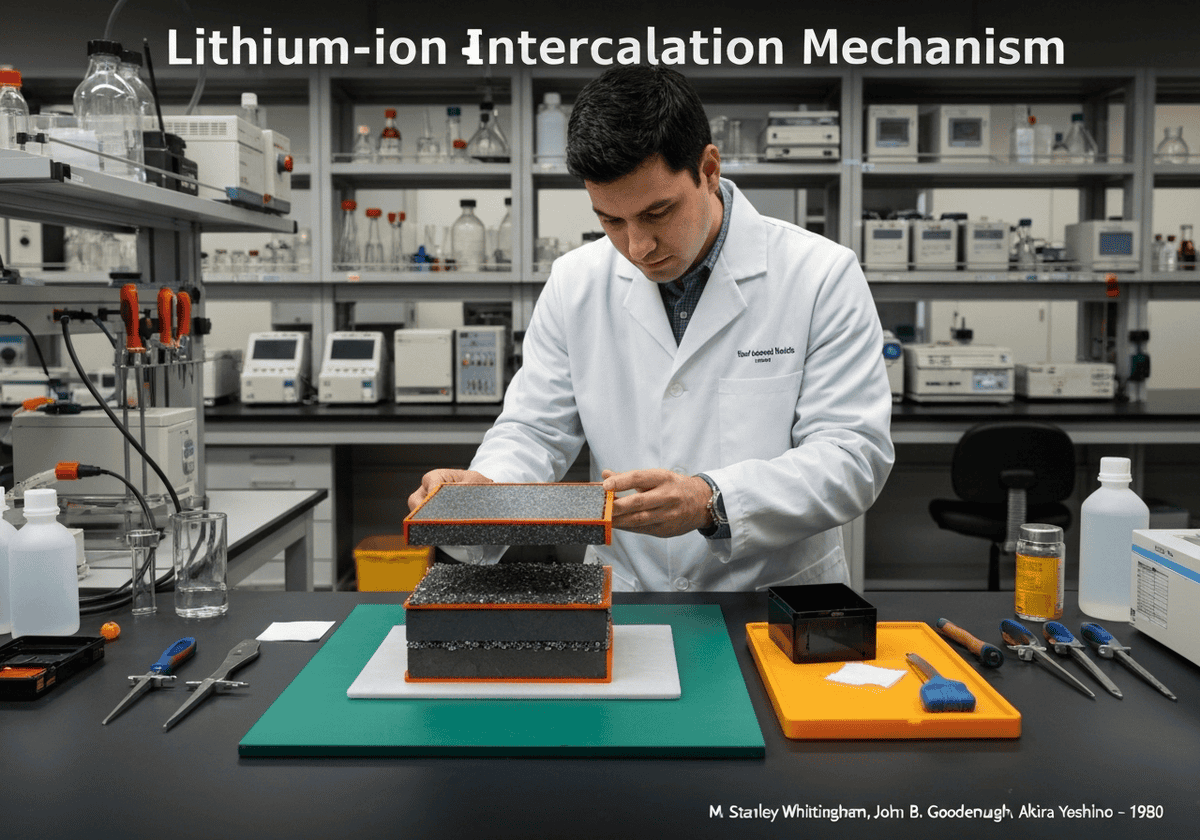
Lithium-ion batteries function via an intercalation mechanism, a reversible insertion of ions into a layered host material. During discharge, 锂 锂离子(Li^+)从负极(阳极,通常是石墨)脱嵌,并在非水系电解质中移动,嵌入正极(阴极,通常是金属氧化物)。电子在外部电路中流动,产生电流。

(图片仅供参考)
Lithium-ion batteries function via an intercalation mechanism, a reversible insertion of ions into a layered host material. During discharge, 锂 锂离子(Li^+)从负极(阳极,通常是石墨)脱嵌,并在非水系电解质中移动,嵌入正极(阴极,通常是金属氧化物)。电子在外部电路中流动,产生电流。

The concept of intercalation is central to the success of lithium-ion batteries. Unlike older battery chemistries where the electrodes undergo significant chemical phase changes, intercalation involves lithium ions acting as ‘guests’ that slide into and out of the ‘host’ crystalline structure of the electrode materials. For the anode, the host is typically graphite, which has a layered structure allowing [latex]Li^+[/latex] ions to fit between its graphene sheets, forming [latex]LiC_6[/latex]. For the cathode, the host is a metal oxide, such as lithium cobalt oxide ([latex]LiCoO_2[/latex]), where lithium ions occupy layers between cobalt oxide sheets.
这一过程具有高度可逆性,不会显著改变宿主结构,因此循环寿命长,降解程度极低。非水有机电解质促进了离子的移动,因为锂与水的反应性很高。微孔聚合物隔板可防止阳极和阴极接触和短路,同时允许离子通过。.
充电过程中,外部电压迫使该过程逆转:锂离子从正极脱出,穿过电解液,重新嵌入石墨负极。 电化学势 锂的原子量低,加上锂的原子密度高,使得电池具有非常高的能量密度和比能量,因此电池彻底改变了便携式电子产品,并推动了向电动汽车的过渡。
锂离子嵌入机理
(如果日期未知或不相关,例如“流体力学”,则提供其显著出现的近似估计)

只有注册会员才能免费获取完整尺寸的图片和下载内容。
> 登录 <