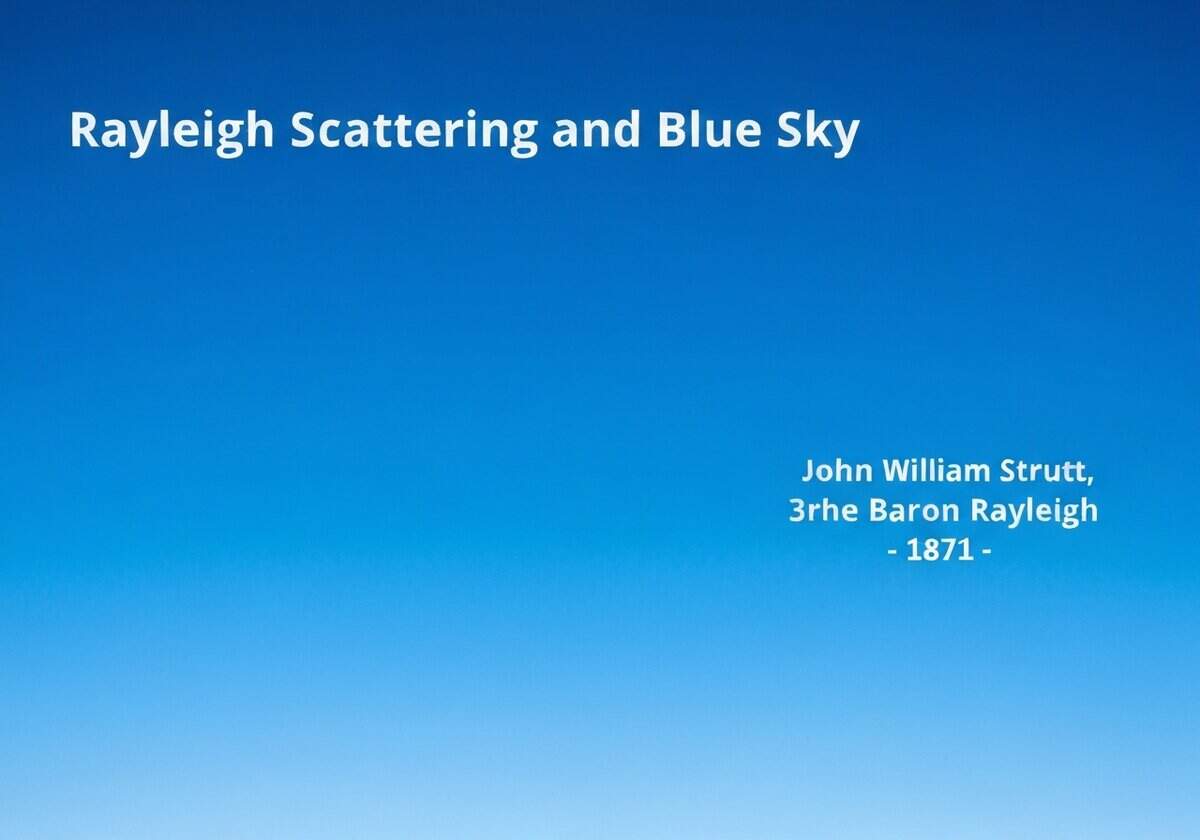
레일리 산란은 빛의 파장보다 훨씬 작은 입자에 의한 빛의 탄성 산란입니다. 이 현상 때문에 낮 하늘이 파랗게 보입니다. 햇빛의 짧은 파장인 파란색 빛은 긴 파장인 붉은색 빛보다 대기 중의 질소와 산소 분자에 의해 더 효과적으로 산란되어 관측자의 눈에는 하늘이 파랗게 보이는 것입니다.

(설명을 위한 생성된 이미지입니다)
레일리 산란은 빛의 파장보다 훨씬 작은 입자에 의한 빛의 탄성 산란입니다. 이 현상 때문에 낮 하늘이 파랗게 보입니다. 햇빛의 짧은 파장인 파란색 빛은 긴 파장인 붉은색 빛보다 대기 중의 질소와 산소 분자에 의해 더 효과적으로 산란되어 관측자의 눈에는 하늘이 파랗게 보이는 것입니다.
The intensity of 레일리 scattering is strongly dependent on the wavelength of the light, following an inverse fourth-power law: [latex]I \\propto \\lambda^{-4}[/latex]. This means that blue light (with a shorter wavelength, ~475 nm) is scattered about 16 times more intensely than red light (~700 nm) by the gas molecules in the atmosphere. When we look at the sky away from the direct sun, our eyes perceive this scattered blue light coming from all directions. Conversely, when the sun is near the horizon at sunrise or sunset, its light must travel through a much longer path in the atmosphere to reach the observer. By the time it does, most of the blue and green light has been scattered away from the direct line of sight, leaving the longer-wavelength oranges and reds to be seen. This same principle explains why distant clouds or mountains can appear bluish. Rayleigh scattering is distinct from Mie scattering, which is caused by particles of a size comparable to or larger than the wavelength of light (like water droplets in clouds) and is not strongly wavelength-dependent, which is why clouds appear white.
Rayleigh Scattering and Blue Sky
(날짜를 알 수 없거나 관련이 없는 경우, 예를 들어 "유체역학"의 경우, 주목할 만한 등장 시기를 대략적으로 추정하여 제공합니다.)

고화질 이미지 및 다운로드는 등록된 회원에게만 100% 무료로 제공됩니다.
> 로그인 <