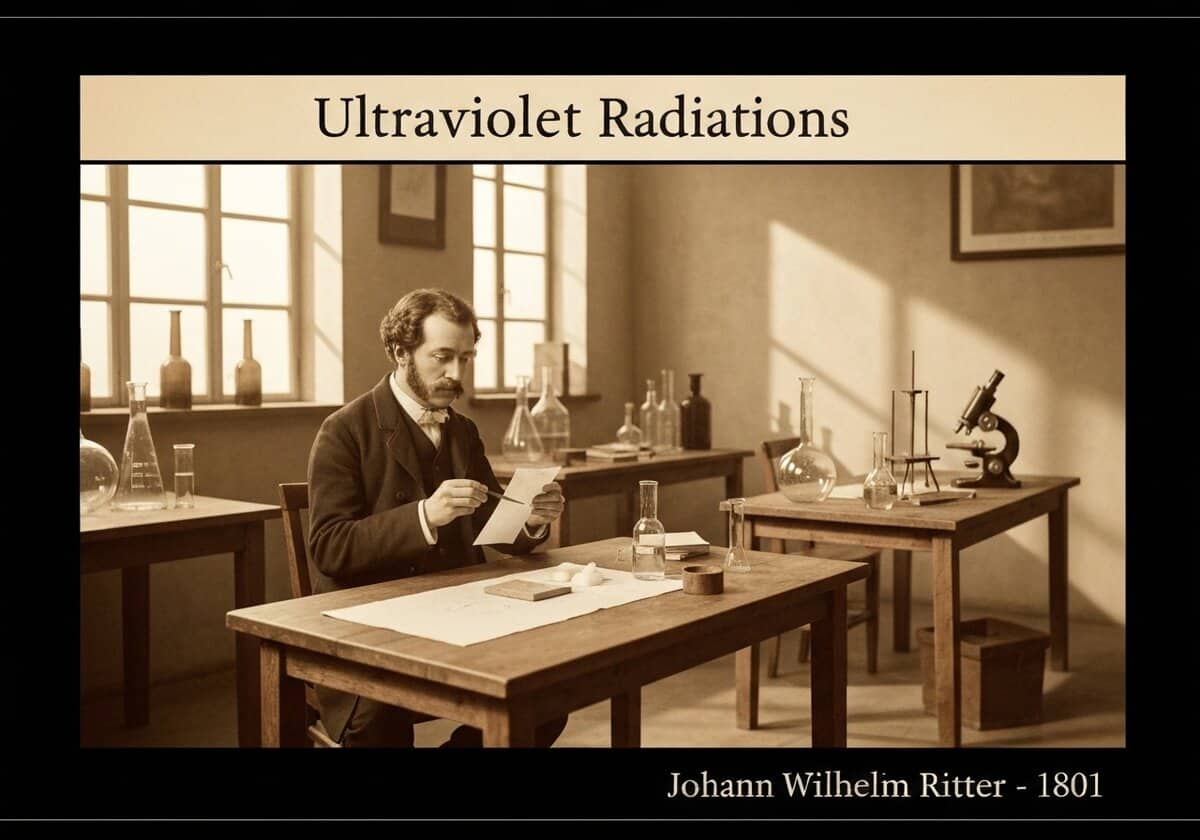
Johann Wilhelm Ritter’s experiment was a direct follow-up to William Herschel’s discovery of infrared radiation in 1800. Herschel had used a prism to split sunlight and placed thermometers beyond the red end of the spectrum, noting a temperature increase. Ritter, intrigued by this, decided to test the other end of the spectrum. He knew that silver chloride decomposed in the presence of light, and that this effect was more pronounced in violet light. He exposed strips of paper soaked in silver chloride to the ソーラー spectrum produced by a prism. As expected, the paper darkened in the visible spectrum, with the effect increasing from red to violet. Crucially, he placed a strip just beyond the violet end, in a region where no visible light was present, and found that this strip darkened even more rapidly than the one in the violet light. This confirmed the existence of radiation with chemical activity stronger than visible light, located beyond the violet. His initial name, “oxidizing rays,” highlighted its chemical properties, which was later replaced by “chemical rays” and eventually “ultraviolet rays.” This discovery fundamentally expanded the known electromagnetic spectrum, proving that human vision perceives only a small fraction of it.