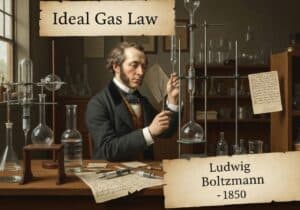
理想气体定律是描述假想理想气体的状态方程,近似描述多种气体在不同条件下的行为。其摩尔形式关联 压力 体积([latex]P[/latex])、物质的量([latex]V[/latex])、摩尔数([latex]n[/latex])及绝对温度([latex]T[/latex])通过普适气体常数([latex]R[/latex])关联:[latex]PV = nRT[/latex]。.

(图片仅供参考)
理想气体定律是描述假想理想气体的状态方程,近似描述多种气体在不同条件下的行为。其摩尔形式关联 压力 体积([latex]P[/latex])、物质的量([latex]V[/latex])、摩尔数([latex]n[/latex])及绝对温度([latex]T[/latex])通过普适气体常数([latex]R[/latex])关联:[latex]PV = nRT[/latex]。.
The ideal gas law, expressed as [latex]PV = nRT[/latex], is a cornerstone of thermodynamics and physical chemistry. It was first stated by Benoît Paul Émile Clapeyron in 1834 as a combination of the empirical laws of Boyle, Charles, Gay-Lussac, and Avogadro. This equation of state provides a remarkably accurate approximation for the behavior of many gases under conditions of moderate temperature and low pressure. In the equation, [latex]P[/latex] represents the absolute pressure, [latex]V[/latex] is the volume, [latex]n[/latex] is the number of moles of the gas, and [latex]T[/latex] is the absolute temperature in Kelvin.
比例常数[latex]R[/latex]被称为普适气体常数。其数值对所有气体均相同,约为8.314焦耳/(摩尔·开尔文)。该定律的强大之处在于能用单一简洁公式关联气体的四个宏观状态量。这使得当其他三个量已知时,可计算任意一个变量。 该定律所描述的“理想”气体性质源于两个关键假设:气体粒子体积可忽略不计,且粒子间不存在分子间引力或斥力。尽管现实中不存在真正理想的气体,但在标准条件下,氮气、氧气和氩气等常见气体表现近乎理想,使该定律在实际应用中极具实用价值。.
理想气体定律(摩尔形式)
(如果日期未知或不相关,例如“流体力学”,则提供其显著出现的近似估计)

只有注册会员才能免费获得 100% 的全尺寸图片和下载。.
> 登录 <