ネオジム magnets are the strongest type of permanent magnet commercially available. They are a ternary 合金 ネオジム、鉄、ホウ素からなる化学式Nd2Fe14B。その強大な磁気強度は、正方晶構造に由来する高い磁気異方性と飽和磁化によるものである。しかしながら、脆く、腐食しやすく、キュリー温度が低いという欠点がある。
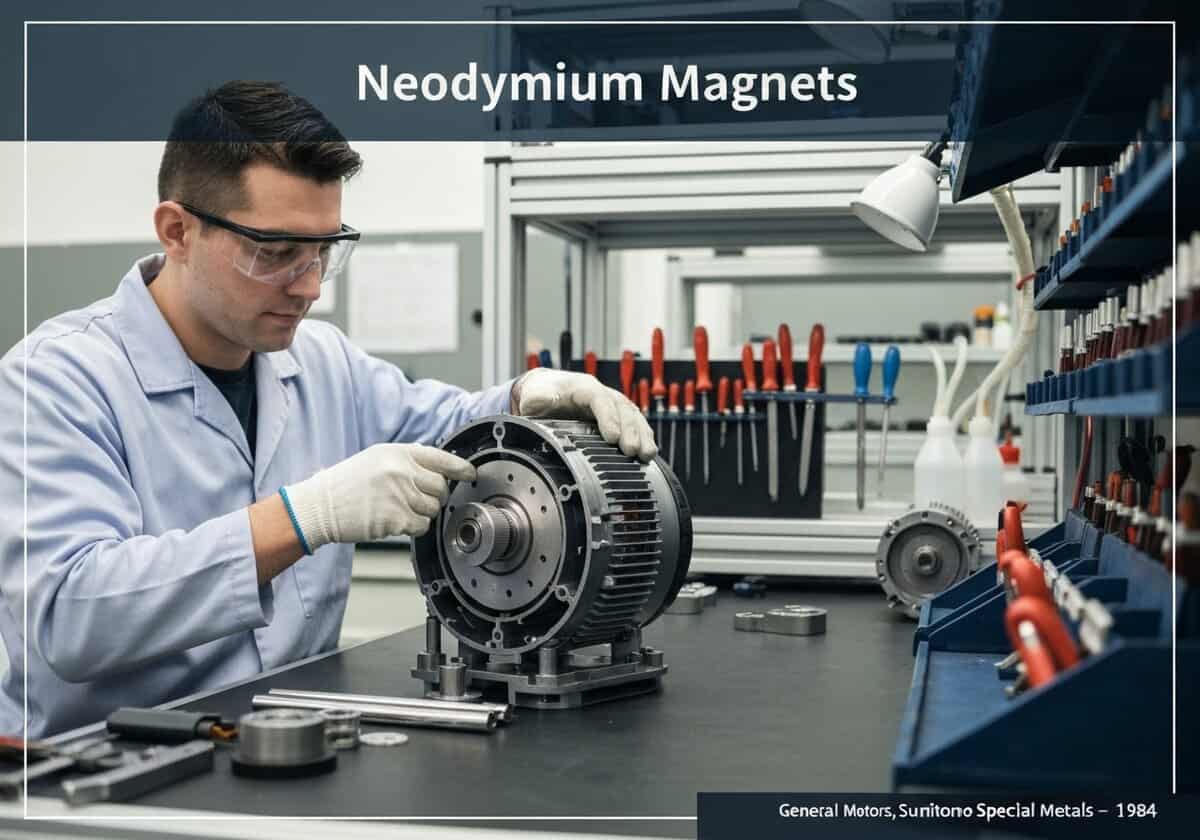
(画像はイメージです)
ネオジム magnets are the strongest type of permanent magnet commercially available. They are a ternary 合金 ネオジム、鉄、ホウ素からなる化学式Nd2Fe14B。その強大な磁気強度は、正方晶構造に由来する高い磁気異方性と飽和磁化によるものである。しかしながら、脆く、腐食しやすく、キュリー温度が低いという欠点がある。
ネオジム磁石の優れた性能は、その独自の結晶構造内で各構成元素が果たす特定の役割に由来します。この化合物は、[latex]Nd_2Fe_{14}B[/latex]の式を持つ正方晶系結晶格子を形成します。この構造では、鉄(Fe)原子が非常に高い飽和磁化を提供し、材料が強い磁場を保持できることを意味します。ネオジム(Nd)は、 希土類元素は、極めて高い磁気結晶異方性を実現するために不可欠です。これは、結晶が特定の磁化軸を持つことを意味し、脱磁が非常に困難になります。ホウ素(B)原子は磁性に直接寄与しませんが、この特定の正方晶相を安定化させ、磁気的に好ましくない他の鉄ネオジム化合物の形成を防ぐために不可欠です。
主な製造方法は2つあります。焼結 NdFeB magnets are produced by powder metallurgy. The raw alloy is milled into a fine powder, which is then aligned in a strong magnetic field, pressed, and heated (sintered) to fuse the particles together. This process creates the strongest, highest-grade magnets but results in a hard, brittle product. Bonded NdFeB magnets are made by mixing the magnetic powder with a polymer binder, which can then be injection-molded or compression-molded into complex shapes. Bonded magnets are weaker than their sintered counterparts but offer greater design flexibility and corrosion resistance. To improve performance at higher temperatures, small amounts of other rare earths like dysprosium (Dy) or terbium (Tb) are often added to increase the material’s coercivity.
ネオジム磁石
(日付が不明または関連性がない場合、例えば「流体力学」などでは、その注目すべき出現時期の概算値が提示されます。)

フルサイズの画像とダウンロードは、登録会員のみが100%無料で利用できます。
> ログイン <