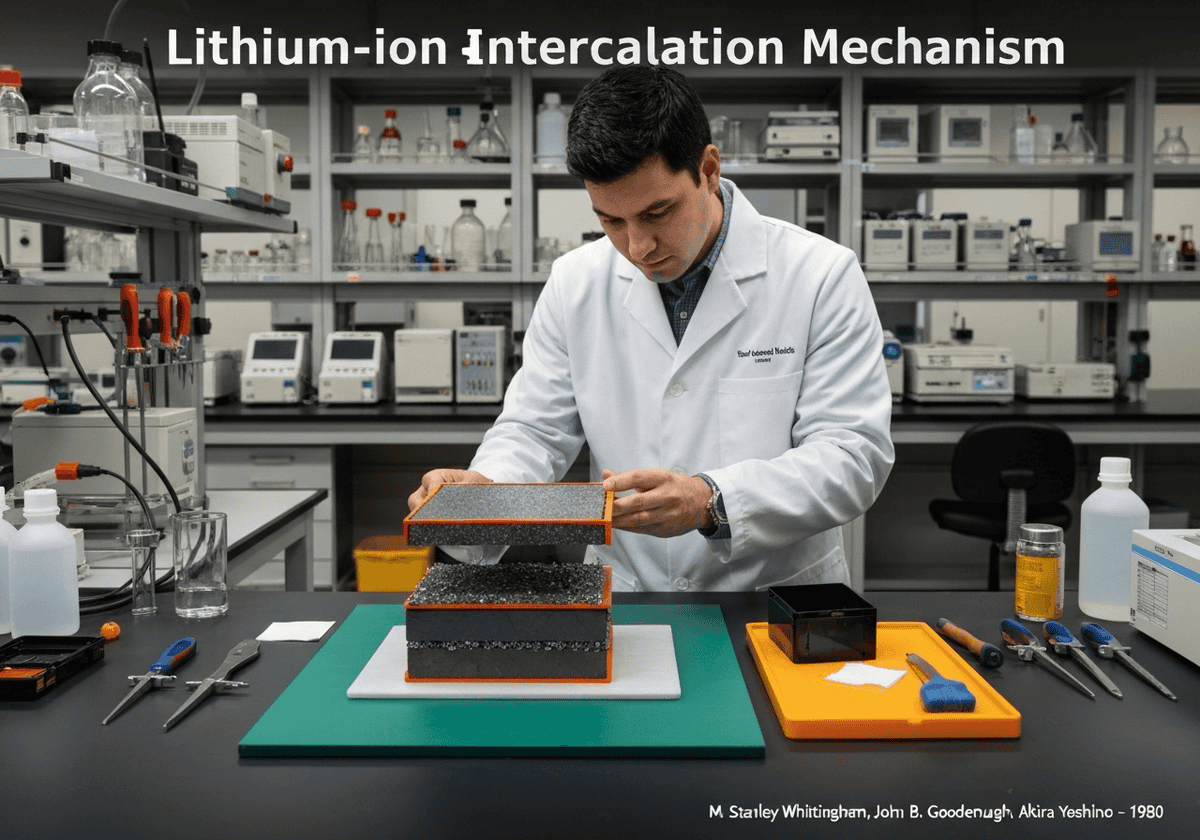
The concept of intercalation is central to the success of lithium-ion batteries. Unlike older battery chemistries where the electrodes undergo significant chemical phase changes, intercalation involves lithium ions acting as ‘guests’ that slide into and out of the ‘host’ crystalline structure of the electrode materials. For the anode, the host is typically graphite, which has a layered structure allowing [latex]Li^+[/latex] ions to fit between its graphene sheets, forming [latex]LiC_6[/latex]. For the cathode, the host is a metal oxide, such as lithium cobalt oxide ([latex]LiCoO_2[/latex]), where lithium ions occupy layers between cobalt oxide sheets.
During charging, an external voltage forces the process to reverse: lithium ions are extracted from the cathode, travel back across the electrolyte, and re-insert into the graphite anode. The high electrochemical potential of lithium, combined with its low atomic weight, allows for batteries with very high energy density and specific energy, which is why they have revolutionized portable electronics and are enabling the transition to electric vehicles.