Product Design, Manufacturing & Innovation Resources
Maison » Neodymium Magnets

Neodymium Magnets

1984
  • General Motors
  • Sumitomo Special Metals
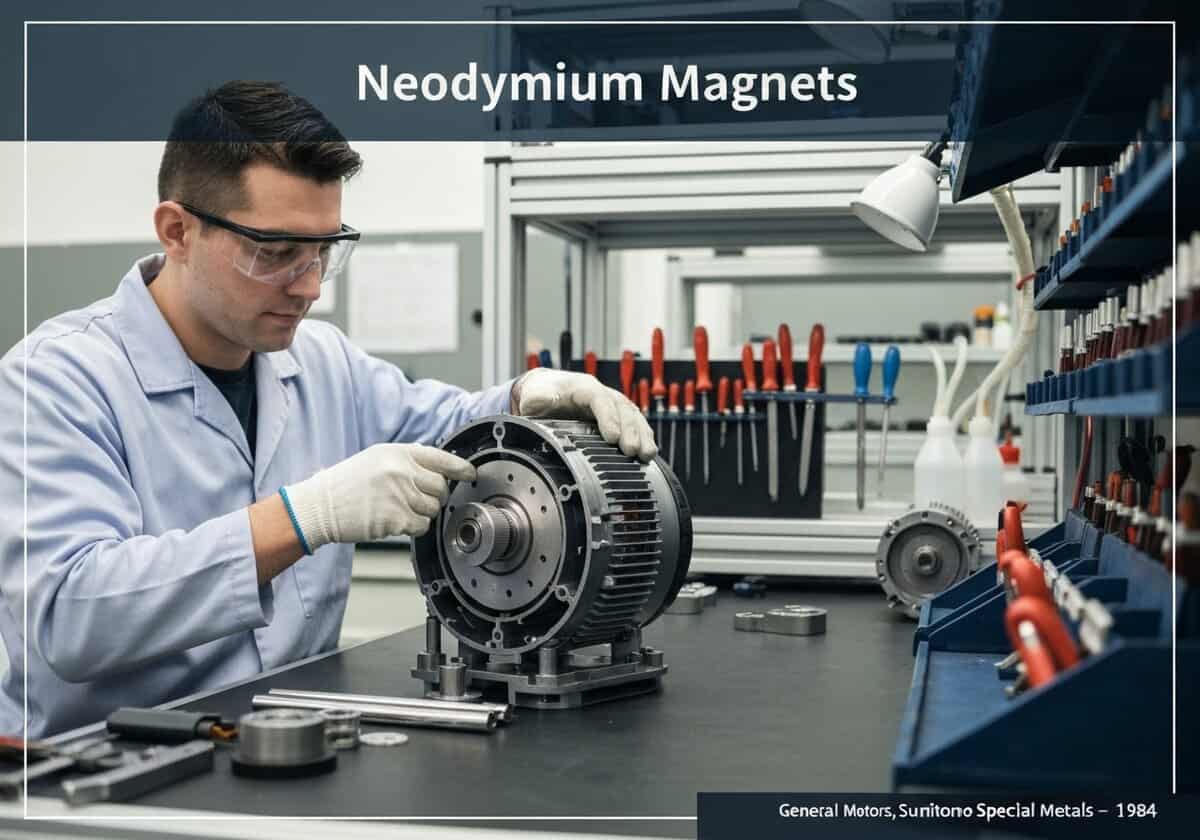
Aimants en néodyme utilisés dans l'assemblage des moteurs électriques en physique des solides.

(Image générée à titre d'illustration uniquement)

Neodymium magnets are the strongest type of permanent magnet commercially available. They are a ternary alliage Ces matériaux sont composés de néodyme, de fer et de bore, de formule stœchiométrique Nd₂Fe₁₄B. Leur force magnétique exceptionnelle résulte de leur forte anisotropie magnétique et de leur aimantation à saturation élevée, elles-mêmes liées à leur structure cristalline tétragonale. Cependant, ils sont fragiles, sensibles à la corrosion et présentent une faible température de Curie.
Les performances exceptionnelles des aimants au néodyme proviennent du rôle spécifique joué par chaque élément constitutif au sein de leur structure cristalline unique. Ce composé forme un réseau cristallin tétragonal de formule [latex]Nd_2Fe_{14}B[/latex]. Dans cette structure, les atomes de fer (Fe) confèrent au matériau une aimantation à saturation très élevée, ce qui lui permet de conserver un champ magnétique puissant. Le néodyme (Nd), un élément de terre rareLa présence de bore est cruciale pour obtenir une anisotropie magnétocristalline extrêmement élevée. Cela signifie que le cristal possède un axe d'aimantation privilégié, ce qui le rend très difficile à démagnétiser. Les atomes de bore (B) ne contribuent pas directement au magnétisme, mais sont essentiels à la stabilisation de cette phase tétragonale spécifique, empêchant ainsi la formation d'autres composés fer-néodyme moins favorables magnétiquement.

There are two primary manufacturing methods. Sintered NdFeB magnets are produced by powder metallurgy. The raw alloy is milled into a fine powder, which is then aligned in a strong magnetic field, pressed, and heated (sintered) to fuse the particles together. This process creates the strongest, highest-grade magnets but results in a hard, brittle product. Bonded NdFeB magnets are made by mixing the magnetic powder with a polymer binder, which can then be injection-molded or compression-molded into complex shapes. Bonded magnets are weaker than their sintered counterparts but offer greater design flexibility and corrosion resistance. To improve performance at higher temperatures, small amounts of other rare earths like dysprosium (Dy) or terbium (Tb) are often added to increase the material’s coercivity.

UNESCO Nomenclature: 2211
- Physique de l'état solide

Taper

Dispositif physique

Perturbation

Révolutionnaire

Usage

Utilisation généralisée

Précurseurs

  • discovery of ferromagnétisme
  • development of earlier permanent magnets like alnico and samarium-cobalt magnets
  • understanding of crystal structures and their relation to magnetic properties
  • advances in powder metallurgy and sintering techniques

Applications

  • electric motors in cordless tools, hybrid and electric vehicles
  • hard disk drives for voice coil motors
  • wind turbine generators
  • audio equipment like headphones and speakers
  • magnetic resonance imaging (mri) scanners
  • magnetic levitation systems

Brevets:

  • US Patent 4,496,395
  • US Patent 4,770,723

Idées d'innovations potentielles

  • miniaturized implants médicaux with magnetic actuation
  • highly efficient, compact maglev transportation systems
  • next-generation data storage using heat-assisted magnetic recording (hamr) with ndfeb tips
  • portable devices for haptic feedback using tiny, powerful magnetic actuators
  • advanced magnetic refrigeration systems that are more energy-efficient than gas-compression
  • self-healing materials with embedded magnetic particles that align to close cracks
  • wireless power transfer systems with enhanced range and efficiency
  • magnetic filtration systems for purifying water or industrial fluids
  • compact, high-torque robotic joints for advanced automation
  • energy harvesting devices that convert ambient vibrations into electricity using magnetic induction
En lien avec : néodyme magnet, NdFeB, permanent magnet, magnetic anisotropy, saturation magnetization, general motors, Sumitomo, sintering, hard disk drive, moteur électrique.

Contexte historique

Neodymium Magnets

1980
1980
1980
1984
1986
1986
1991
1980
1980
1980
1984
1985
1986
1990
1993-01-01

(si la date est inconnue ou non pertinente, par exemple « mécanique des fluides », une estimation arrondie de son émergence notable est fournie)

10e année anniversaire

Les images en pleine résolution et les téléchargements sont uniquement disponibles, et 100% gratuits, pour les membres inscrits.