Product Design, Manufacturing & Innovation Resources
Hogar » Imanes de neodimio

Imanes de neodimio

1984
  • General Motors
  • Sumitomo Special Metals
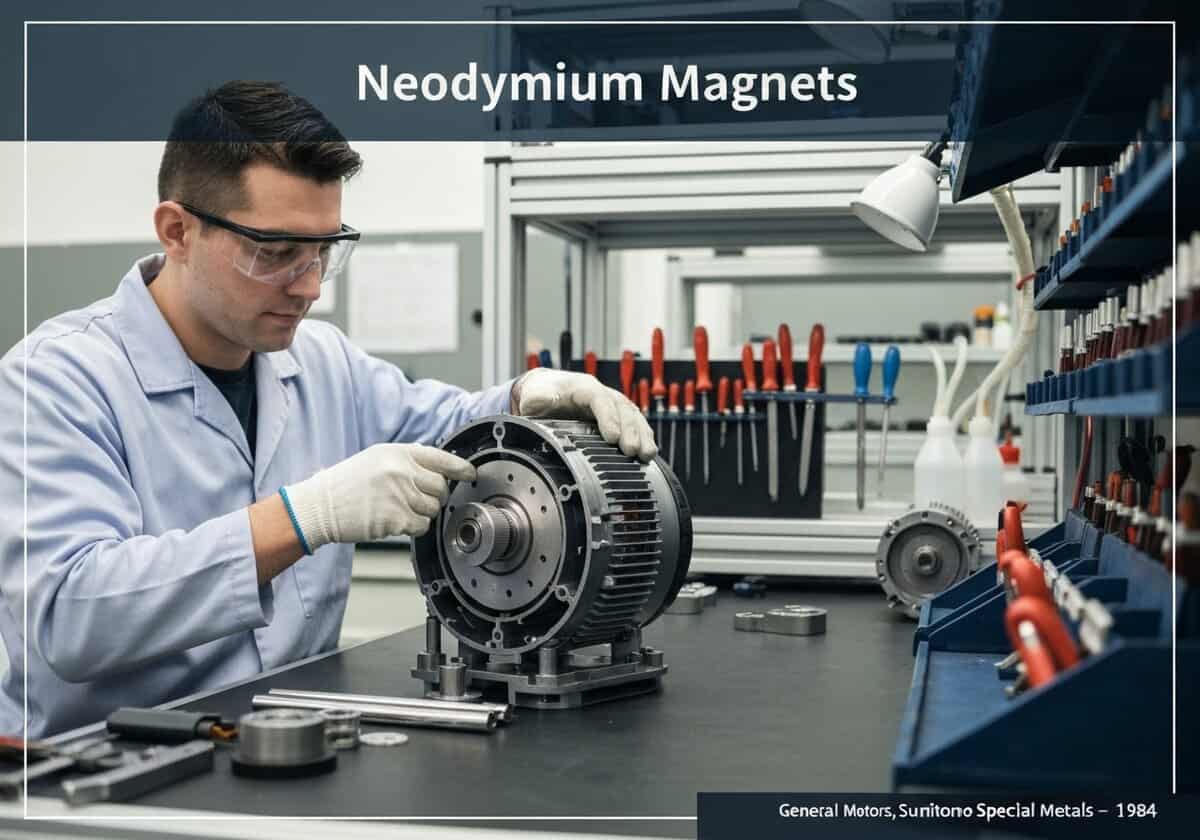
Imanes de neodimio utilizados en el montaje de motores eléctricos en física del estado sólido.

(Imagen generada únicamente con fines ilustrativos)

Neodymium magnets are the strongest type of permanent magnet commercially available. They are a ternary alloy of neodymium, iron, and boron, with the stoichiometric formula Nd2Fe14B. Their immense magnetic strength results from the material’s high magnetic anisotropy and saturation magnetization, derived from its tetragonal crystal structure. However, they are brittle, susceptible to corrosion, and have a low curie temperature.

The exceptional performance of neodimio magnets stems from the specific roles played by each constituent element within its unique crystal structure. The compound forms a tetragonal crystal lattice with the formula [latex]Nd_2Fe_{14}B[/latex]. In this structure, iron (Fe) atoms provide a very high saturation magnetization, meaning the material can hold a strong magnetic field. Neodymium (Nd), a rare-earth element, is crucial for providing an extremely high magnetocrystalline anisotropy. This means that the crystal has a preferred axis of magnetization, making it very difficult to demagnetize. The boron (B) atoms do not contribute directly to the magnetism but are essential for stabilizing this specific tetragonal phase, preventing the formation of other, less magnetically favorable iron-neodymium compounds.

There are two primary manufacturing methods. Sintered NdFeB magnets are produced by powder metallurgy. The raw aleación is milled into a fine powder, which is then aligned in a strong magnetic field, pressed, and heated (sintered) to fuse the particles together. This process creates the strongest, highest-grade magnets but results in a hard, brittle product. Bonded NdFeB magnets are made by mixing the magnetic powder with a polymer binder, which can then be injection-molded or compression-molded into complex shapes. Bonded magnets are weaker than their sintered counterparts but offer greater design flexibility and corrosion resistance. To improve performance at higher temperatures, small amounts of other rare earths like dysprosium (Dy) or terbium (Tb) are often added to increase the material’s coercivity.

UNESCO Nomenclature: 2211
- Física del estado sólido

Tipo

Dispositivo físico

Ruptura

Revolucionario

Uso

Uso generalizado

Precursores

  • descubrimiento de ferromagnetismo
  • Desarrollo de imanes permanentes anteriores, como los imanes de alnico y de samario-cobalto
  • Comprensión de las estructuras cristalinas y su relación con las propiedades magnéticas.
  • avances en pulvimetalurgia y técnicas de sinterización

Aplicaciones

  • Motores eléctricos en herramientas inalámbricas, vehículos híbridos y eléctricos
  • unidades de disco duro para motores de bobina móvil
  • wind turbine generators
  • equipos de audio como auriculares y altavoces
  • resonancia magnética imaging (mri) scanners
  • sistemas de levitación magnética

Patentes:

  • US Patent 4,496,395
  • US Patent 4,770,723

Ideas para posibles innovaciones

  • Implantes médicos miniaturizados con accionamiento magnético
  • Sistemas de transporte maglev compactos y altamente eficientes
  • Almacenamiento de datos de última generación mediante grabación magnética asistida por calor (HAMR) con puntas de NdFeB.
  • wearable devices for haptic feedback using tiny, powerful magnetic actuators
  • Sistemas de refrigeración magnética avanzados que son más eficientes energéticamente que la compresión de gas.
  • Materiales autocurativos con partículas magnéticas incrustadas que se alinean para cerrar grietas.
  • Sistemas de transferencia de energía inalámbrica con alcance y eficiencia mejorados
  • Sistemas de filtración magnética para purificar agua o fluidos industriales
  • Articulaciones robóticas compactas y de alto par para automatización avanzada
  • Dispositivos de recolección de energía que convierten las vibraciones ambientales en electricidad mediante inducción magnética.
Related to: neodymium imán, NdFeB, permanent magnet, magnetic anisotropy, saturation magnetization, general motors, Sumitomo, sintering, hard disk drive, motor eléctrico.

Contexto histórico

Imanes de neodimio

1980
1980
1980
1984
1986
1986
1991
1980
1980
1980
1984
1985
1986
1990
1993-01-01

(Si la fecha es desconocida o no es relevante, por ejemplo "mecánica de fluidos", se proporciona una estimación redondeada de su aparición notable)

décimo año aniversario

Las imágenes en tamaño completo y las descargas solo están disponibles, de forma totalmente gratuita, para los miembros registrados.

> Acceso <