Product Design, Manufacturing & Innovation Resources
घर » नियोडिमियम चुंबक

नियोडिमियम चुंबक

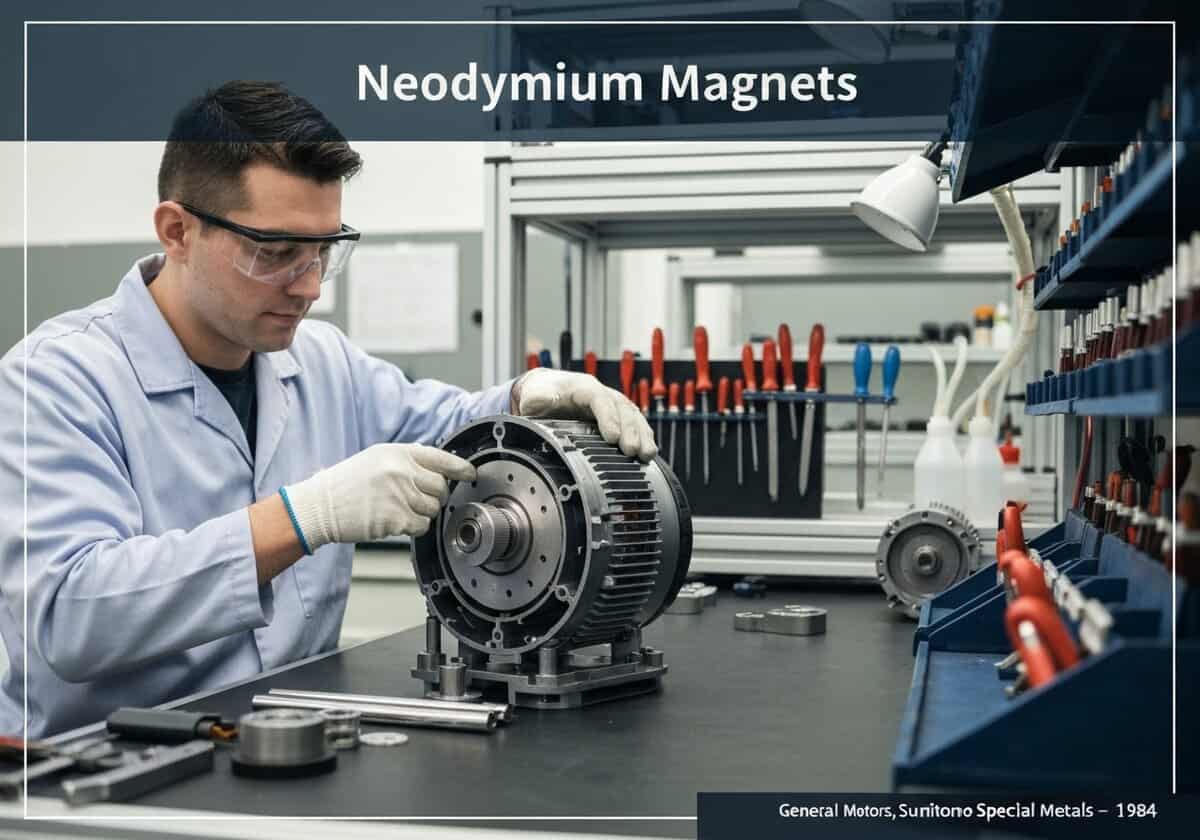
1984
  • General Motors
  • Sumitomo Special Metals
ठोस अवस्था भौतिकी में विद्युत मोटर असेंबली में प्रयुक्त नीओडिमियम चुम्बक।.

(यह छवि केवल उदाहरण के लिए बनाई गई है)

Neodymium magnets are the strongest type of permanent magnet commercially available. They are a ternary alloy of neodymium, iron, and boron, with the stoichiometric formula Nd2Fe14B. Their immense magnetic strength results from the material’s high magnetic anisotropy and saturation magnetization, derived from its tetragonal crystal structure. However, they are brittle, susceptible to corrosion, and have a low curie temperature.
The exceptional performance of Neodymium magnets stems from the specific roles played by each constituent element within its unique crystal structure. The compound forms a tetragonal crystal lattice with the formula [latex]Nd_2Fe_{14}B[/latex]. In this structure, iron (Fe) atoms provide a very high saturation magnetization, meaning the material can hold a strong magnetic field. Neodymium (Nd), a rare-earth element, is crucial for providing an extremely high magnetocrystalline anisotropy. This means that the crystal has a preferred axis of magnetization, making it very difficult to demagnetize. The boron (B) atoms do not contribute directly to the magnetism but are essential for stabilizing this specific tetragonal phase, preventing the formation of other, less magnetically favorable iron-neodymium compounds.

There are two primary manufacturing methods. Sintered एनडीफेबी magnets are produced by powder metallurgy. The raw मिश्र धातु is milled into a fine powder, which is then aligned in a strong magnetic field, pressed, and heated (sintered) to fuse the particles together. This process creates the strongest, highest-grade magnets but results in a hard, brittle product. Bonded NdFeB magnets are made by mixing the magnetic powder with a polymer binder, which can then be injection-molded or compression-molded into complex shapes. Bonded magnets are weaker than their sintered counterparts but offer greater design flexibility and corrosion resistance. To improve performance at higher temperatures, small amounts of other rare earths like dysprosium (Dy) or terbium (Tb) are often added to increase the material’s coercivity.

UNESCO Nomenclature: 2211
ठोस अवस्था भौतिकी

Type

भौतिक उपकरण

व्यवधान

क्रांतिकारी

उपयोग

व्यापक उपयोग

शगुन

  • की खोज लोहित चुंबकत्व
  • एल्निको और समैरियम-कोबाल्ट चुंबक जैसे प्रारंभिक स्थायी चुंबकों का विकास
  • क्रिस्टल संरचनाओं और चुंबकीय गुणों से उनके संबंध की समझ
  • पाउडर धातु विज्ञान और सिंटरिंग तकनीकों में प्रगति

आवेदन

  • कॉर्डलेस टूल्स, हाइब्रिड और इलेक्ट्रिक वाहनों में इलेक्ट्रिक मोटर्स
  • वॉइस कॉइल मोटर्स के लिए हार्ड डिस्क ड्राइव
  • wind turbine generators
  • हेडफ़ोन और स्पीकर जैसे ऑडियो उपकरण
  • चुंबकीय अनुनाद imaging (mri) scanners
  • चुंबकीय उत्तोलन प्रणालियाँ

पेटेंट:

  • US Patent 4,496,395
  • US Patent 4,770,723

संभावित नवाचार विचार

  • चुंबकीय सक्रियण वाले लघु चिकित्सा प्रत्यारोपण
  • अत्यधिक कुशल, कॉम्पैक्ट मैग्लेव परिवहन प्रणालियाँ
  • एनडीएफईबी टिप्स के साथ हीट-असिस्टेड मैग्नेटिक रिकॉर्डिंग (एचएएमआर) का उपयोग करके अगली पीढ़ी का डेटा स्टोरेज
  • पहनने योग्य devices for haptic feedback using tiny, powerful magnetic actuators
  • उन्नत चुंबकीय प्रशीतन प्रणालियाँ जो गैस-संपीड़न प्रणालियों की तुलना में अधिक ऊर्जा-कुशल हैं
  • चुंबकीय कणों से युक्त स्व-उपचार सामग्री जो दरारों को बंद करने के लिए संरेखित होती है
  • बेहतर रेंज और दक्षता वाले वायरलेस पावर ट्रांसफर सिस्टम
  • पानी या औद्योगिक तरल पदार्थों को शुद्ध करने के लिए चुंबकीय निस्पंदन प्रणाली
  • उन्नत स्वचालन के लिए कॉम्पैक्ट, उच्च-टॉर्क वाले रोबोटिक जोड़
  • चुंबकीय प्रेरण का उपयोग करके परिवेशीय कंपन को बिजली में परिवर्तित करने वाले ऊर्जा संचयन उपकरण
Related to: neodymium चुंबक, NdFeB, permanent magnet, magnetic anisotropy, saturation magnetization, general motors, Sumitomo, sintering, hard disk drive, विद्युत मोटर.

ऐतिहासिक संदर्भ

नियोडिमियम चुंबक

1980
1980
1980
1984
1986
1986
1991
1980
1980
1980
1984
1985
1986
1990
1993-01-01
ठोस अवस्था भौतिकी प्रयोगशाला में दुर्लभ-पृथ्वी चुम्बकों का परीक्षण।.

दुर्लभ-पृथ्वी चुंबक

दुर्लभ-पृथ्वी चुंबक दुर्लभ-पृथ्वी तत्वों के मिश्र धातुओं से बने मजबूत स्थायी चुंबक होते हैं। 1970 और 1980 के दशक में विकसित, सबसे सामान्य प्रकार नियोडिमियम चुंबक (NdFeB) और समैरियम-कोबाल्ट चुंबक (SmCo) हैं। वे बनाए गए स्थायी चुंबकों में सबसे मजबूत प्रकार के होते हैं, जो फेराइट या अलिनको चुंबकों की तुलना में काफी मजबूत चुंबकीय क्षेत्र उत्पन्न करते हैं, जिससे कई प्रौद्योगिकियों में लघुकरण और बेहतर प्रदर्शन संभव हो पाता है। नोट: 'दुर्लभ-पृथ्वी तत्व' शब्द एक ऐतिहासिक भ्रामक नाम है। ये तत्व पृथ्वी की पपड़ी में असाधारण रूप से दुर्लभ नहीं हैं। सीरियम, सबसे प्रचुर मात्रा में, 25वां सबसे प्रचुर तत्व है, जो तांबे के समान है। यहाँ तक कि सबसे कम प्रचुर स्थिर दुर्लभ-पृथ्वी, ल्यूटेशियम, सोने की तुलना में लगभग 200 गुना अधिक सामान्य है। 'दुर्लभ' लेबल इसलिए उत्पन्न हुआ क्योंकि उन्हें अलग करना मुश्किल था।

(यदि तिथि अज्ञात है या प्रासंगिक नहीं है, उदाहरण के लिए "द्रव यांत्रिकी", तो इसके उल्लेखनीय उद्भव का एक अनुमानित आंकड़ा प्रदान किया गया है)

नवीनतम परिवर्धन

शीर्ष पोस्ट और लेख

शीर्ष मूल उपकरण

10वां वर्ष सालगिरह

पंजीकृत सदस्यों के लिए पूर्ण आकार की छवियाँ और डाउनलोड 100% निःशुल्क उपलब्ध हैं।