ピックアンドプレースマシン(P&PまたはPnP)は、既知の位置から小型部品を迅速かつ正確にピックアップし、高い再現性でターゲットの表面またはアセンブリに配置するように設計された自動化された産業システムです。元々は電子機器製造業界(SMT)向けに開発されたこれらのマシンは、コンピュータ制御のモーションシステム、真空または機械式グリッパー、およびビジョンベースのアライメントを組み合わせて、数ミリメートルから数ミリメートル以下の部品を扱います。1時間に数万個以上の配置を行う速度で動作し、人間のオペレーターが生産工程で維持できないレベルの精度と一貫性を実現するため、現代の大量生産の基盤となっています。
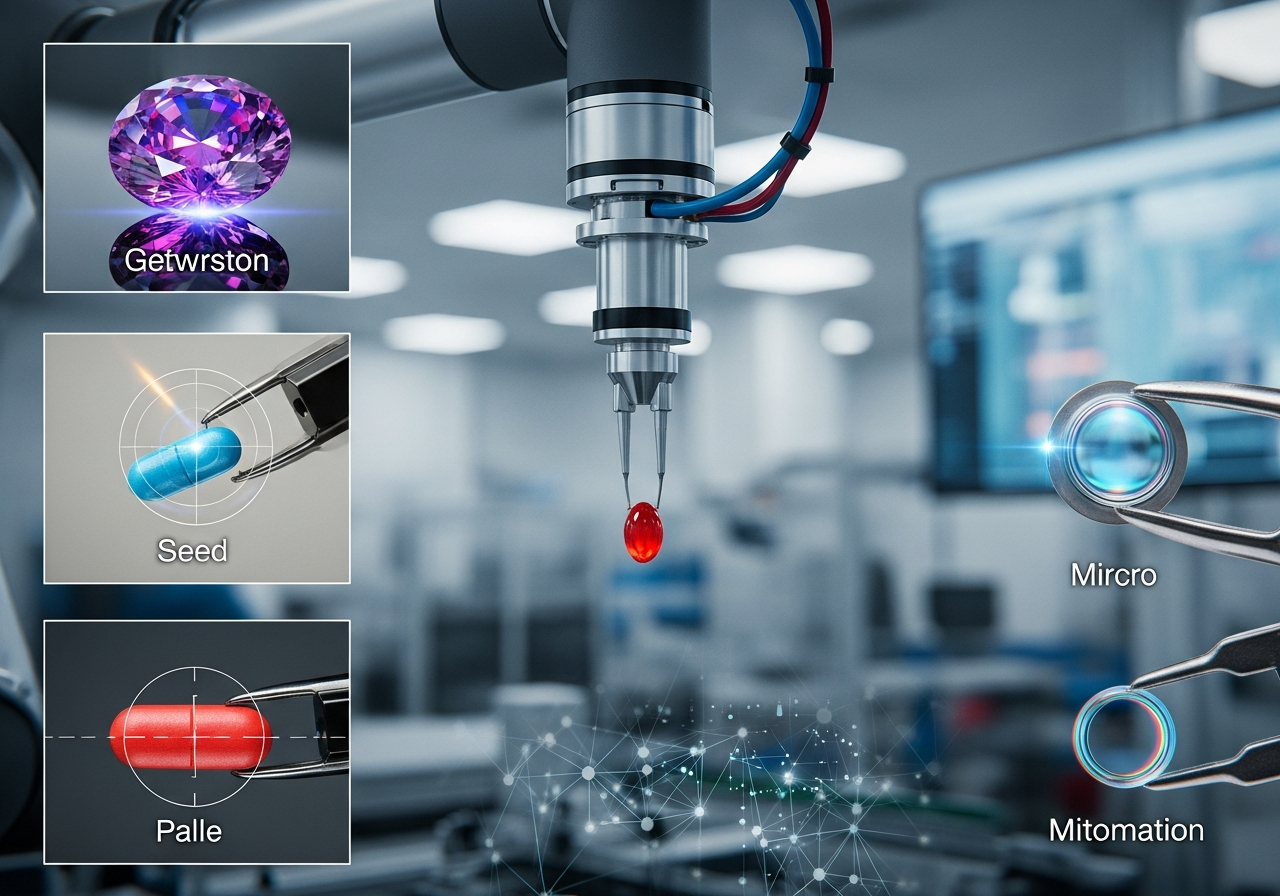
ピックアンドプレース技術が電子機器分野を超えてこれほど魅力的なのは、その中核となる機能の普遍性、すなわち、小さな物体を三次元空間内で制御された再現性の高い操作が可能である点にある。対象物が宝石、種子、錠剤、マイクロレンズなど、どのようなものであっても、根本的な課題は常に同じだ。それは、対象物を識別し、正しい向きに向け、損傷を与えることなく移動させ、正確な位置に配置することである。ピックアンドプレース装置は、この問題を洗練された方法で大規模に解決するため、その価値は回路基板の分野にとどまらない。
This transferability becomes even more powerful when combined with modern sensing and software. Computer vision systems can distinguish between object types, detect defects, and confirm correct placement in real time. Force-sensitive grippers can handle fragile biological or optical materials without crushing them. And programmable motion paths mean the same physical machine can be reconfigured for an entirely different product with a software update rather than a hardware overhaul. Across pharmaceuticals, jewelry, agri-tech, medical devices, and beyond, the pick and place principle quietly underpins a growing share of precision manufacturing — one placement at a time.
ピック&プレイスとは
表面実装技術(SMT)を用いた代表的な電子機器アプリケーション:
さらに、より汎用性が高く大型のロボットまたは協働ロボット(SMT用ではない):
1. 医薬品ブリスター包装
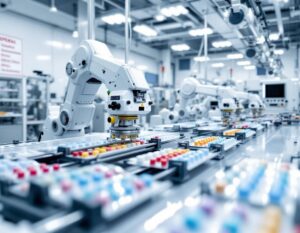
医薬品のブリスター包装では、錠剤、カプセル、ソフトジェル、トローチなどの個々の錠剤を、あらかじめ成形されたプラスチックまたはアルミニウム製の容器に入れ、その後、箔で密封します。この用途は既に確立されており、電子機器以外の分野でP&P技術が採用された初期の例の一つです。この分野の機械は高度に専門化されており、容器成形、箔密封、印刷、カートニングなどを含むより広範な包装ラインに統合されていることがよくあります。FDAやEMAなどの規制機関は完全なトレーサビリティを要求するため、最新のシステムでは、すべての配置イベントを記録し、錠剤の欠落や破損を検出し、密封ステーションに到達する前に規格外のブリスターを自動的に拒否することができます。
The key benefit over manual or bulk-filling methods is the elimination of dose errors and cross-contamination, which are critical in a regulated environment where a single missing tablet in a blister pack can trigger a costly recall. Vision systems that verify tablet color, shape, and size before placement add an extra layer of quality assurance that bulk filling simply cannot provide. The main risk lies in handling friable or oddly shaped tablets that can break under vacuum suction, so nozzle geometry and suction pressure must be carefully tuned per product. A practical tip is to invest early in changeover tooling standardization, as pharmaceutical lines switch products frequently and downtime during changeover is one of the largest hidden costs.
2. Seed Singulation for Vertical Farms

Vertical farming and controlled-environment agriculture require extreme precision in seed placement to ensure uniform germination, optimal root spacing, and efficient use of grow space. Unlike traditional broadcast seeding or manual tray filling, P&P-based seed singulation picks one seed at a time from a bulk supply and deposits it into a specific cell of a grow tray or plug at a defined depth and orientation. This application is emerging rather than fully established, with a handful of agri-tech companies and research institutions actively developing dedicated seed-handling end effectors. The challenge is significant because seeds vary enormously in size, shape, surface texture, and fragility across species, making a universal gripper design difficult to achieve.
Compared to drum seeders or vacuum wheel systems commonly used in greenhouse operations, a P&P approach offers far greater flexibility — the same machine can switch between lettuce, basil, and arugula seeds with a software-driven parameter change rather than a mechanical tooling swap. This is a major advantage for vertical farms that run diverse crop rotations. Germination rate improvements of several percentage points are achievable simply by ensuring consistent seeding depth, which directly translates into yield and revenue. The primary risk is seed damage from excessive vacuum pressure on delicate seeds like microgreens or herbs, so low-pressure compliant nozzles with soft silicone tips are recommended. Contamination control is also critical, as any oil or residue from the machine must be food-safe and ideally certified for organic production environments.
3. Chocolate and Confectionery Assembly

In premium confectionery manufacturing, decoration and assembly are still largely performed by hand, with skilled workers placing nuts, dried fruits, edible flowers, or sugar decorations onto chocolates moving along a conveyor. P&P technology is beginning to penetrate this space, particularly for mid-to-high volume artisan brands that want to scale without losing the visual precision of hand-finishing. The machines used here must operate in temperature- and humidity-controlled environments, since chocolate surfaces are sensitive and can bloom or deform if handled carelessly. Some manufacturers are already using delta-robot pick and place systems — the fast, spider-like parallel robots common in food packaging — for placing uniform toppings, though fully flexible decoration with vision-guided placement of irregular toppings remains at the development frontier.
The core benefit over manual decoration is throughput consistency: a human decorator slows down over a shift, introduces variability in placement aesthetics, and cannot easily maintain the exact gram-weight of a topping across thousands of pieces. A P&P system places the same nut in the same position on every piece for hours without fatigue. For premium gift boxes where visual symmetry is part of the brand promise, this consistency has direct commercial value. The main risk is product damage — chocolate surfaces scratch easily and vacuum cups can leave visible marks — so non-contact or very soft-touch end effectors using gentle airflow rather than suction contact are worth exploring. A key success tip is to run the placement station in a cold zone slightly below ambient to firm the chocolate surface and reduce deformation during contact.

4. Micro-Surgical Instrument Assembly
Micro-surgical instruments such as those used in ophthalmology, neurosurgery, or robotic-assisted minimally invasive surgery contain components that are simply too small and too precise to be assembled reliably by human hands alone. Needle tips, micro-forceps jaws, valve seats, and actuator pivots often measure less than a millimeter and must be assembled to tolerances in the tens of microns. Automated P&P assembly of such instruments is an active and growing field, particularly as the market for single-use surgical devices expands rapidly and demands high-volume production of components that were previously made in small batches by skilled technicians. Several medical device manufacturers are already deploying custom P&P cells for subassembly tasks, though full end-to-end automated assembly of complex instruments remains largely in development.
Compared to manual assembly under magnification — which is slow, ergonomically taxing, and highly dependent on individual operator skill — automated P&P brings repeatability, speed, and full process documentation that is essential for ISO 13485 and FDA 21 CFR Part 820 compliance. Every placement event can be logged with timestamp, force data, and vision confirmation, creating a complete assembly record for each unit — something virtually impossible to achieve manually at scale. The primary risk is the extreme fragility of the components: a misaligned gripper applying even slightly excess force can permanently deform a micro-tip worth hundreds of dollars. Success depends heavily on investing in high-resolution inline vision and force-torque sensing on the end effector, and on designing the component feeding system carefully since micro-parts are notoriously difficult to orient reliably from bulk.
5. Watchmaking and Micro-Mechanics

Mechanical watchmaking is one of the most demanding assembly disciplines in any industry, involving dozens of components — escape wheels, pallet forks, balance springs, jewel bearings — that are assembled into a movement with tolerances measured in microns. While luxury Swiss manufacture remains largely artisanal by tradition and brand identity, the mid-range and high-volume segment of the watch industry has strong economic incentives to automate subassembly steps. P&P systems for watchmaking are already in use at several movement manufacturers for tasks like jewel pressing, gear train placement, and rotor assembly, though they require highly customized tooling and are typically built as bespoke installations rather than off-the-shelf solutions.
The benefit over purely manual assembly is most apparent in consistency and yield: a skilled watchmaker can assemble a movement in minutes, but microscopic variations in jewel seating depth or gear mesh play accumulate across a production batch and affect timekeeping accuracy and long-term wear. Automated placement eliminates this drift. The risk profile is significant — watch components are irreplaceable in many cases, especially in vintage or limited-edition movements, and a single misplaced part can damage a gear train that costs more than the machine’s hourly operating cost. A crucial success factor is the component presentation system: parts must arrive at the pick station in a perfectly controlled orientation, which typically requires custom vibratory feeders with vision-assisted orientation rather than generic bowl feeders.
6. DNA Microarray Fabrication

A DNA microarray is a glass or polymer slide onto which thousands of tiny spots of genetic probes are deposited in a precise grid, allowing researchers to test a biological sample against many genetic sequences simultaneously. The fabrication of these arrays is essentially a high-precision fluid dispensing and placement task: nanoliter volumes of reagent must be deposited at exact coordinates with no cross-contamination between spots. This application is well-established in the life sciences instrumentation industry, with companies like Agilent and Illumina having invested heavily in automated spotting and placement systems. However, the technology continues to evolve, particularly as spatial genomics and point-of-care diagnostics push toward ever-smaller spot sizes and higher array densities.
Compared to manual pipetting or early robotic liquid handlers, modern P&P-derived deposition systems offer spot sizes below 100 microns with positional accuracy in the single-micron range, enabling array densities that would be physically impossible by hand. This directly increases the information content per slide and reduces reagent consumption, both of which are commercially critical. The primary risk is carryover contamination between spots, which requires meticulous nozzle washing protocols and careful fluid dynamics design to prevent satellite droplets from landing outside their intended location. A practical tip is to control humidity precisely in the deposition environment, as evaporation rate during spotting directly affects spot morphology and hybridization performance — even small humidity fluctuations can degrade array quality enough to invalidate experimental results.
7. Eyeglass Lens Coating Application

High-performance ophthalmic lenses are coated with multiple functional layers — anti-reflective, scratch-resistant, UV-blocking, and hydrophobic — often applied as thin films or laminate layers that must be positioned and bonded with great accuracy. While many coatings are applied by vacuum deposition or spin coating, certain specialty products involve the physical placement of pre-cut film layers or polarizing inserts onto lens blanks, a task that requires precise alignment to the lens optical axis. This is an emerging automation target, as the growing demand for progressive and photochromic lenses with complex geometries makes manual film alignment increasingly error-prone and labor-intensive. Some manufacturers are already trialing P&P-assisted lamination cells, though full automation of the alignment step remains technically challenging.
The benefit over manual placement is primarily in optical quality consistency: a misaligned polarizing film by even half a degree introduces visible distortion that results in customer returns and remakes, which are extremely costly in the ophthalmic industry. Automated placement with angular vision alignment can hold tolerances that human operators cannot achieve reliably over a full shift. The main risk is surface contamination — any dust particle trapped between the lens and the film creates a permanent defect — making cleanroom-grade environments and ionizing air bars essential components of the system design. A key tip is to integrate the placement cell directly with the lens surfacing line so that lenses are handled as little as possible between steps, since every additional handling event is an opportunity for surface contamination or scratching.
8. Bullet and Cartridge Assembly
Ammunition manufacturing involves assembling multiple precise components — brass casings, primers, powder charges, and projectiles — into a finished cartridge that must meet tight dimensional and ballistic performance specifications. Pick and place principles are already deeply embedded in high-speed cartridge assembly machines, where primers are individually oriented and pressed into the casing pocket, and projectiles are seated and crimped with exact force profiles. What is newer is the application of vision-guided P&P technology for quality inspection and selective placement in premium ammunition lines, where every round is individually verified for primer seating depth, case mouth geometry, and projectile concentricity before being allowed to proceed down the line.
Compared to purely mechanical indexing machines that have dominated this industry for decades, vision-integrated P&P systems enable a level of per-round traceability and quality sorting that is increasingly demanded by military and precision shooting customers. The benefit is fewer duds, fewer pressure anomalies, and a verifiable quality record per lot. The risk is primarily mechanical: ammunition components are subjected to significant press forces during assembly, and any misalignment at the placement stage that goes undetected can result in dangerous cartridges entering the supply chain. Robust go/no-go force monitoring on every placement stroke, combined with automatic reject lanes, is non-negotiable. A practical success tip is to design the system for single-piece flow with no batch buffers between stations, which forces every defect to be caught immediately rather than discovered after thousands of rounds have been assembled.

9. Micro-Optics Assembly
Micro-optics assembly involves placing and bonding tiny optical elements — lenses as small as 0.3mm in diameter, beam splitters, diffractive elements, or fiber collimators — into housings for cameras, LiDAR sensors, endoscopes, augmented reality headsets, or laser modules. This is a well-established but rapidly growing application area, driven by the explosion of demand for compact imaging systems in smartphones, autonomous vehicles, and medical devices. The assembly process is unusually demanding because optical alignment tolerances are often measured in sub-micron units and angular tolerances in milliradians, requiring active alignment — where the optical output is measured in real time while the element is being positioned, and placement is locked only when the measured performance peaks.
The benefit of P&P automation here is not just speed but achievability: many micro-optics assemblies are physically impossible to build reliably by hand at production volumes because human hands simply cannot achieve the required positional resolution consistently. Automated systems using piezoelectric stages and interferometric feedback can place and bond elements to tolerances that exceed what any manual process can deliver. The risk is adhesive management — UV-cure adhesives used for bonding must be dispensed in precise volumes and cured without introducing mechanical stress that shifts the element out of alignment during shrinkage. Careful characterization of adhesive shrinkage vectors and compensation routines built into the placement algorithm are essential for achieving high first-pass yield in volume production.
10. Braille Document Production

Braille production traditionally relies on mechanical embossing — steel pins punching raised dots into thick paper or polymer substrates according to a stored pattern. While this works well for standard text documents, it struggles with mixed-format content combining Braille text, tactile graphics, and dimensional landmarks on the same surface. An alternative emerging approach uses P&P technology to physically place pre-formed raised dots or tactile elements onto a flat substrate with adhesive backing, allowing much greater dimensional variety and the integration of different dot heights, shapes, and materials on the same page. This is a relatively niche and still largely developmental application, with some assistive technology research groups and specialty print houses exploring it for high-quality tactile educational materials.
The benefit over conventional embossing is primarily in the richness of the tactile experience: embossed dots have a fixed height and diameter constrained by the paper and embossing force, whereas placed elements can vary in height, hardness, and shape to convey more nuanced information — crucial for tactile maps, scientific diagrams, or art reproductions intended for visually impaired users. The main risk is adhesive durability, as placed dots must survive repeated finger reading without detaching, which requires careful selection of pressure-sensitive adhesives compatible with the substrate and resistant to skin oils. A practical tip is to design the dot carrier tape format carefully so that the P&P machine can feed and place at high speed without the tiny dots flipping or tilting before adhesion is secured.
Note that several other dedicated methods exist for Braille, especially for cardboard Braille punching
11. Jewelry Stone Setting
Automated gemstone setting is an emerging frontier in the jewelry manufacturing industry, where the placement of diamonds, rubies, sapphires, and other stones into pre-cut settings (prong, bezel, pavé, channel) has historically been performed entirely by hand by highly skilled setters. P&P systems for this application use high-resolution vision to identify stone orientation — particularly the table facet facing up — and place them into settings with sufficient accuracy that the subsequent mechanical setting step (pushing prongs or pressing bezels) can be performed reliably. Several jewelry manufacturing hubs in Antwerp, Surat, and Shenzhen are actively piloting automated setting machines, though full automation of the prong-pushing step following placement remains an open engineering challenge.
The economic case is compelling: skilled stone setters are expensive, scarce, and subject to fatigue-related quality variation, while the stones themselves — particularly melee diamonds under 1mm — are so small that handling losses during manual setting are a significant cost. Automated placement drastically reduces loss rates, which alone can justify the capital investment on high-volume pavé work. The primary risk is stone damage: diamonds are hard but brittle, and a gripper applying force at the wrong angle against a facet edge can cause chipping that destroys the stone’s value entirely. Non-contact placement using micro-vacuum cups aligned precisely to the table facet is the safest approach, and vision systems must be calibrated to handle the extreme specular reflectivity of polished gemstones, which can confuse standard edge-detection algorithms.
12. Microfluidic Chip Fabrication
Microfluidic chips — also called lab-on-a-chip devices — are diagnostic or research tools that route tiny fluid volumes through networks of micro-channels to perform biochemical reactions, cell sorting, or analyte detection. Their fabrication requires assembling multiple functional layers: membranes, valves, electrode arrays, and optical windows that must be aligned to within a few microns and bonded without blocking the microchannels. This application sits at the intersection of semiconductor fabrication and medical device assembly, and automated P&P systems are already being used by companies like Illumina, 10x Genomics, and various point-of-care diagnostics manufacturers for layer alignment and component placement steps. As the market for rapid diagnostic tests expands — accelerated significantly by the COVID-19 pandemic — production volumes are rising to levels where manual assembly is no longer economically viable.
The benefit of P&P automation over manual assembly under microscopes is throughput and alignment consistency: a human assembler aligning a 5mm membrane over a microfluidic layer under magnification can achieve perhaps 50–100 units per hour with variable yield, while an automated system can place thousands per hour with alignment errors measured in single microns. This directly improves device performance, since even a slight misalignment of a valve membrane can alter the flow resistance of a channel and give erroneous test results. The main risk is electrostatic damage and particle contamination — microfluidic channels are easily blocked by a single dust particle, and static charge on polymer components attracts contamination — making cleanroom operation and ionization essential. A critical tip is to design the chip architecture so that the most dimensionally critical layers are placed last, allowing earlier layers to serve as reference datums for vision alignment.

13. Toy and Kit Component Packaging
Hobby kits, model sets, educational STEM toys, and collectible miniature games all require that specific small parts — gears, figures, tiles, tokens, connectors — be sorted, counted, and placed into compartmentalized packaging or individual bags with exact contents. This is currently done largely by hand in low-labor-cost regions, with workers picking parts from bins and filling bags or trays according to a manifest. P&P automation for this application is emerging as labor costs rise globally and kit complexity increases, with some larger toy manufacturers beginning to deploy vision-guided pick systems for part sorting and kitting. The challenge compared to electronics P&P is that toy parts are geometrically irregular, made of flexible materials, and come in a far wider variety of sizes and weights than electronic components.
The benefit over manual kitting is accuracy and auditability: a missing part in a premium hobby kit generates a disproportionately negative customer experience, and manual picking error rates of even 0.1% translate into thousands of unhappy customers at scale. Automated systems with post-placement weight verification or vision confirmation can achieve near-zero missing-part rates. The risk is the sheer geometric diversity of toy parts — a single kit may contain 50 different part types with irregular shapes that resist reliable vacuum gripping — making flexible grippers or a combination of vacuum and mechanical fingers necessary. A practical success tip is to design new kit products from the outset with automation in mind, standardizing part geometries, surface finishes, and weight ranges to the capabilities of the placement system rather than retrofitting automation to a legacy product line.
14. Forensic Evidence Micro-Sampling
In forensic science, the collection and preparation of trace evidence — soil particles, textile fibers, glass fragments, hair samples, or biological material — for laboratory analysis requires precise handling of extremely small quantities that must be placed onto analysis slides, sample holders, or storage substrates without cross-contamination and with full chain-of-custody documentation. P&P technology adapted for this purpose could enable a robotic evidence preparation workstation that picks micro-samples from a collection substrate, places them onto labeled analysis slides, and logs the entire process with timestamps and positional data. This application is largely at the research and concept stage, with some forensic automation work underway in academic and government laboratory settings, but no widely deployed commercial system yet exists.
The benefit over manual evidence preparation is the elimination of examiner-introduced contamination and the creation of a fully auditable, legally defensible preparation record — increasingly important as forensic evidence faces greater scrutiny in criminal proceedings. Every placement event logged by the machine becomes part of the evidence chain, something a human examiner’s notes can never fully replicate. The primary risk is cross-contamination between samples, which demands single-use or rigorously sterilized end effectors for each sample and an enclosed, filtered environment that prevents airborne transfer of fibers or biological material. A key tip for development is to involve forensic legal experts early in the system design process, as the admissibility standards for evidence handling vary significantly by jurisdiction and must be built into the workflow architecture from the start rather than added as an afterthought.
15. Textile Embellishment

High-end fashion and accessories manufacturing frequently involves applying sequins, rhinestones, metal studs, heat-transfer gems, or micro-beads to fabric panels in precise decorative patterns — a process currently performed either by hand in artisan workshops or by semi-automated embroidery machines that are limited in the types of embellishment they can apply. P&P systems adapted for textile use can place a far wider variety of embellishment types, sizes, and materials onto fabric with programmable pattern flexibility, enabling mass customization at a level unachievable by conventional methods. This application is in active commercial development, with several fashion-tech startups and industrial sewing machine manufacturers working on flexible embellishment automation, particularly for sportswear, luxury leather goods, and denim decoration markets.
The benefit over hand application is speed and pattern precision: a human worker applying 3mm rhinestones one at a time onto a garment panel achieves perhaps a few hundred placements per hour, while an automated system can achieve tens of thousands, with each stone placed at the exact programmed coordinate and orientation. For luxury brands where pattern symmetry is part of the product’s perceived quality, this consistency is a genuine differentiator. The main risk is fabric deformation — textile substrates shift, stretch, and distort under the placement head, making vision-based real-time compensation of the placement coordinates essential rather than optional. A practical tip is to use a rigid backing frame that holds the fabric under controlled tension during placement and to map fabric distortion with a pre-placement vision scan so the software can compensate the full pattern before a single stone is placed.
External Links on Pick and Place (P&P or PnP)
国際規格
(リンクにカーソルを合わせると、コンテンツの説明が表示されます)
用語集
Code of Federal Regulations (CFR): アメリカ合衆国の連邦機関が発行する一般規則および恒久規則をまとめたもので、主題別に50のタイトルに分類されており、連邦規則の公式な法的情報源として機能する。
Controlled-Environment Agriculture (CEA): 温度、湿度、光、栄養素などの要素を制御する技術を利用して、生育条件と資源効率を最適化する、管理された環境下で植物を栽培する方法。温室や屋内農場でよく実施される。
Cost and Freight (CFR): 輸送契約とは、売主が指定された港まで商品を配送するための輸送費と運賃を負担し、買主は商品が船舶に積み込まれた後の保険および費用に関するリスクと責任を負うという契約である。
Deoxyribonucleic Acid (DNA): 二重らせん構造を形成する2本の鎖からなる分子で、アデニン、チミン、シトシン、グアニンの4種類の塩基配列によって遺伝情報がコード化されたヌクレオチドから構成される。ほとんどの生物において遺伝物質として機能する。
Food and Drug Administration (FDA): a federal agency of the United States Department of Health and Human Services responsible for regulating food safety, pharmaceuticals, medical devices, cosmetics, and tobacco products to ensure public health and safety through scientific evaluation and enforcement of compliance standards.
International Organization for Standardization (ISO): a non-governmental international body that develops and publishes standards to ensure quality, safety, efficiency, and interoperability across various industries and sectors, facilitating global trade and cooperation. Established in 1947, it comprises national standardization organizations from member countries.
Surface-Mount Technology (SMT): プリント基板表面に電子部品を直接実装する方法であり、高密度化と小型化を実現する。部品の接合には、はんだペーストとリフローはんだ付け技術を用いる。高速全自動機械による組み立てに最適化されているが、手動による組み立ても可能である。
































