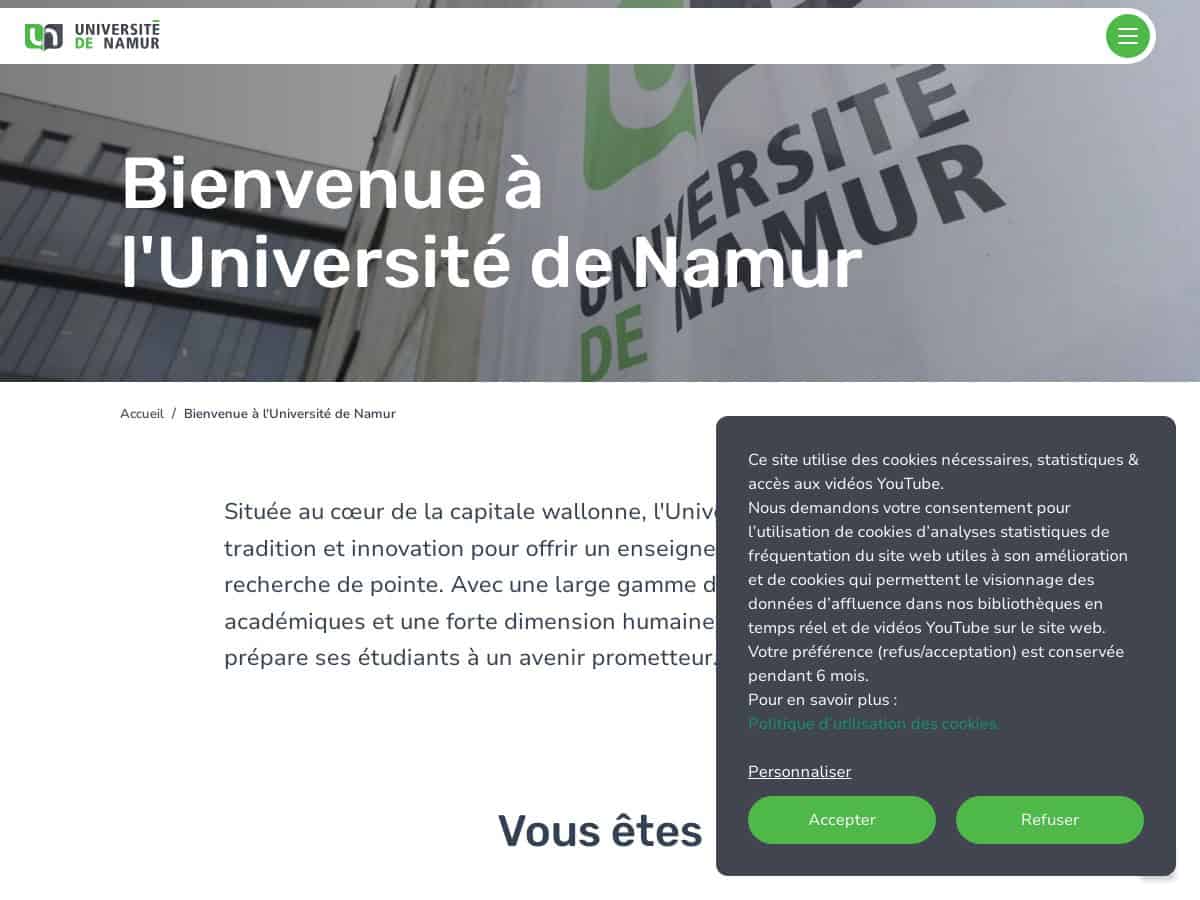
UNamur is a private, Jesuit-founded French-speaking university. It offers programs in various fields including strong science, computer science, and biomedical science departments.
UNamur is a French-speaking university in Namur, the capital of Wallonia, founded in 1831 by Jesuits as the Facultés Notre-Dame de la Paix. It remains a private institution with a Jesuit heritage, and it is also the smallest of the large French-speaking universities, with about 7,000 students and 1,200 staff. About one student in ten comes from abroad. The compact campus sits in the city centre, close to the station and the river Meuse.
Size is part of the appeal. Class groups are small, professors are easy to approach and students often work in the same buildings across several disciplines. Computer science is a flagship, and the Namur Digital Institute covers information technology, cybersecurity and software engineering. The sciences cover physics, chemistry, biology and mathematics, and the biomedical sciences link to the regional hospital network.
Research is concentrated on information technology and cybersecurity, life sciences and health, materials science and sustainable development. Its materials work includes the Namur Institute of Structured Matter. The university belongs to the Federation of European Catholic Universities and to the Jesuit university network, which supports exchange with partner institutions in Europe and the Americas.
Courses are given in French, with some programmes in English. The French Community regulates tuition, which is low for EU students and reduced for students from low-income households, while non-EU students pay higher fees. Applicants to engineering-oriented programmes should check the entrance requirements in mathematics and sciences early.
Namur is a small city with a citadel overlooking the confluence of the Meuse and the Sambre. Rents are among the lowest of Belgian university cities, and Brussels is about an hour away by train. About 30,000 people have graduated from the university since its creation, so the alumni community is close and active in regional business.
Domains taught:
AI and Machine Learning, Bioengineering, Bioinformatics, Chemistry, Data Analytics, Life Sciences, Materials, Mathematics, Microbiology and Genetics, Nanotechnologies, Physics, Software Engineering, Statistics
Diplomas*:
Bachelor, Doctor, Master
Status:
Private
Partnerships:
Federation of European Catholic Universities (FUCE). Regional and some international links, particularly within the Jesuit university network.
Research:
Information technology and cybersecurity, Life sciences and health, Materials science, Sustainable development.
Famous Alumnis:
Jean-Luc Dehaene (attended briefly), Philippe Maystadt
International recognition**:
Number of staff***:
1200
Current students***:
7000
Foreign students***:
10%
Cumulative former students***:
30000
Pros
Small class sizes, strong community feel, good student supervision, pleasant campus environment in the city of Namur.
Cons
Primarily focused on undergraduate and master’s level, less extensive doctoral programs in some tech fields compared to larger universities, fewer English-taught options.
Best For
Personalized education in science, technology, and humanities in a historic setting.
Anyone who wants a second school in the same country with a similar spread of bioinformatics, nanotechnologies and bioengineering can consider Universiteit Hasselt, and it has almost the same size, at about 7,000 students, and is public, whereas this institution is private.
Université de Mons sits close to this institution on nanotechnologies, microbiology and genetics and chemistry; it is public, whereas this institution is private, and runs the same bachelor's, master's and doctoral programmes.
Where this university leans on bioinformatics, nanotechnologies and microbiology and genetics, Universiteit Antwerpen does the same, and it covers computer vision and process control as well, and is far larger, with about 22,000 students against roughly 7,000 here.
Université libre de Bruxelles offers a comparable education in bioinformatics, nanotechnologies and bioengineering: it runs the same bachelor's, master's and doctoral programmes, and covers optics and fluid dynamics as well.
On content, Université catholique de Louvain and this university are close, as both teach bioinformatics, nanotechnologies and microbiology and genetics; it is far larger, with about 37,000 students against roughly 7,000 here, and is also a private institution.
Most Similar Schools Abroad
Princeton University brings a the United States setting to the same core fields, physics, mathematics and life sciences, and it covers project management as well, and is slightly larger, at about 9,100 students against roughly 7,000 here.
Students considering a move abroad can look at Brown University in the United States, where physics, mathematics and life sciences also form the core, and it is slightly larger, at about 10,000 students against roughly 7,000 here, and is also a private institution.
Yokohama City University offers an international parallel to this institution, with bioinformatics, nanotechnologies and microbiology and genetics as common ground; it teaches at the same levels, namely bachelor's, master's and doctoral, and covers optics and computer vision as well.
The closest overseas parallel on microbiology and genetics, chemistry and physics is University of Regensburg, located in Germany; it runs the same bachelor's, master's and doctoral programmes, and is far larger, with about 21,088 students against roughly 7,000 here.
Students considering a move abroad can look at Keio University in Japan, where bioinformatics, nanotechnologies and microbiology and genetics also form the core, and it covers astroscience and optics as well, and is far larger, with about 33,000 students against roughly 7,000 here.
*our own picks (our criteria: a mix between domains, diploma delivered, reputation and size), but obviously too many criteria for an apple-to-apple ranking.
FAQ
Where is UNamur?
The university is in Namur, Wallonia, with its central address at Rue de Bruxelles 61.
When was it founded?
It was founded in 1831 by Jesuits as the Facultés Notre-Dame de la Paix.
How large is UNamur?
About 7,000 students and 1,200 staff, so classes tend to be small.
Is it public or private?
It is a private university of Jesuit heritage, funded in part by the French Community.
What can you study at UNamur?
Computer science, sciences, biomedical sciences, humanities, law, economics and management, among others.
What language are courses taught in?
Mainly French. Some programmes are offered in English.
How much does tuition cost?
Fees are regulated and low for EU students, with reductions for low-income households. Non-EU students pay higher fees.
What is UNamur known for in research?
Information technology and cybersecurity, life sciences, materials science and sustainable development.
Which networks does it belong to?
The Federation of European Catholic Universities and the Jesuit university network.
Is Namur a good student city?
It is small, affordable and well connected, with trains to Brussels in about an hour and a compact historic centre.
Cybersecurity, Information Technology (IT), Innovation, Life Cycle Assessment (LCA), Sustainable Development, User-Centered Design
*: without any judgment of the quality, readers are strongly encouraged to check the official status of the exact diploma envisioned as many universities have a mix of recognized diplomas, not recognized, “co-delivered,” “equivalent to”, “some pathways” (…), can change over time, and can be named differently from one country to another.
**: international reputation: is based on some criteria that do not mean much in some domains or specialties (number of researchers, of scientific publications, on budget ….). Our approximate 1-4 scale:
known locally
known locally and internationally
is listed in some of the world university’s classifications
is listed among the 20 firsts in some of world university’s classifications
***: estimated numbers, based on online sources and/or feedbacks. The numbers can vary greatly depending on school organisation (ex.: school is part of a group, it employs internal staff or external consultants or has public staff without employing them …). Refer to all the links provided to have accurate and updated numbers.
Innovation.world is not affiliated with this school/university. We recommend to contact them directly on their website for any special request.
To complete or correct any information here or share your opinion, please comment below or > send us a direct message <.