The Waterfall Model (software)
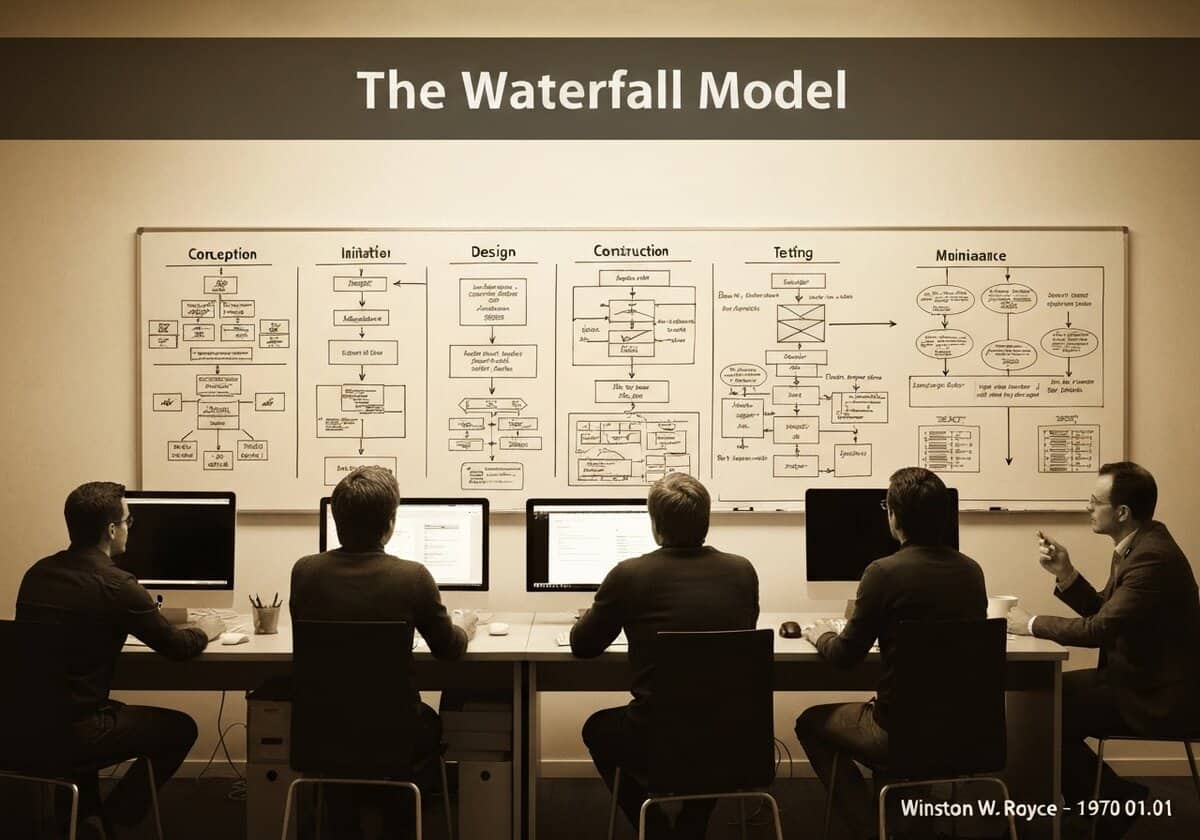
The Waterfall Model is a sequential, non-iterative software development process, where progress flows steadily downwards (like a waterfall) through distinct phases: conception, initiation, analysis, design, construction, testing, deployment and maintenance. Each phase must be fully completed before moving to the next. It is often contrasted with iterative models to highlight their flexibility.
The Waterfall Model represents a traditional, linear approach to project management and software development. Its structure is highly rigid, with a strict sequence of phases. The process begins with a comprehensive requirements gathering and analysis phase, where every detail of the system is documented and approved. Once the requirements are signed off, the system design phase begins, creating the architecture and module specifications. This is followed by implementation (coding), integration and testing, deployment, and finally, a maintenance phase. The defining characteristic is the ‘gate’ between each phase; one phase cannot begin until the previous one is fully complete and its deliverables are approved. This approach was derived from manufacturing and construction industries, where such sequential processes are logical (e.g., you cannot build walls before the foundation is complete). However, in software, this rigidity is often a major drawback. Requirements frequently change, and a flaw discovered during testing may require a costly and difficult return to the design phase. Ironically, Winston W. Royce, who first formally described this model in 1970, presented it as an example of a flawed process, advocating for the addition of iterative feedback loops to improve it.
UNESCO Nomenclature: 1208
– Software
Precursors
- gantt charts
- manufacturing process models
- construction project management methodologies
- systems engineering principles
Applications
- projects with stable, well-understood requirements
- simple, small-scale projects
- systems where safety and security are paramount and design must be locked down early (e.g., some aerospace or medical software)
Potential Innovations Ideas
Due to scrapping bot traffic, currently more than 40k per day, this content is reserved to community members.
> Login < or > Register < (100% free) to access this, so as all other restricted content and tools.
Related to: waterfall model, sequential development, software development lifecycle, SDLC, project management, non-iterative, winston royce, requirements analysis, linear model, software engineering.