Le modèle en cascade (logiciel)
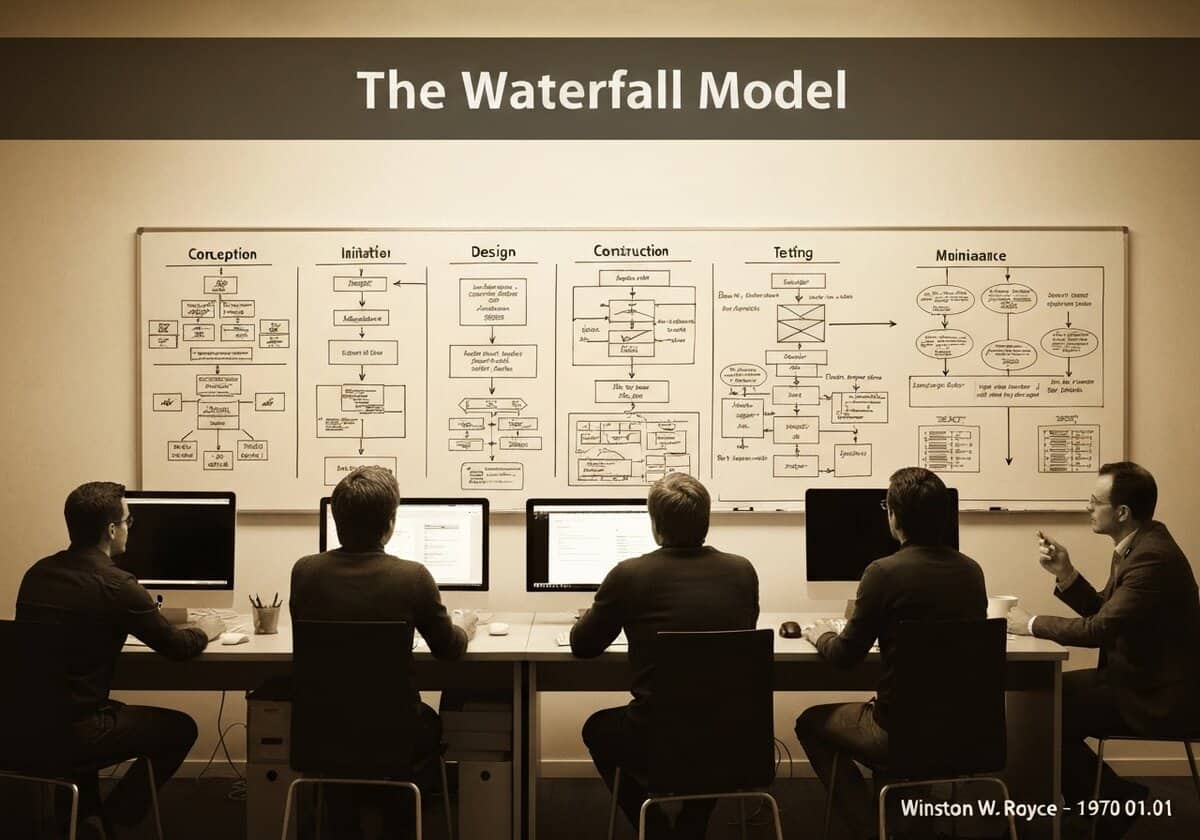
The Waterfall Model is a sequential, non-iterative logiciel development process, where progress flows steadily downwards (like a waterfall) through distinct phases: conception, initiation, analysis, design, construction, testing, deployment and maintenance. Each phase must be fully completed before moving to the next. It is often contrasted with iterative models to highlight their flexibility.
The Waterfall Model represents a traditional, linear approach to project management and software development. Its structure is highly rigid, with a strict sequence of phases. The process begins with a comprehensive requirements gathering and analysis phase, where every detail of the system is documented and approved. Once the requirements are signed off, the system design phase begins, creating the architecture and module specifications. This is followed by implementation (coding), integration and testing, deployment, and finally, a maintenance phase. The defining characteristic is the ‘gate’ between each phase; one phase cannot begin until the previous one is fully complete and its deliverables are approved. This approach was derived from manufacturing and construction industries, where such sequential processes are logical (e.g., you cannot build walls before the foundation is complete). However, in software, this rigidity is often a major drawback. Requirements frequently change, and a flaw discovered during testing may require a costly and difficult return to the design phase. Ironically, Winston W. Royce, who first formally described this model in 1970, presented it as an example of a flawed process, advocating for the addition of iterative feedback loops to improve it.
UNESCO Nomenclature: 1208
- Logiciel
Perturbation
Incrémentale
Précurseurs
- diagrammes de Gantt
- modèles de processus de fabrication
- méthodologies de gestion de projets de construction
- principes d'ingénierie des systèmes
Applications
- projets avec des exigences stables et bien comprises
- projets simples et à petite échelle
- systèmes où la sécurité est primordiale et où la conception doit être verrouillée à un stade précoce (par exemple, certains logiciels aérospatiaux ou médicaux)
Idées d'innovations potentielles
En raison du trafic généré par les robots de scraping, actuellement supérieur à 40 000 par jour, ce contenu est réservé aux membres de la communauté.
> Connexion < ou > Registre < (100% gratuit) pour y accéder, ainsi qu'à tous les autres contenus et outils à accès restreint.
Related to: waterfall model, sequential development, software development lifecycle, SDLC, project management, non-iterative, winston royce, requirements analysis, linear model, software engineering.