Product Design, Manufacturing & Innovation Resources
家 » ウォーターフォールモデル(ソフトウェア)

ウォーターフォールモデル(ソフトウェア)

1970-01-01
  • Winston W. Royce
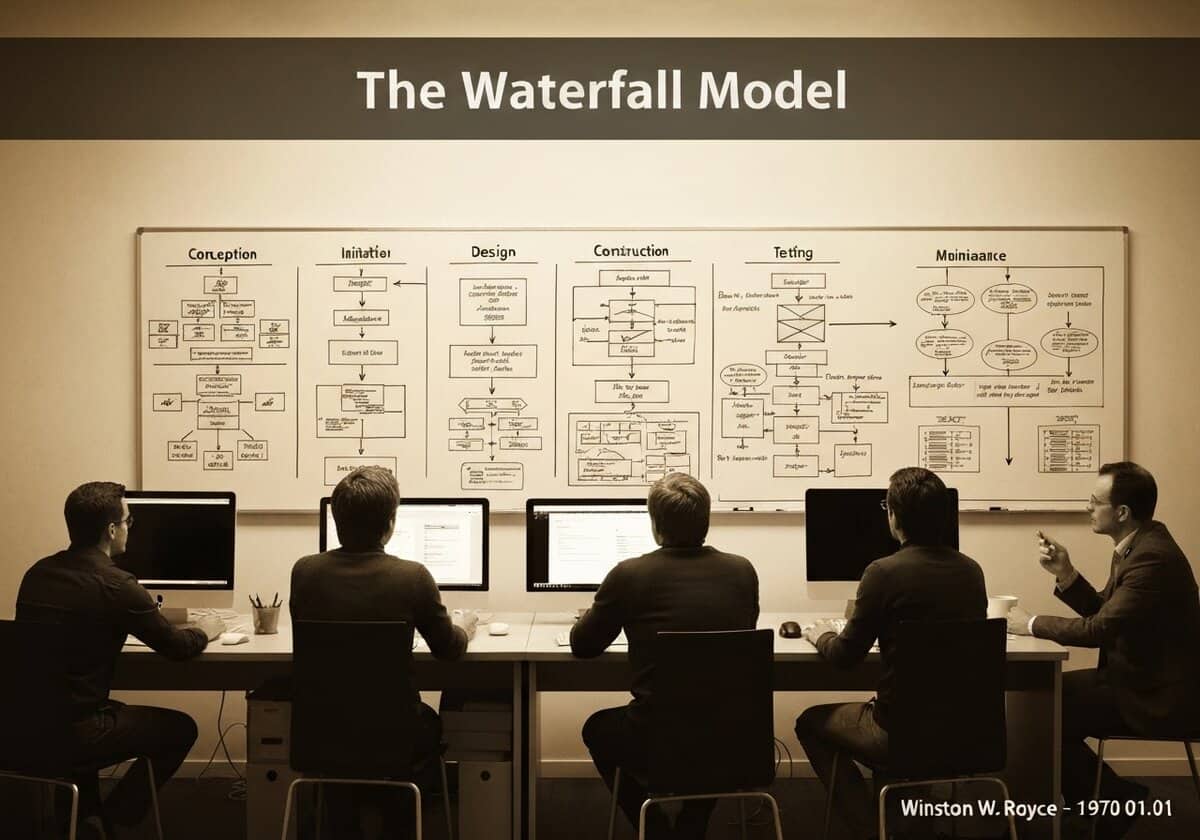
ソフトウェアエンジニアリング部門が、ウォーターフォールモデルのプロセスフェーズを紹介しています。

(画像はイメージです)

ウォーターフォールモデルは、反復的ではないシーケンシャルなソフトウェア開発プロセスであり、開発は構想、開始、分析、設計、構築、テスト、展開、保守という明確なフェーズを経て、滝のように着実に下へと流れていきます。各フェーズは、次のフェーズに進む前に完全に完了する必要があります。ウォーターフォールモデルは、その柔軟性を強調するために、反復型モデルと対比されることがよくあります。テストフェーズで発見された欠陥は追跡され、修正されます。なぜなら、「これはバグではなく機能だ」という言い訳は、要件ベースのレビューでは通用しないからです。「これはバグではなく機能だ」とは、欠陥を意図された動作として再ラベル付けすることに関するジョークです。


The Waterfall Model represents a traditional, linear approach to プロジェクト管理 and software development. Its structure is highly rigid, with a strict sequence of phases. The process begins with a comprehensive requirements gathering and analysis phase, where every detail of the system is documented and approved. Once the requirements are signed off, the system design phase begins, creating the architecture and module specifications. This is followed by implementation (coding), integration and testing, deployment, and finally, a maintenance phase. The defining characteristic is the ‘gate’ between each phase; one phase cannot begin until the previous one is fully complete and its deliverables are approved. This approach was derived from manufacturing and construction industries, where such sequential processes are logical (e.g., you cannot build walls before the foundation is complete). However, in software, this rigidity is often a major drawback. Requirements frequently change, and a flaw discovered during testing may require a costly and difficult return to the design phase. Ironically, Winston W. Royce, who first formally described this model in 1970, presented it as an example of a flawed process, advocating for the addition of iterative feedback loops to improve it.

UNESCO Nomenclature: 1208
– Software

タイプ

抽象システム

混乱

増分

使用法

ニッチ/専門分野

前駆物質

  • gantt charts
  • manufacturing process models
  • construction project management methodologies
  • システムエンジニアリングの原則

アプリケーション

  • projects with stable, well-understood requirements
  • simple, small-scale projects
  • systems where safety and security are paramount and design must be locked down early (e.g., some aerospace or medical software)

特許:

NA

潜在的なイノベーションのアイデア

  • agile methodology as a direct response to waterfall’s rigidity
  • devops practices that merge development and operations, impossible under a strict waterfall model
  • continuous integration/continuous deployment (CI/CD) pipelines
  • lean software development principles
  • feature-driven development (FDD)
  • test-driven development (TDD)
  • scrum フレームワーク
  • extreme programming (XP)
  • かんばん for software development
  • rapid application development (RAD)
Related to: waterfall model, sequential development, software development lifecycle, SDLC, project management, non-iterative, winston royce, requirements analysis, linear model, software engineering.

歴史的背景

ウォーターフォールモデル(ソフトウェア)

1970
1970
1970
1970-01-01
1975-06-01
1980
1980
1970
1970
1970
1970
1973
1980
1980
1980

(日付が不明または関連性がない場合、例えば「流体力学」などでは、その注目すべき出現時期の概算値が提示されます。)

10年目 周年

フルサイズの画像とダウンロードは、登録会員のみが100%無料で利用できます。