Product Design, Manufacturing & Innovation Resources
Lar » Protocolo de Controle de Transmissão (TCP)

Protocolo de Controle de Transmissão (TCP)

1974
  • Vint Cerf
  • Robert E. Kahn
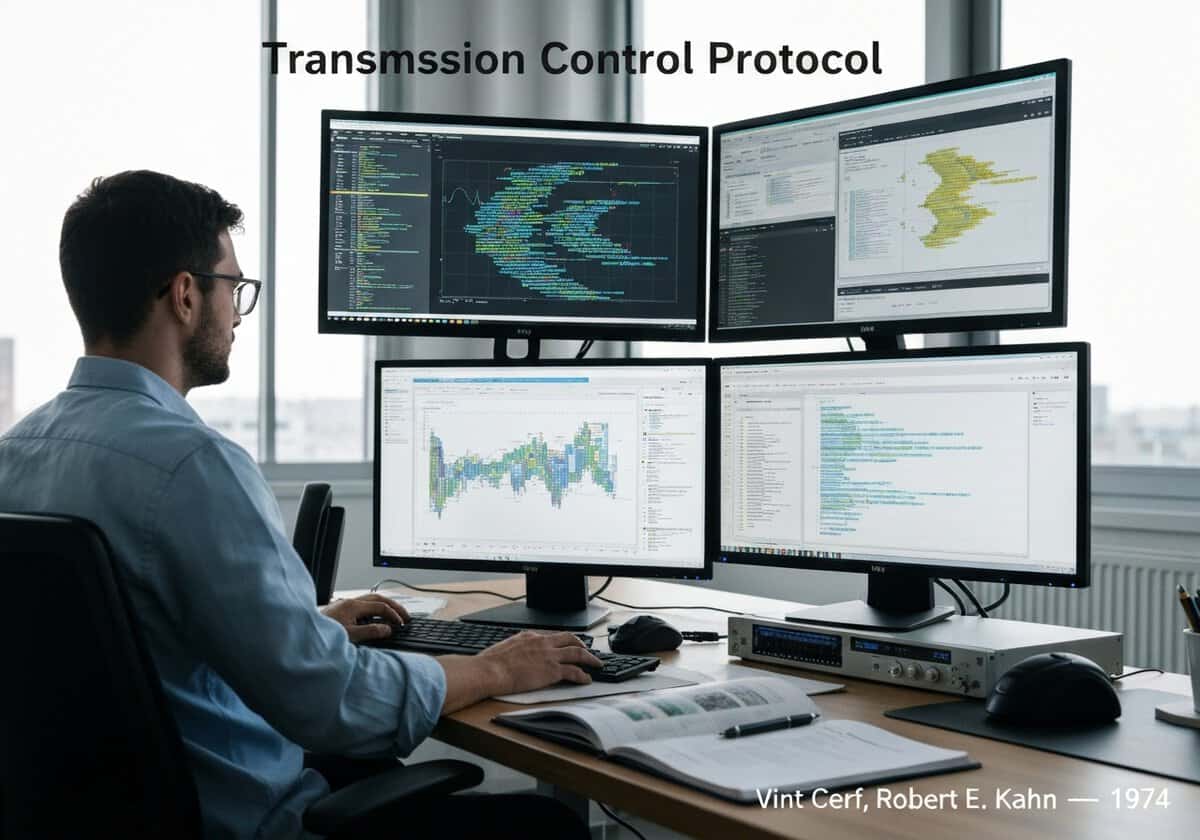
Estação de trabalho de computador analisando o Protocolo de Controle de Transmissão em um ambiente profissional.

(Imagem gerada apenas para fins ilustrativos)

TCP is a core protocol of the Transport Layer, providing reliable, ordered, and error-checked delivery of a stream of bytes between applications running on hosts. It is a connection-oriented protocol, meaning it establishes a connection via a three-way handshake before data transfer begins. This ensures data integrity at the cost of higher overhead compared to UDP. Chat protocols such as IRC run on top of TCP, so the basic irc commands travel as plain text over a TCP connection.

TCP’s reliability is achieved through several mechanisms. It uses sequence numbers to track segments and reorder them if they arrive out of sequence. It requires acknowledgments (ACKs) from the receiver for data segments; if an ACK is not received within a certain time, the segment is retransmitted. A soma de verificação field is used to detect data corruption within segments. Flow control is managed using a sliding window mechanism, where the receiver advertises how much data it can buffer, preventing the sender from overwhelming it. Furthermore, TCP incorporates sophisticated congestion control algorithms (e.g., slow start, congestion avoidance) to prevent the network from being overloaded. The initial connection is established with a three-way handshake (SYN, SYN-ACK, ACK) to ensure both sides are ready to communicate. This robust feature set makes TCP suitable for applications where data integrity is paramount, such as web browsing and file transfers, but its overhead makes it less ideal for real-time applications like streaming or online gaming.

UNESCO Nomenclature: 3307
Ciência da Computação

Tipo

Software/Algoritmo

Interrupção

Fundamentais

Uso

Uso generalizado

Precursores

  • programa de controle de rede da arpanet (ncp)
  • projeto de protocolo de transporte de cíclades
  • pesquisa em transferência confiável de dados por canais não confiáveis

Aplicações

  • World Wide Web (http/https)
  • e-mail (smtp, imap, pop3)
  • protocolo de transferência de arquivos (ftp)
  • shell seguro (ssh)
  • conexões de banco de dados

Patentes:

NA

Ideias de Inovação Potencial

  • multipath tcp (mptcp) for using multiple network interfaces simultaneously
  • tcp bbr (bottleneck bandwidth and round-trip propagation time) congestion control algorithm
  • ai-driven predictive congestion control to anticipate network bottlenecks
  • tcp extensions for ultra-low latency datacenter networks
  • quantum-resistant encryption integrated directly into the tcp handshake
  • tcp for long-delay satellite and interplanetary links
  • lightweight tcp implementations for resource-constrained iot devices
  • tcp over secure scuttlebutt (ssb) for decentralized applications
  • verifiable-delay tcp to prevent network timing attacks
  • tcp state migration for seamless vm and container live migration
Relacionado a: TCP, protocolo de controle de transmissão, camada de transporte, transporte confiável, orientado a conexão, handshake de três vias, controle de fluxo, controle de congestionamento, número de sequência, confirmação.

Contexto histórico

Protocolo de Controle de Transmissão (TCP)

1970
1970
1972
1974
1975-06-01
1980
1980
1970
1970
1970
1974
1974
1978
1980
1980

(Caso a data seja desconhecida ou irrelevante, por exemplo, "mecânica dos fluidos", é fornecida uma estimativa aproximada de seu surgimento notável)

10º ano aniversário

Imagens em tamanho real e downloads estão disponíveis apenas, 100% gratuitos, para membros registrados.