Product Design, Manufacturing & Innovation Resources
Home » Soil Vapor Extraction (SVE)

Soil Vapor Extraction (SVE)

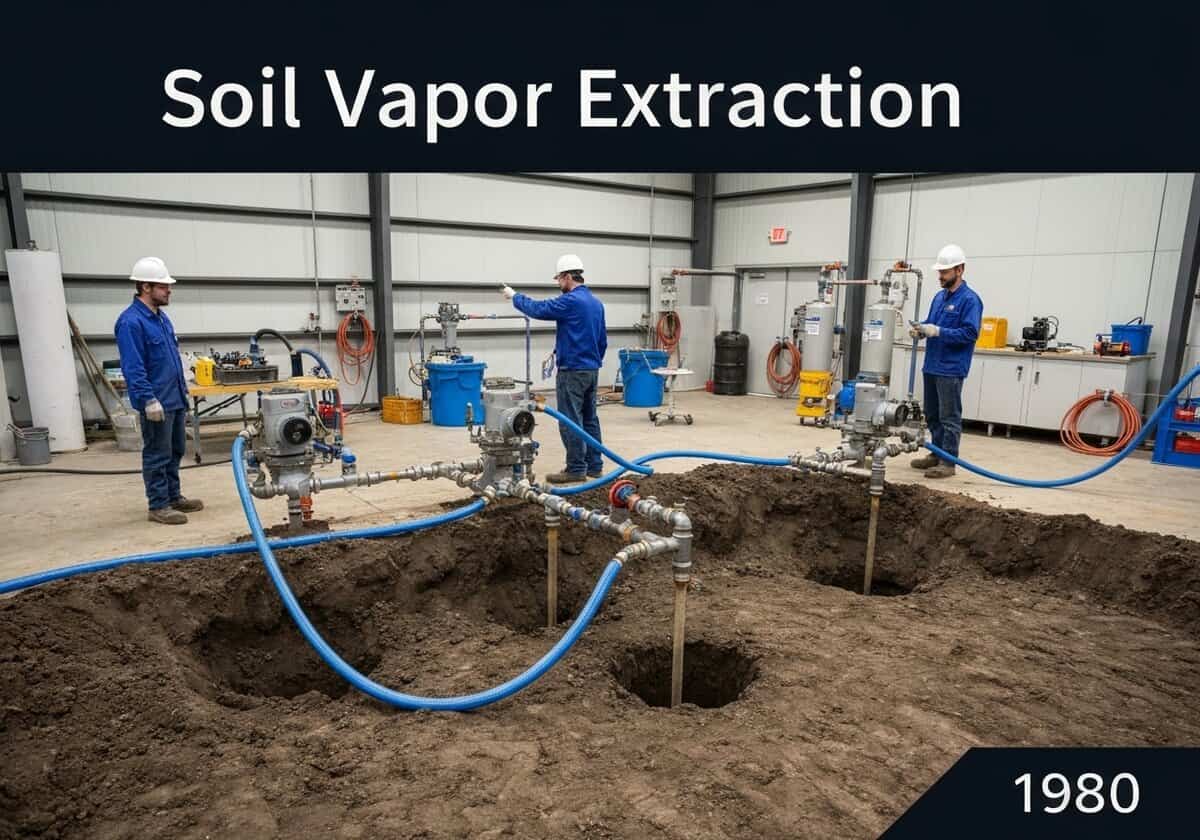
1980
Soil vapor extraction site with extraction wells and monitoring equipment for VOC remediation.

(generated image for illustration only)

Soil Vapor Extraction (SVE) is an in-situ physical remediation technology used for volatile organic compounds (VOCs) and some semi-volatile organic compounds (SVOCs) in unsaturated soil (the vadose zone). The process involves applying a vacuum to the soil through extraction wells, which creates a pressure gradient that induces gas-phase contaminants to move through the soil and be collected for treatment.
Soil Vapor Extraction operates on the principle of volatilization. By applying a vacuum, SVE lowers the pressure in the soil pore space, causing volatile contaminants adsorbed to soil particles or dissolved in soil moisture to partition into the vapor phase. This contaminated vapor is then drawn towards extraction wells. The effectiveness of SVE is highly dependent on the contaminant’s volatility, described by its Henry’s Law constant and vapor pressure, and the soil’s permeability. It works best in sandy or gravelly soils with high air permeability and is less effective in tight, low-permeability clays.

A typical SVE system consists of extraction wells, vacuum blowers, and an off-gas treatment system. The extracted vapor, laden with contaminants, cannot be directly released into the atmosphere. It must be treated, commonly using methods like granular activated carbon (GAC) adsorption, thermal oxidation, or catalytic oxidation to destroy the VOCs. SVE is often combined with other technologies. For instance, air sparging can be used concurrently to treat saturated zones below the water table. In this combined approach, air is injected into the groundwater, stripping volatile contaminants, which then travel up into the vadose zone where the SVE system captures them. This makes SVE a versatile and relatively low-cost solution for specific types of contamination.

UNESCO Nomenclature: 2506
– Environmental sciences

Type

Physical Process

Disruption

Substantial

Usage

Widespread Use

Precursors

  • development of vacuum pump technology
  • understanding of fluid dynamics in porous media (darcy’s law)
  • principles of chemical partitioning and volatility (henry’s law)
  • advances in air pollution control technologies for off-gas treatment

Applications

  • cleanup of gasoline spills from underground storage tanks
  • remediation of sites contaminated with industrial solvents like trichloroethylene (tce)
  • removal of volatile contaminants from landfill sites
  • integration with air sparging for groundwater treatment
  • remediation of dry cleaner sites contaminated with perchloroethylene (pce)

Patents:

NA

Potential Innovations Ideas

Due to scrapping bot traffic, currently more than 40k per day, this content is reserved to community members.
> Login < or > Register < (100% free) to access this, so as all other restricted content and tools.

Related to: soil vapor extraction, sve, vocs, in-situ remediation, vadose zone, soil contamination, vacuum extraction, air sparging, remediation technology, volatile organic compounds.

Historical Context

Soil Vapor Extraction (SVE)

1970
1970
1978
1980
1980
1982
1990
1960
1970
1975
1980
1980
1982
1990
1990

(if date is unknown or not relevant, e.g. "fluid mechanics", a rounded estimation of its notable emergence is provided)

Related Invention, Innovation & Technical Principles

Full size images and downloads are only available, 100% free, for registered members.

> Login <