Product Design, Manufacturing & Innovation Resources
Home » The Signor–Lipps Effect

The Signor–Lipps Effect

1982
  • Philip W. Signor
  • Jere H. Lipps
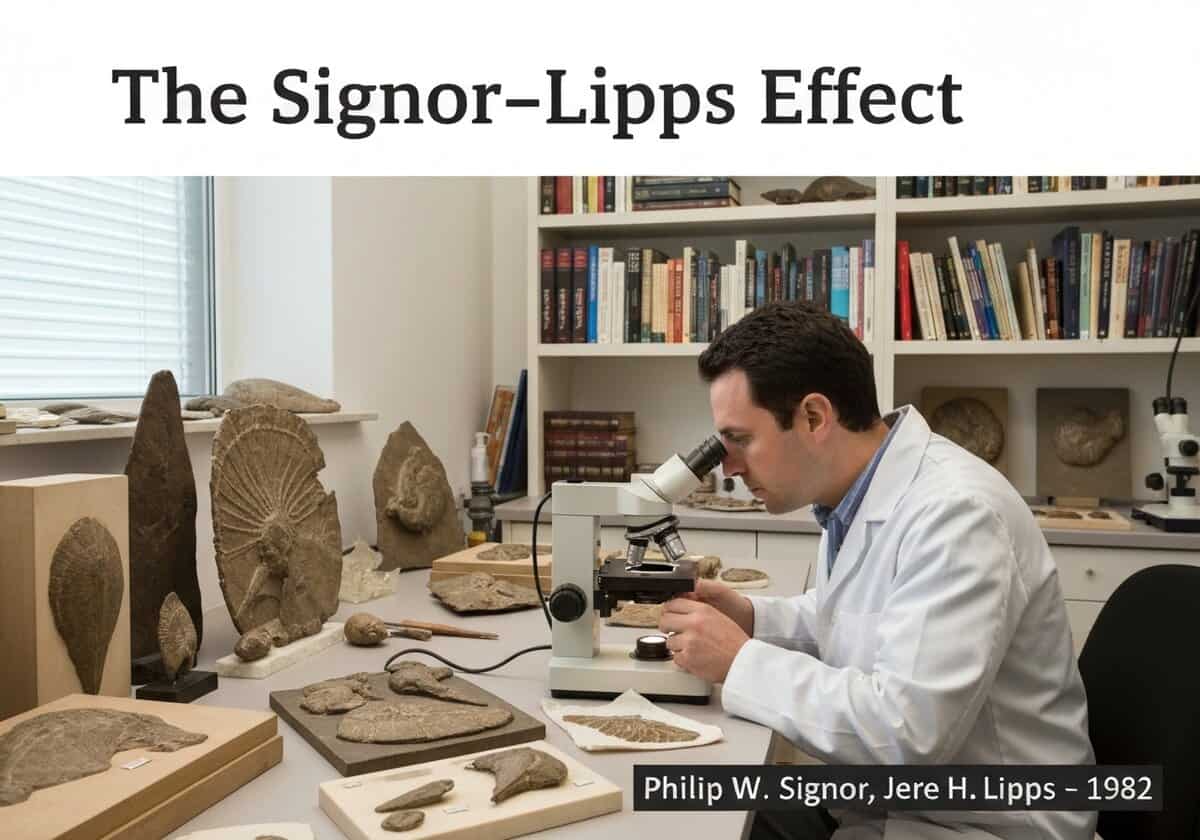
Paleontologist analyzing fossil specimens in a laboratory setting, focusing on extinction events.

(generated image for illustration only)

The Signor–Lipps effect is a paleontological principle stating that, because the fossil record is incomplete, the last known fossil of a species will almost certainly predate the actual extinction of that species. This artifact can make abrupt mass extinctions appear gradual in the fossil record, as the last appearances of different species are smeared backward in time.


Proposed by Philip W. Signor and Jere H. Lipps in 1982, the Signor–Lipps effect addresses a fundamental challenge in interpreting the fossil record: its inherent incompleteness. The chance of any individual organism being fossilized is extremely low, and the chance of paleontologists finding that fossil is even lower. Consequently, the known fossil range of a taxon (its first to last appearance) is almost always shorter than its true temporal range. The effect is particularly significant when analyzing extinction events. For a group of species that went extinct simultaneously in a catastrophic event, their last known fossils will not be found in the same rock layer. Instead, due to random sampling (fossilization and discovery), their last appearances will be scattered through the rock layers leading up to the event.

This creates an illusion of a gradual decline in biodiversity, even if the extinction was geologically instantaneous. For example, before the Alvarez hypothesis gained wide acceptance, many scientists argued that the fossil record showed dinosaurs dwindling in diversity for millions of years before the K-Pg boundary, suggesting a gradual cause. The Signor–Lipps effect provides a powerful counter-argument: this apparent decline could simply be an artifact of an incomplete fossil record approaching a sudden termination point. To counteract this effect, paleontologists now use statistical confidence intervals to estimate the true extinction horizon and prioritize searching for fossils in the layers immediately preceding a suspected mass extinction boundary, a practice known as “ground-truthing” the last appearance data.

UNESCO Nomenclature: 2508
– Geology

Type

Scientific Principle

Disruption

Incremental

Usage

Widespread Use

Precursors

  • principles of stratigraphy and superposition
  • Charles Darwin’s discussion of the “imperfection of the geological record” in ‘on the origin of species’
  • development of biostratigraphy for dating rock layers
  • statistical sampling theory
  • taphonomy, the study of how organisms decay and become fossilized

Applications

  • used by paleontologists to critically evaluate the tempo of extinction events
  • informs statistical methods for estimating true extinction dates from incomplete fossil data
  • highlights the importance of high-resolution sampling (e.g., centimeter-scale) across extinction boundaries
  • applied in conservation biology to understand the “extinction debt” of currently living species

Patents:

NA

Potential Innovations Ideas

Due to scrapping bot traffic, currently more than 40k per day, this content is reserved to community members.
> Login < or > Register < (100% free) to access this, so as all other restricted content and tools.

Related to: Signor-Lipps effect, fossil record, paleontology, taphonomy, extinction, sampling bias, k-pg boundary, gradualism, catastrophism, fossil range.

Historical Context

The Signor–Lipps Effect

1978
1980
1980
1982
1990
1990
1990
1975
1980
1980
1982
1990
1990
1990
1990

(if date is unknown or not relevant, e.g. "fluid mechanics", a rounded estimation of its notable emergence is provided)

Related Invention, Innovation & Technical Principles

Full size images and downloads are only available, 100% free, for registered members.

> Login <