Product Design, Manufacturing & Innovation Resources
Home » Pythagorean Triples

Pythagorean Triples

-300
  • Euclid of Alexandria
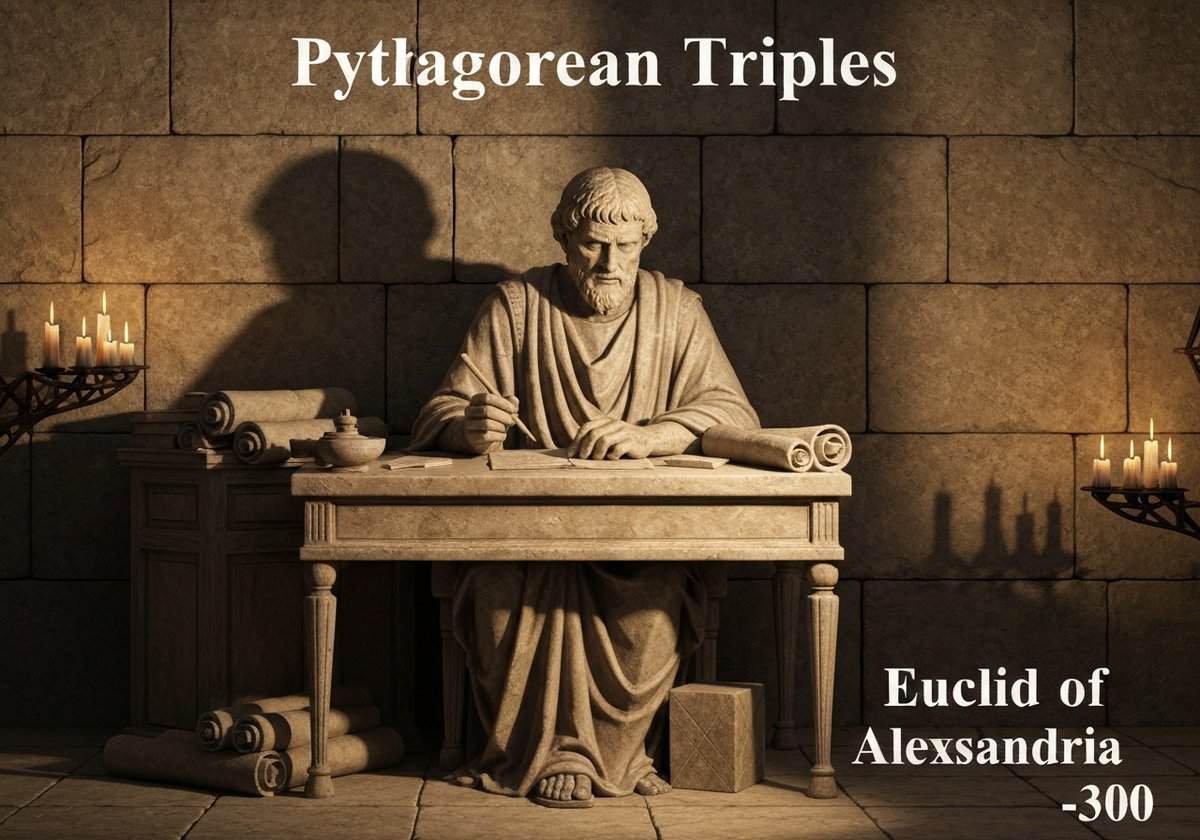
Euclid of Alexandria deriving Pythagorean triples in an ancient study.

(generated image for illustration only)

A Pythagorean triple consists of three positive integers a, b, and c, such that \(a^2 + b^2 = c^2\). A well-known example is (3, 4, 5). Euclid’s formula is a fundamental method for generating these triples. Given any two positive integers m and n with \(m > n\), the formula \(a = m^2 – n^2\), \(b = 2mn\), \(c = m^2 + n^2\) generates a Pythagorean triple.

A Pythagorean triple is a set of three positive integers \((a, b, c)\) that perfectly satisfy the Pythagorean equation \(a^2 + b^2 = c^2\). These triples represent right-angled triangles with sides of integer length. The simplest and most famous triple is (3, 4, 5), as \(3^2 + 4^2 = 9 + 16 = 25 = 5^2\). A triple is considered ‘primitive’ if a, b, and c share no common divisor other than 1. For example, (3, 4, 5) is primitive, but (6, 8, 10), which is just a multiple of (3, 4, 5), is not.

The study of these triples bridges the gap between geometry and number theory. The challenge is not just to find individual triples, but to find a systematic way to generate all of them. This problem was solved by Euclid of Alexandria. In his “Elements” (Book X, Proposition 29), he presented a formula that can generate all primitive Pythagorean triples. The formula requires two positive integers, m and n, which are coprime (share no common factors) and are not both odd, with \(m > n\). The triple is then given by: \(a = m^2 – n^2\), \(b = 2mn\), \(c = m^2 + n^2\). For example, if we choose \(m=2\) and \(n=1\), we generate the triple \(a = 2^2 – 1^2 = 3\), \(b = 2(2)(1) = 4\), and \(c = 2^2 + 1^2 = 5\), which is the classic (3, 4, 5) triple. If we choose \(m=3\) and \(n=2\), we get the primitive triple (5, 12, 13).

This formula is incredibly powerful because it transforms the problem of solving a quadratic Diophantine equation (an equation with integer solutions) into a simple substitution process. It demonstrates a deep structure within the integers and their relationship to geometry. The existence of such a parameterization has had far-reaching implications, influencing work on other Diophantine equations, including the famous Fermat’s Last Theorem, which explores the impossibility of finding integer solutions for \(a^n + b^n = c^n\) for any integer value of n greater than 2.

UNESCO Nomenclature: 1202
– Algebra

Type

Abstract System

Disruption

Substantial

Usage

Widespread Use

Precursors

  • knowledge of the Pythagorean theorem
  • Babylonian records of Pythagorean triples (e.g., Plimpton 322)
  • development of algebraic manipulation and variable representation
  • interest in integer solutions to equations (Diophantine analysis)

Applications

  • cryptography (based on number theory)
  • computer science algorithms for problem-solving
  • educational tools for teaching number theory and geometry
  • architectural design for creating aesthetically pleasing right-angled structures

Patents:

NA

Potential Innovations Ideas

  • a new cryptographic algorithm that uses the properties of large pythagorean triples generated from private integer keys (m and n) for data encryption
  • a procedural generation algorithm for video game level design that uses pythagorean triples to create complex, grid-based layouts with integer coordinates and right-angled corridors
  • a method for designing efficient circuit board layouts by routing conductive paths along the legs of pythagorean triangles to minimize path length and interference
  • a musical composition technique where harmonic frequencies are based on the ratios of pythagorean triples, creating novel consonant intervals
  • an educational app that visualizes euclid’s formula, allowing students to interactively generate and explore the geometric properties of pythagorean triples
  • a data compression algorithm that encodes certain types of geometric data by identifying pythagorean triples and storing only the generating integers m and n
  • a structural engineering software for designing geodesic domes where some struts are sized according to pythagorean triples to ensure right-angled connections at key vertices
  • a quantum computing algorithm that leverages the number-theoretic properties of euclid’s formula to solve specific optimization problems
  • a method for creating artistic patterns and tilings for textiles or architecture based on the geometric shapes derived from a sequence of pythagorean triples
  • a financial modeling tool that uses integer-based pythagorean relationships to define risk parameters in a simplified, computationally efficient manner
Related to: Pythagorean triple, number theory, Diophantine equation, Euclid’s formula, integers, algebra, geometry, (3, 4, 5), primitive triples, mathematics.
Historical Context

Pythagorean Triples

-300
-300
-350
-500
150
1640
1650
-300
-300
-300
-400
-550
1635
1650
1736

(if date is unknown or not relevant, e.g. "fluid mechanics", a rounded estimation of its notable emergence is provided)

10th year anniversary

Full size images and downloads are only available, 100% free, for registered members.

> Login <