A Pythagorean triple consists of three positive integers a, b, and c, such that [latex]a^2 + b^2 = c^2[/latex]. A well-known example is (3, 4, 5). Euclid’s formula is a fundamental method for generating these triples. Given any two positive integers m and n with [latex]m > n[/latex], the formula [latex]a = m^2 – n^2[/latex], [latex]b = 2mn[/latex], [latex]c = m^2 + n^2[/latex] generates a Pythagorean triple.
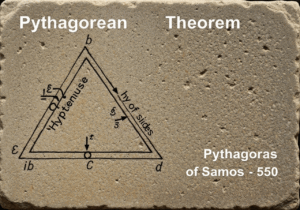
一个 Pythagorean triple is a set of three positive integers [latex](a, b, c)[/latex] that perfectly satisfy the Pythagorean equation [latex]a^2 + b^2 = c^2[/latex]. These triples represent right-angled triangles with sides of integer length. The simplest and most famous triple is (3, 4, 5), as [latex]3^2 + 4^2 = 9 + 16 = 25 = 5^2[/latex]. A triple is considered ‘primitive’ if a, b, and c share no common divisor other than 1. For example, (3, 4, 5) is primitive, but (6, 8, 10), which is just a multiple of (3, 4, 5), is not.
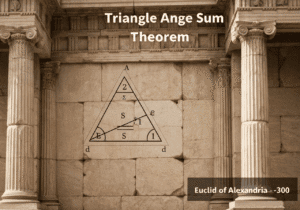
对这些三元组的研究弥合了几何学和数论之间的鸿沟。挑战不仅在于找到单个三元组,还在于找到一种系统地生成所有三元组的方法。这个问题由……解决。 欧几里得 亚历山大的毕达哥拉斯。在他的《几何原本》(第十卷,命题29)中,他提出了一个可以生成所有本原毕达哥拉斯三元组的公式。该公式需要两个互质(没有公因数)且不均为奇数的正整数m和n,其中m>n。三元组由下式给出:a = m² + n²,b = 2mn,c = m² + n²。例如,如果我们选择m=2和n=1,则生成三元组a = 2² + n²。 1² = 3,b = 2(2)(1) = 4,c = 2² + 1² = 5,这就是经典的 (3, 4, 5) 三元组。如果我们选择 m = 3 和 n = 2,我们就得到本原三元组 (5, 12, 13)。
这个公式非常强大,因为它将求解二次丢番图方程(具有整数解的方程)的问题转化为一个简单的代换过程。它揭示了整数及其与几何关系中蕴含的深层结构。这种参数化方法的存在产生了深远的影响,影响了其他丢番图方程的研究,包括著名的费马大定理。费马大定理探讨了对于任何大于 2 的整数 n,方程 a^n + b^n = c^n 都不存在整数解的结论。