Product Design, Manufacturing & Innovation Resources
Home » Euclid’s Postulates

Euclid’s Postulates

-300
  • Euclid of Alexandria
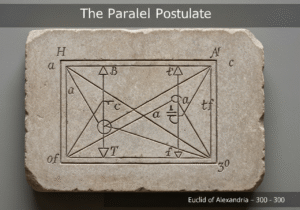
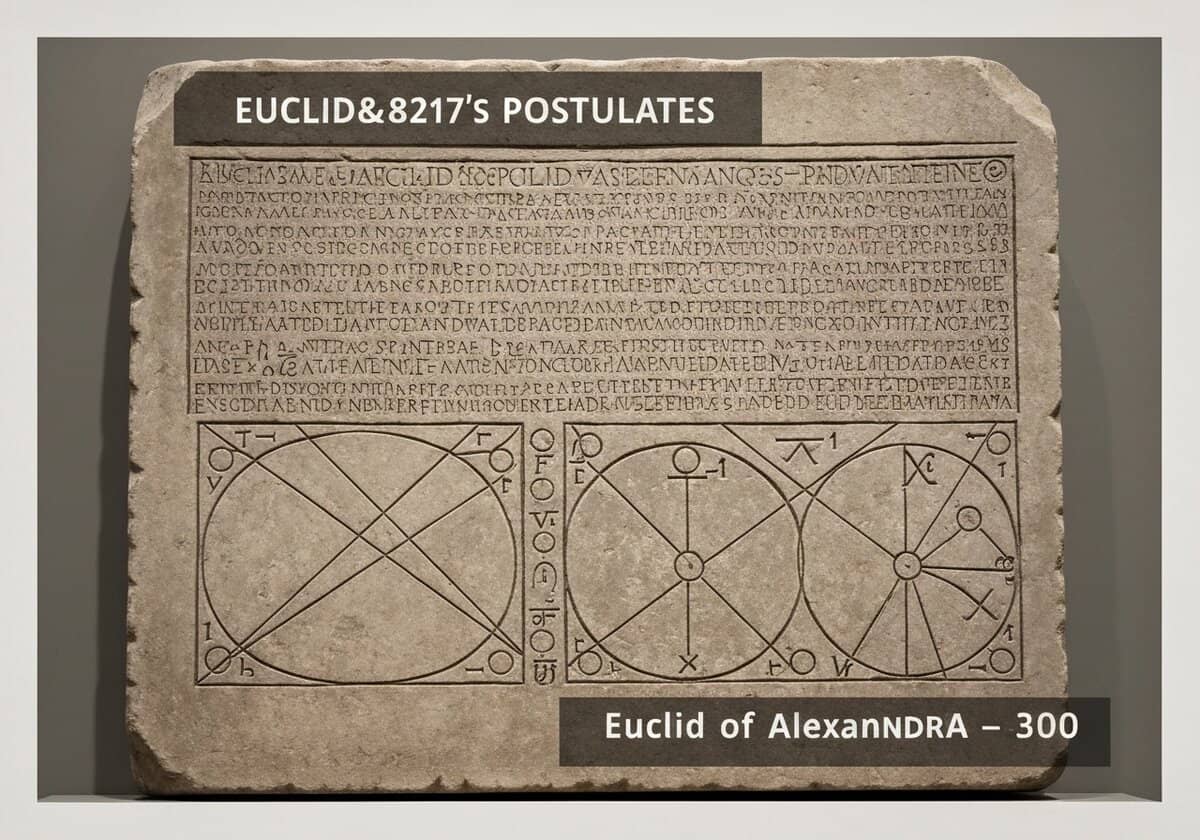
Stone tablet inscribed with Euclid's Postulates, foundational to geometry.

(generated image for illustration only)

Euclid’s five postulates form the axiomatic basis for Euclidean geometry as described in his treatise, ‘Elements’. They are fundamental assumptions from which all other theorems are logically derived. The first four concern the construction of lines and circles, while the fifth, the parallel postulate, uniquely defines the flat, non-curved nature of Euclidean space. These axioms established the deductive method in mathematics.

The five postulates are the bedrock of the system Euclid developed. They are not proven, but assumed to be true, providing a starting point for logical deduction. The first three are constructive: 1. A straight line segment can be drawn joining any two points. 2. Any straight line segment can be extended indefinitely in a straight line. 3. Given any straight line segment, a circle can be drawn having the segment as radius and one endpoint as center. The fourth postulate ensures uniformity: 4. All right angles are congruent.

The fifth postulate is the most complex and famous, setting Euclidean geometry apart. For centuries, mathematicians attempted to prove it as a theorem derived from the first four, believing it was less self-evident. These efforts were unsuccessful but profoundly important, as they eventually led to the discovery of non-Euclidean geometries in the 19th century by mathematicians like Lobachevsky, Bolyai, and Riemann, who explored systems where the fifth postulate was replaced by an alternative. This demonstrated that Euclid’s system was not the only possible logical geometry, revolutionizing mathematics and our understanding of space itself. The axiomatic method pioneered by Euclid remains the standard for modern mathematics, providing a rigorous framework for building complex theories from a small set of foundational principles.

UNESCO Nomenclature: 1204
– Geometry

Type

Abstract System

Disruption

Revolutionary

Usage

Widespread Use

Precursors

  • Geometric knowledge from Babylonian and Egyptian mathematics
  • Work of earlier Greek mathematicians like Thales of Miletus and Pythagoras
  • Plato’s philosophical emphasis on ideal forms and logical deduction
  • Aristotle’s development of formal logic

Applications

  • foundations of classical mechanics
  • architectural design and civil engineering
  • computer graphics and CAD software
  • optical lens design
  • cartography and navigation

Patents:

NA

Potential Innovations Ideas

  • an AI tutor that generates geometric proofs from first principles
  • a software library for verifying the logical consistency of complex engineering specifications
  • a procedural generation algorithm for creating game worlds based on strict geometric rules
  • a new educational curriculum that introduces logic and deductive reasoning through interactive geometric constructions
  • a framework for creating self-consistent legal systems based on a core set of axioms
  • a tool for designing molecular structures with predictable geometric properties
  • a method for optimizing network topologies by applying geometric axioms
  • a programming language where syntax is derived from a minimal set of logical postulates
Related to: axiomatic system, Euclid’s Elements, postulates, geometry, deductive reasoning, classical geometry, foundations of mathematics, Greek mathematics.

Historical Context

Euclid’s Postulates

-300
-300
-300
-400
-550
1635
1650
1736
-300
-300
-350
-500
150
1640
1650

(if date is unknown or not relevant, e.g. "fluid mechanics", a rounded estimation of its notable emergence is provided)

10th year anniversary

Full size images and downloads are only available, 100% free, for registered members.

> Login <