Product Design, Manufacturing & Innovation Resources
Home » Plastic Ultrasonic Welding

Plastic Ultrasonic Welding

1965-12-21
  • Robert Soloff
  • Seymour Linsley
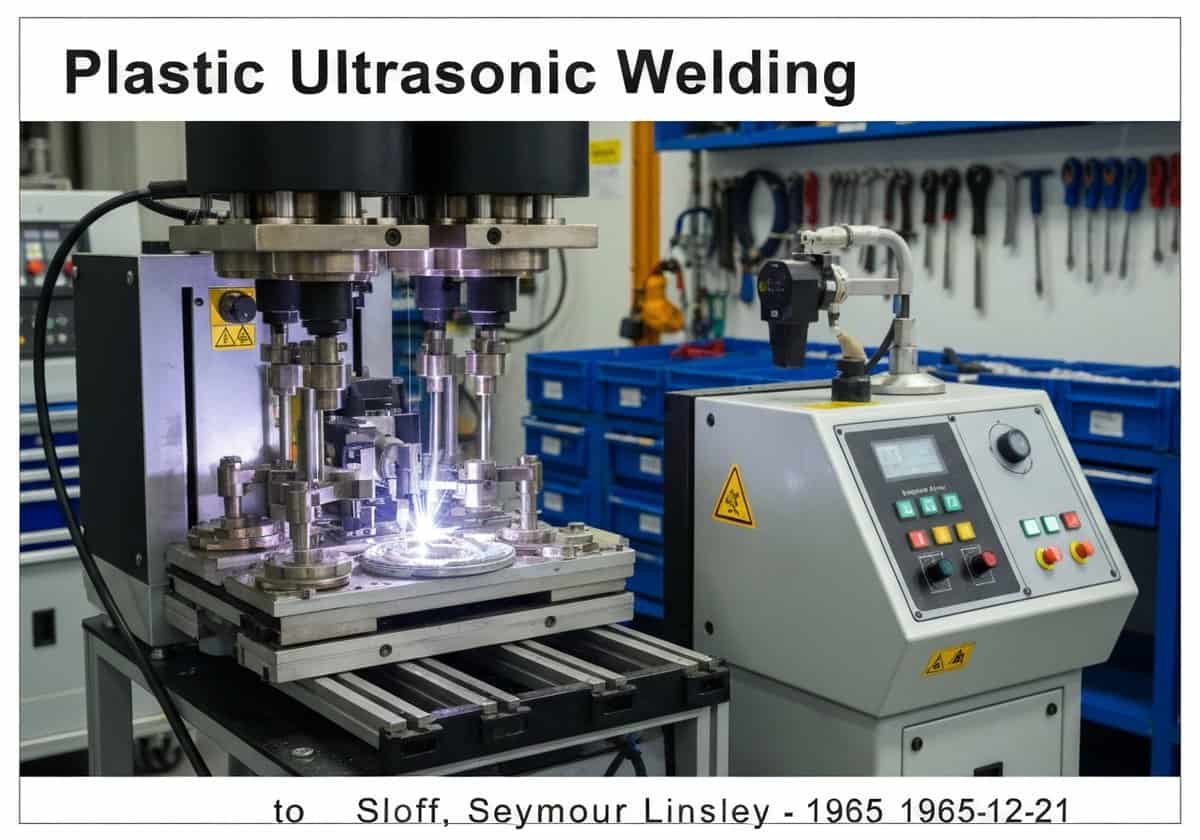
Ultrasonic welding machine joining plastic components in a factory setting, Polymer Technology.

(generated image for illustration only)

Ultrasonic welding joins plastics using high-frequency acoustic vibrations, typically between 15 kHz and 70 kHz. The vibrations are applied to parts clamped under pressure, generating intense frictional heat at their interface. This localized heat rapidly melts the thermoplastic. Once the vibration ceases, the molten material solidifies under pressure, creating a strong, solid-state weld without the need for adhesives or fasteners.


The core of an ultrasonic welding system consists of a power supply (generator), a transducer (converter) that changes high-frequency electrical energy into mechanical vibrations, a booster to amplify these vibrations, and a sonotrode (or horn) that transmits the energy to the workpiece. The process is extremely fast, with weld times often under one second. A critical aspect of successful ultrasonic welding is the joint design. Parts are often molded with ‘energy directors’—small, sharp triangular ridges on one of the surfaces. These features concentrate the ultrasonic energy, initiating a rapid melt and ensuring a uniform bond. The technique is best suited for amorphous polymers like ABS, polystyrene, and polycarbonate, as their random molecular structure allows for efficient transmission of vibrational energy. Semi-crystalline polymers like polyethylene and polypropylene can also be welded, but they require higher energy levels due to their ordered structure, which dampens the vibrations. The process is clean, energy-efficient, and highly repeatable, making it ideal for automated, high-volume manufacturing.

UNESCO Nomenclature: 3322
– Polymer Technology

Type

Physical Process

Disruption

Revolutionary

Usage

Widespread Use

Precursors

  • discovery of piezoelectricity by Jacques and Pierre Curie
  • development of high-power ultrasonic transducers for sonar
  • understanding of friction and heat generation
  • advances in high-frequency electronics for power generation

Applications

  • automotive components (instrument panels, door panels)
  • medical devices (filters, catheters, masks)
  • electronic devices (phone casings, connectors)
  • consumer goods (toys, packaging)
  • textile and fabric joining (non-wovens)

Patents:

  • US3224916A

Potential Innovations Ideas

Due to scrapping bot traffic, currently more than 40k per day, this content is reserved to community members.
> Login < or > Register < (100% free) to access this, so as all other restricted content and tools.

Related to: ultrasonic welding, acoustic vibration, friction welding, thermoplastic, sonotrode, energy director, polymer joining, high-frequency welding, solid-state welding, plastics assembly.

Historical Context

Plastic Ultrasonic Welding

1960
1960
1963
1965-12-21
1970
1970
1970
1960
1960
1962
1964
1970
1970
1970
1970

(if date is unknown or not relevant, e.g. "fluid mechanics", a rounded estimation of its notable emergence is provided)

Related Invention, Innovation & Technical Principles

Full size images and downloads are only available, 100% free, for registered members.

> Login <