Product Design, Manufacturing & Innovation Resources
Home » The Nernst Equation

The Nernst Equation

1889
  • Walther Nernst
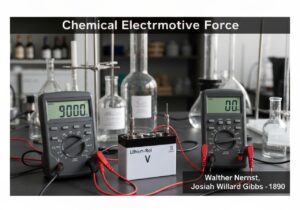
Electrochemical cell with Nernst equation applications in electrochemistry.

(generated image for illustration only)

The Nernst equation relates the reduction potential of a half-cell (or the total voltage of an electrochemical cell) to the standard electrode potential, temperature, and the activities (often approximated by concentrations) of the chemical species undergoing redox. The equation is \(E = E^{\circ} – \frac{RT}{nF} \ln Q\), where Q is the reaction quotient.


The Nernst equation is a cornerstone of electrochemistry, providing a quantitative link between thermodynamics and cell potential. In the formula \(E = E^{\circ} – \frac{RT}{nF} \ln Q\), \(E\) is the cell potential under specific conditions, and \(E^{\circ}\) is the standard cell potential, measured when all species are at unit activity. \(R\) is the universal gas constant, \(T\) is the absolute temperature, \(n\) is the number of moles of electrons transferred, and \(F\) is the Faraday constant.

The term \(Q\), the reaction quotient, uses non-equilibrium concentrations. For a generic reaction \(aA + bB \rightleftharpoons cC + dD\), \(Q = \frac{\{C\}^c \{D\}^d}{\{A\}^a \{B\}^b}\), where {X} denotes activity. This equation shows that cell potential decreases as the reaction proceeds towards equilibrium (Q increases). At equilibrium, \(Q = K\) (the equilibrium constant) and \(E = 0\), meaning the battery is ‘dead’. The equation is crucial for understanding how concentration changes affect battery voltage and the potential across biological membranes, such as in neurons, where ion concentration gradients create membrane potentials essential for nerve signaling.

UNESCO Nomenclature: 2202
– Electrochemistry

Type

Formula

Disruption

Foundational

Usage

Widespread Use

Precursors

  • laws of thermodynamics, particularly gibbs free energy
  • concept of chemical equilibrium and the reaction quotient
  • faraday’s laws of electrolysis
  • development of the electrochemical cell

Applications

  • calculating battery voltage under non-standard conditions
  • ph meters and ion-selective electrodes
  • understanding nerve impulses (membrane potentials)
  • corrosion studies
  • potentiometric titrations

Patents:

NA

Potential Innovations Ideas

  • real-time cellular health sensors monitoring mitochondrial membrane potential
  • smart batteries that adjust output based on environmental temperature and load
  • advanced corrosion prediction software for bridges and pipelines
  • ion-selective sensors for precision agriculture to monitor soil nutrient levels
  • dynamic computational models for predicting nerve cell firing patterns in neurological research
  • lab-on-a-chip devices for rapid potentiometric analysis of blood samples
  • energy-efficient desalination systems based on manipulating electrochemical potentials
  • geochemical models for predicting the formation of ore deposits
Related to: nernst equation, electrochemistry, cell potential, standard potential, reaction quotient, non-standard conditions, thermodynamics, equilibrium.

Historical Context

The Nernst Equation

1884
1885
1887
1889
1890
1890
1895
1883
1884
1887
1888
1889
1890
1890
1895

(if date is unknown or not relevant, e.g. "fluid mechanics", a rounded estimation of its notable emergence is provided)

10th year anniversary

Full size images and downloads are only available, 100% free, for registered members.

> Login <