Product Design, Manufacturing & Innovation Resources
Home » AC Induction Motors

AC Induction Motors

1888
  • Nikola Tesla
  • Galileo Ferraris
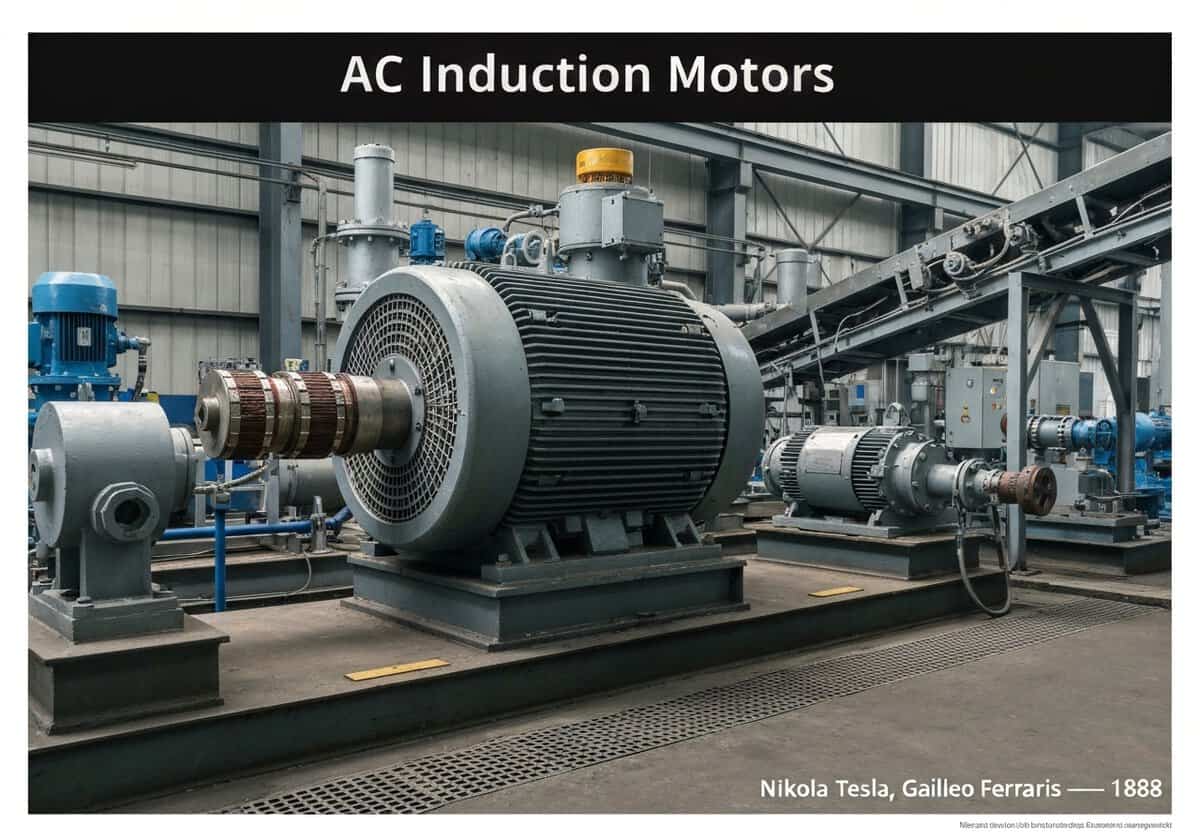
AC induction motor in industrial application with visible stator and rotor components.

(generated image for illustration only)

The AC induction motor operates on the principle of a rotating magnetic field generated by the stator. This field is created by supplying polyphase AC currents to spatially distributed stator windings. The rotating field induces currents in the rotor conductors (e.g., a squirrel cage), which create an opposing magnetic field. The interaction between these fields produces the rotational torque.
The genius of the AC induction motor lies in its ability to create motion without any electrical connections to the rotor, making it simple, rugged, and reliable. The key concept is the rotating magnetic field. In a typical three-phase motor, the stator has three sets of windings, physically offset by 120 degrees. When these are energized by a three-phase AC supply (where each phase’s voltage is also offset by 120 degrees in time), the resultant magnetic field has a constant magnitude but rotates at a fixed speed, known as the synchronous speed (\(N_s = 120f / P\), where f is the supply frequency and P is the number of poles).

This rotating stator field sweeps past the conductive bars of the rotor. By Faraday’s law of induction, this relative motion induces a voltage, and consequently a large current, in the short-circuited rotor bars. This induced current creates its own magnetic field in the rotor. According to Lenz’s law, the rotor field will oppose the change that caused it, meaning it will be dragged along by the stator field. For torque to be produced, the rotor must turn slightly slower than the synchronous speed; this speed difference is called ‘slip’. Slip is what allows the stator field to continue ‘cutting’ the rotor conductors and inducing current.

UNESCO Nomenclature: 2205
– Electrical engineering

Type

Physical Device

Disruption

Revolutionary

Usage

Widespread Use

Precursors

  • Michael Faraday’s law of electromagnetic induction
  • Development of polyphase alternating current (AC) power systems
  • James Clerk Maxwell’s equations unifying electricity and magnetism

Applications

  • industrial drives (pumps, fans, conveyors)
  • household appliances (refrigerators, washing machines)
  • electric vehicles (e.g., tesla model s)
  • high-speed trains
  • water and wastewater treatment plants

Patents:

  • US381968A

Potential Innovations Ideas

Due to scrapping bot traffic, currently more than 40k per day, this content is reserved to community members.
> Login < or > Register < (100% free) to access this, so as all other restricted content and tools.

Related to: AC motor, induction motor, rotating magnetic field, Nikola Tesla, squirrel cage rotor, stator, slip, three-phase power, synchronous speed, electromagnetism.

Historical Context

AC Induction Motors

1883
1884
1887
1888
1889
1890
1890
1882-01-01
1884
1885
1887
1889
1890
1890
1895

(if date is unknown or not relevant, e.g. "fluid mechanics", a rounded estimation of its notable emergence is provided)

Full size images and downloads are only available, 100% free, for registered members.

> Login <