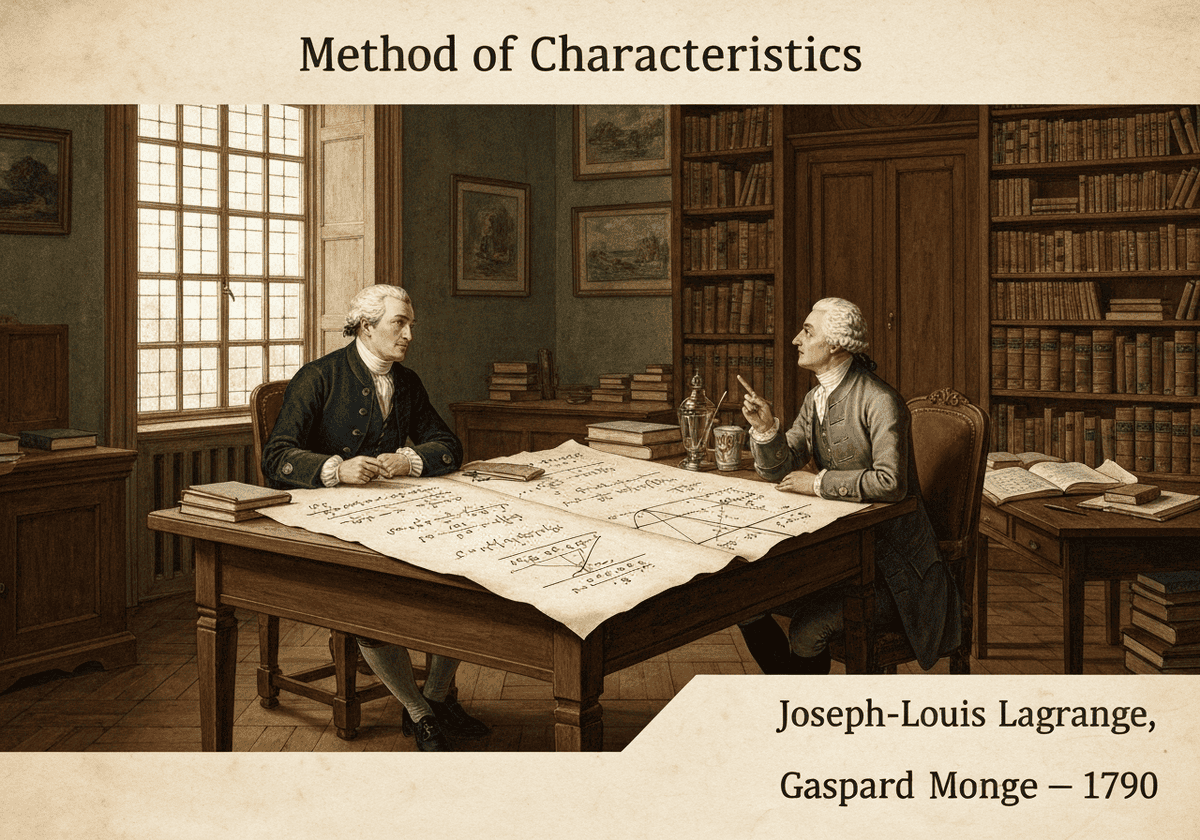
Method of Characteristics (math)
1790
- Joseph-Louis Lagrange
- Gaspard Monge
A technique for solving first-order and hyperbolic second-order partial differential equations (PDE). The method reduces a PDE to a family of ordinary differential equations (ODEs) along specific curves called ‘characteristics’. Along these curves, the PDE simplifies, allowing the solution to be found by integrating the system of ODEs. It is particularly powerful for problems involving transport and wave propagation.
The core idea of the method of characteristics is to find curves in the domain of the PDE along which the solution’s behavior is simpler. For a first-order quasilinear PDE of the form \(a(x,y,u)u_x + b(x,y,u)u_y = c(x,y,u)\), the method involves solving a system of ODEs called the characteristic equations: \(frac{dx}{dt} = a\), \(frac{dy}{dt} = b\), and \(frac{du}{dt} = c\). By solving this system, one can trace back the value of the solution \(u\) from a point \((x,y)\) to the initial data curve.
For hyperbolic equations, there are multiple families of characteristic curves. For the one-dimensional wave equation \(u_{tt} – c^2 u_{xx} = 0\), the characteristics are the straight lines \(x pm ct = text{constant}\). Information, or the values of the solution, propagates along these lines. This is the mathematical basis for d’Alembert’s solution, which shows the solution as a sum of right- and left-traveling waves.
A significant feature of the method when applied to nonlinear equations is its ability to predict and handle the formation of shock waves or discontinuities. If the characteristic curves, which carry constant values of the solution, intersect, it implies that the solution is trying to take on multiple values at the same point. This signals the breakdown of a smooth solution and the formation of a shock, a phenomenon common in gas dynamics and traffic flow.
UNESCO Nomenclature: 1102
– Analysis
Precursors
- theory of ordinary differential equations (odes)
- geometric interpretation of derivatives
- formulation of first-order pdes by d’alembert and euler
- parametric representation of curves
Applications
- fluid dynamics for solving the euler equations and modeling shock waves
- traffic flow analysis
- gas dynamics and supersonic flow
- nonlinear wave propagation
- optimal control theory (hamilton-jacobi-bellman equation)
Potential Innovations Ideas
Due to scrapping bot traffic, currently more than 40k per day, this content is reserved to community members.
> Login < or > Register < (100% free) to access this, so as all other restricted content and tools.
Related to: method of characteristics, first-order pde, hyperbolic pde, ode reduction, lagrange-charpit method, shock waves, transport equation, wave propagation.