Product Design, Manufacturing & Innovation Resources
Home » MEMS Electrostatic Actuation

MEMS Electrostatic Actuation

1990
  • William C. Tang
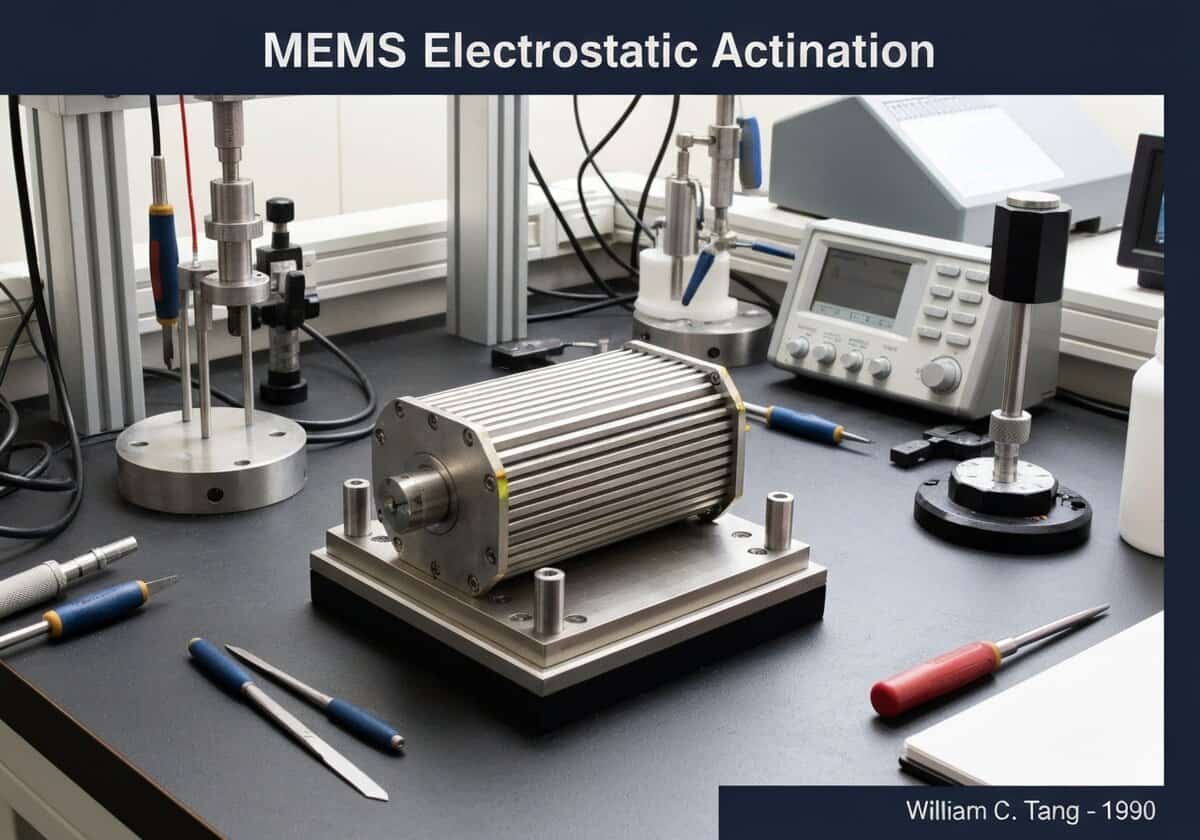
MEMS electrostatic actuator with comb drive design in electrical engineering.

(generated image for illustration only)

Electrostatic actuation is a primary method for inducing motion in MEMS. It utilizes the attractive force between two electrodes separated by a dielectric gap when a voltage is applied. The force is proportional to the square of the voltage and the capacitance gradient. Common designs include parallel-plate capacitors for out-of-plane motion and comb drives for large in-plane displacement.


Electrostatic actuation is favored in MEMS due to its low power consumption (ideally zero static power), high speed, and compatibility with standard microfabrication processes. The fundamental force \(F\) in a parallel-plate actuator is given by \(F = \frac{1}{2} \frac{dC}{dx}V^2\), where \(V\) is the voltage and \(\frac{dC}{dx}\) is the gradient of the capacitance \(C\) with respect to displacement \(x\). For an ideal parallel-plate capacitor, this simplifies to \(F approx \frac{1}{2} \frac{\epsilon A V^2}{g^2}\), where \(\epsilon\) is the dielectric permittivity, \(A\) is the plate area, and \(g\) is the gap. This equation highlights a critical challenge: the force is highly non-linear with displacement. As the gap closes, the electrostatic force increases rapidly, while a typical mechanical restoring force (from a spring) increases linearly. At a certain point (typically one-third of the initial gap), the electrostatic force overwhelms the restoring force, causing the movable plate to snap unstably to the fixed plate. This phenomenon, known as ‘pull-in,’ limits the stable travel range of simple electrostatic actuators.

To overcome this limitation, the comb drive actuator was invented. It consists of two interdigitated comb-like structures of conductive fingers. When a voltage is applied, electrostatic fields form between the sides of the fingers. This generates a lateral force that moves one comb relative to the other, parallel to the substrate. The key advantage is that as the combs engage, the number of overlapping finger pairs increases, but the gap between them remains constant. This results in a capacitance that changes linearly with displacement, producing a force that is largely independent of the position of the movable comb. This stable, long-range actuation was a revolutionary development, enabling a wide range of devices, particularly high-performance resonant sensors like gyroscopes and accelerometers, where precise and stable force feedback is required.

UNESCO Nomenclature: 3308
– Electrical engineering

Type

Physical Device

Disruption

Foundational

Usage

Widespread Use

Precursors

  • Coulomb’s law of electrostatic force
  • the concept of the capacitor
  • semiconductor fabrication for creating precise electrode gaps
  • micromachining to create released, movable structures

Applications

  • comb drive resonators in gyroscopes
  • digital micromirror devices (DMDs)
  • RF MEMS switches and varactors
  • tunable lasers and optical filters
  • atomic force microscope (AFM) scanners

Patents:

  • US5025346A

Potential Innovations Ideas

Due to scrapping bot traffic, currently more than 40k per day, this content is reserved to community members.
> Login < or > Register < (100% free) to access this, so as all other restricted content and tools.

Related to: electrostatic actuation, MEMS, comb drive, actuator, pull-in effect, capacitance, micro-actuator, voltage, parallel-plate, microelectronics.

Historical Context

MEMS Electrostatic Actuation

1990
1990
1990
1990
1991
1992
1993
1990
1990
1990
1990
1990
1992
1992
1993-07-22

(if date is unknown or not relevant, e.g. "fluid mechanics", a rounded estimation of its notable emergence is provided)

Related Invention, Innovation & Technical Principles

Full size images and downloads are only available, 100% free, for registered members.

> Login <