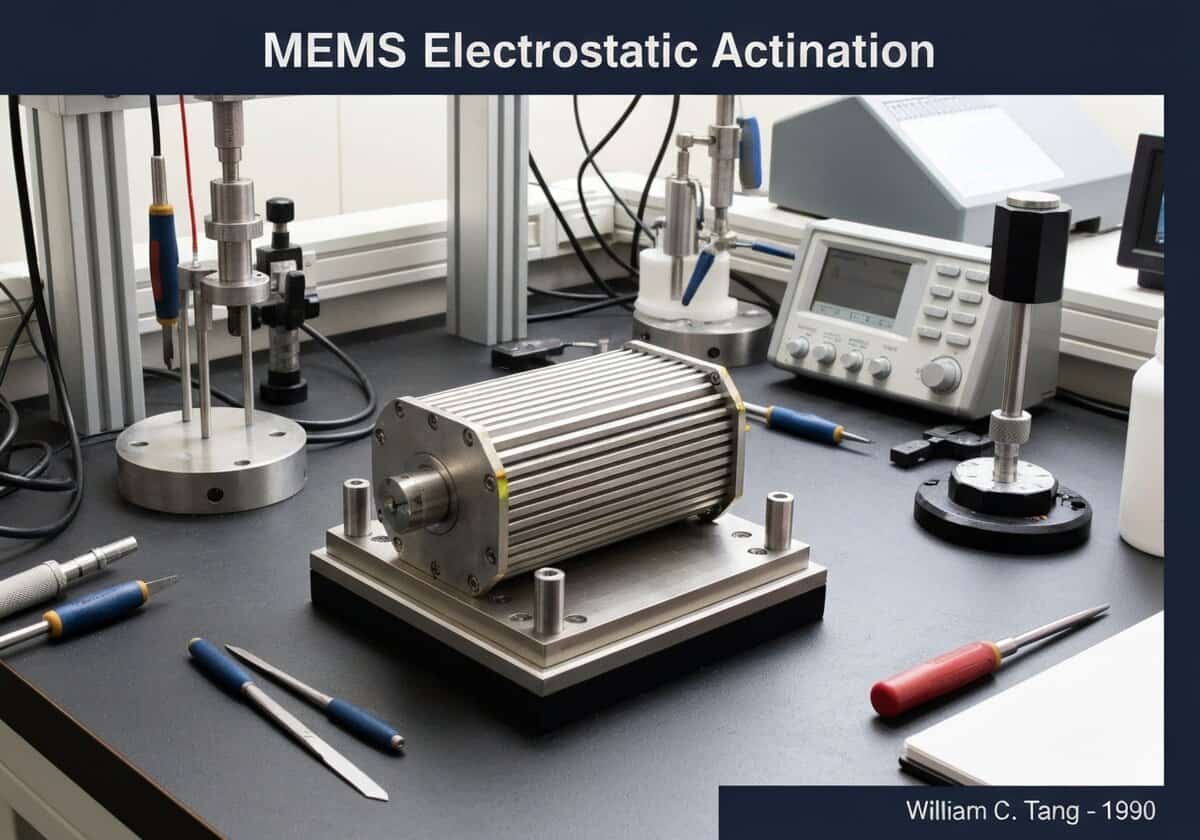
MEMS Electrostatic Actuation
La actuación electrostática es una técnica principal. método para inducir movimiento en MEMSUtiliza la fuerza de atracción entre dos electrodos separados por un espacio dieléctrico al aplicar un voltaje. Esta fuerza es proporcional al cuadrado del voltaje y al gradiente de capacitancia. Los diseños comunes incluyen condensadores de placas paralelas para movimientos fuera del plano y actuadores de peine para grandes desplazamientos en el plano.
La actuación electrostática es preferida en los MEMS debido a su bajo consumo de energía (idealmente energía estática cero), alta velocidad y compatibilidad con los procesos de microfabricación estándar. La fuerza fundamental [latex]F[/latex] en un actuador de placas paralelas viene dada por [latex]F = frac{1}{2} frac{dC}{dx}V^2[/latex], donde [latex]V[/latex] es el voltaje y [latex]frac{dC}{dx}[/latex] es el gradiente de la capacitancia [latex]C[/latex] con respecto al desplazamiento [latex]x[/latex]. Para un capacitor de placas paralelas ideal, esto se simplifica a [latex]F aprox frac{1}{2} frac{epsilon AV^2}{g^2}[/latex], donde [latex]epsilon[/latex] es la permitividad dieléctrica, [latex]A[/latex] es el área de la placa y [latex]g[/latex] es la distancia entre placas. Esta ecuación pone de manifiesto un desafío crítico: la fuerza es altamente no lineal con respecto al desplazamiento. A medida que la distancia se reduce, la fuerza electrostática aumenta rápidamente, mientras que una fuerza restauradora mecánica típica (de un resorte) aumenta linealmente. En cierto punto (típicamente un tercio de la distancia inicial), la fuerza electrostática supera a la fuerza restauradora, lo que provoca que la placa móvil se adhiera de forma inestable a la placa fija. Este fenómeno, conocido como "atracción", limita el rango de desplazamiento estable de los actuadores electrostáticos simples.
To overcome this limitation, the comb drive actuator was invented. It consists of two interdigitated comb-like structures of conductive fingers. When a voltage is applied, electrostatic fields form between the sides of the fingers. This generates a lateral force that moves one comb relative to the other, parallel to the substrate. The key advantage is that as the combs engage, the number of overlapping finger pairs increases, but the gap between them remains constant. This results in a capacitance that changes linearly with displacement, producing a force that is largely independent of the position of the movable comb. This stable, long-range actuation was a revolutionary development, enabling a wide range of devices, particularly high-performance resonant sensors like gyroscopes and accelerometers, where precise and stable force feedback is required.
UNESCO Nomenclature: 3308
- Ingeniería eléctrica
Precursores
- Ley de Coulomb de la fuerza electrostática
- the concept of the capacitor
- semiconductor fabrication for creating precise electrode gaps
- micromachining to create released, movable structures
Aplicaciones
- comb drive resonators in gyroscopes
- digital micromirror devices (DMDs)
- RF MEMS switches and varactors
- tunable lasers and optical filters
- atomic force microscope (AFM) scanners
Ideas para posibles innovaciones
Debido al bloqueo del tráfico generado por bots, que actualmente supera los 40.000 al día, este contenido está reservado para los miembros de la comunidad.
> Iniciar sesión < o > Registrarse < (100% gratis) para acceder a esto, al igual que a todo el demás contenido y herramientas restringidos.
Relacionado con: actuación electrostática, MEMS, accionamiento de peine, actuador, efecto de atracción, capacitancia, microactuador, voltaje, placas paralelas, microelectrónica.