Product Design, Manufacturing & Innovation Resources
Home » The 1.5 Sigma Shift

The 1.5 Sigma Shift

1990
  • Mikel Harry
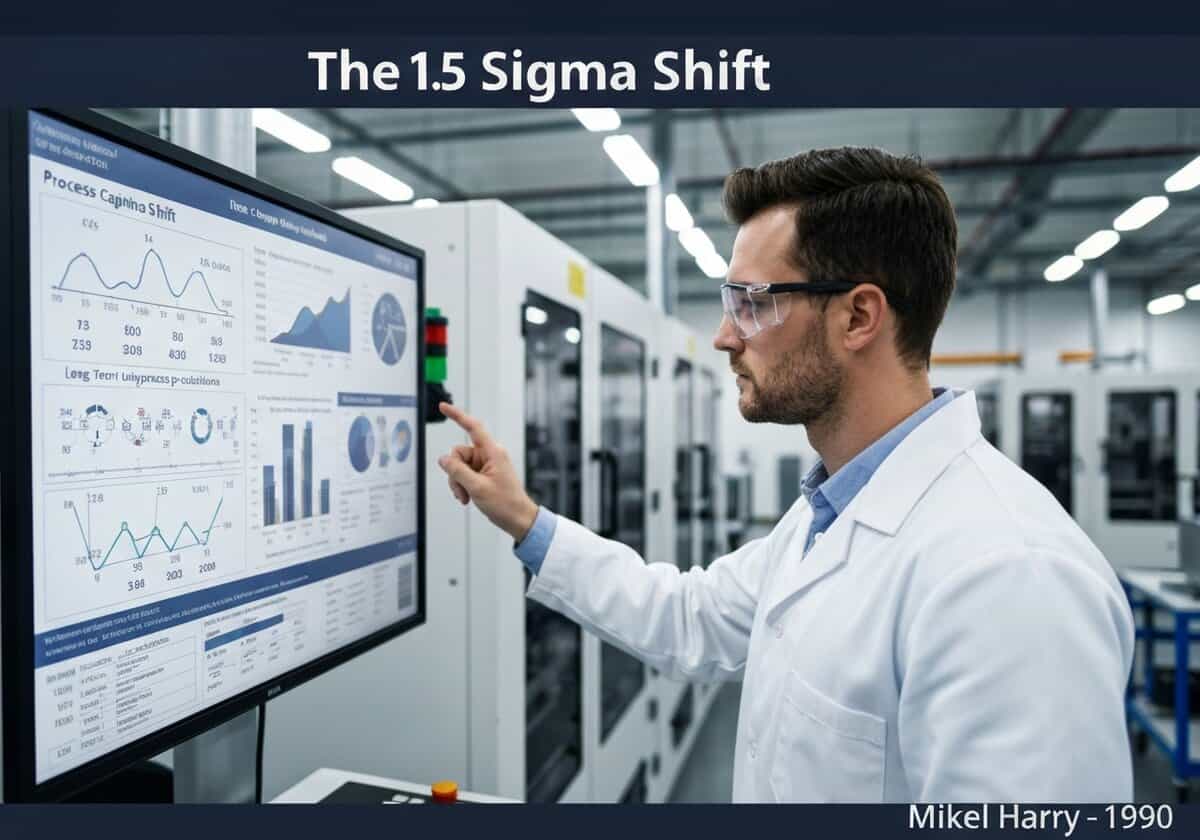
Quality control engineer analyzing process capability metrics in manufacturing.

(generated image for illustration only)

The 1.5 sigma shift is an empirical correction used in Six Sigma calculations to account for the long-term dynamic variation of a process. It posits that over time, a process mean will tend to drift by about 1.5 standard deviations from its short-term centered position. This shift is the reason a 6 sigma process corresponds to 3.4 DPMO, not the theoretical 2 defects per billion.


Disclaimer: the 1.5 sigma shift is one of the most debated aspects of Six Sigma. It originates from the observation that short-term data, collected over a brief period, typically shows less variation than long-term data from the same process. This is because over longer periods, factors like tool wear, material variations, operator differences, and environmental changes cause the process mean to drift. The 1.5 sigma value was determined empirically by Motorola engineers as a reasonable general estimate for this drift. By incorporating this shift, Six Sigma provides a more realistic, long-term view of process performance. The calculation for DPMO is thus based on the probability of an outcome falling outside a specification limit that is \(4.5\sigma\) from the drifted mean (\(6\sigma – 1.5\sigma\)). Critics argue that the 1.5 value is arbitrary and that a well-controlled process should not drift this much. Proponents argue it’s a pragmatic adjustment that makes the Six Sigma standard more applicable to real-world industrial processes.

UNESCO Nomenclature: 3308
– Industrial engineering and technology

Type

Abstract System

Disruption

Incremental

Usage

Widespread Use

Precursors

  • Walter A. Shewhart’s work on common and special cause variation
  • long-term vs. short-term process capability studies
  • empirical observations of industrial processes
  • control chart theory

Applications

  • calculating long-term process capability (Cpk, Ppk)
  • setting realistic quality targets in manufacturing
  • risk assessment in financial modeling
  • reliability engineering for long-life products

Patents:

NA

Potential Innovations Ideas

Due to scrapping bot traffic, currently more than 40k per day, this content is reserved to community members.
> Login < or > Register < (100% free) to access this, so as all other restricted content and tools.

Related to: 1.5 sigma shift, process drift, six sigma, dpmo, statistical process control, process capability, long-term variation, motorola, quality control, standard deviation.

Historical Context

The 1.5 Sigma Shift

1990
1990
1990
1990
1990
1990
1992
1990
1990
1990
1990
1990
1990
1991
1992

(if date is unknown or not relevant, e.g. "fluid mechanics", a rounded estimation of its notable emergence is provided)

Full size images and downloads are only available, 100% free, for registered members.

> Login <