The “Big Five” Mass Extinctions
1982
- David M. Raup
- Jack Sepkoski
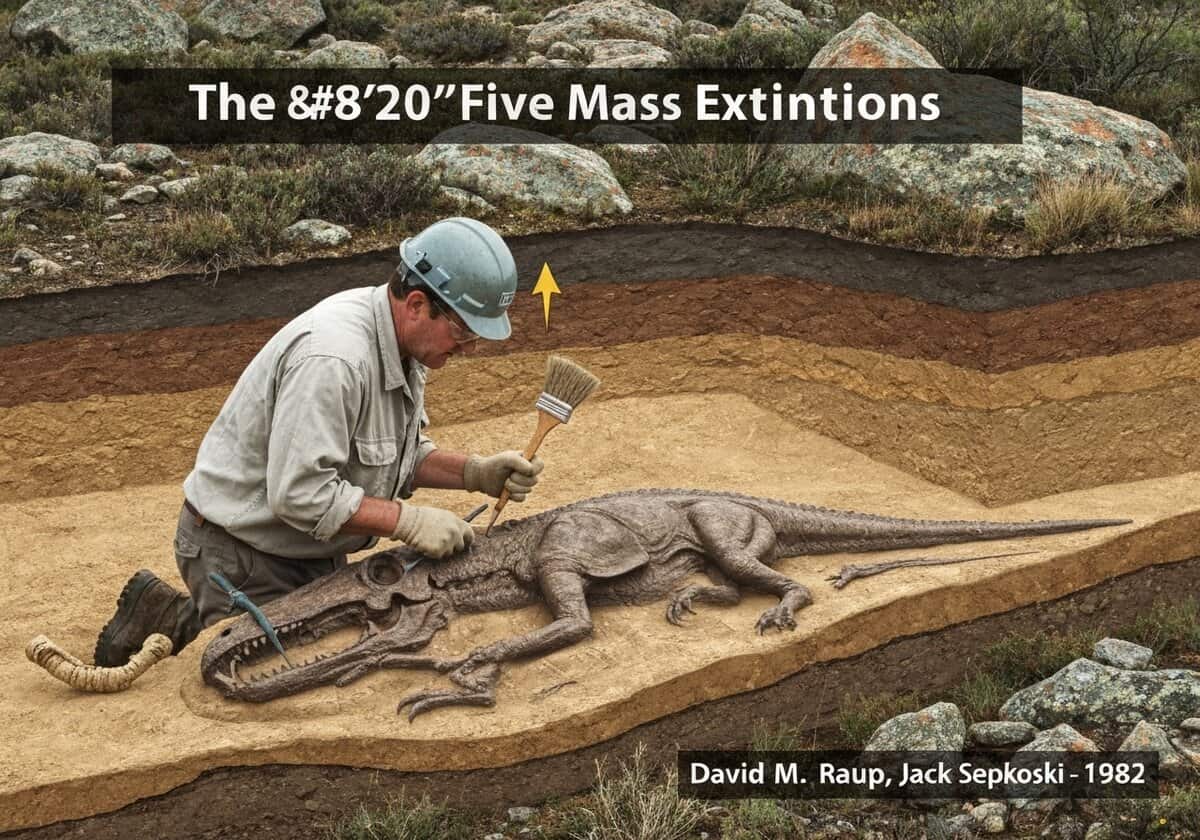
The “Big Five” are five major extinction events in Earth’s history where over 75% of species disappeared in a geologically short interval. Identified by Jack Sepkoski and David M. Raup, they are the Ordovician–Silurian, Late Devonian, Permian–Triassic, Triassic–Jurassic, and Cretaceous–Paleogene events. These events profoundly reshaped the biosphere, creating opportunities for new life forms to radiate.
The concept of the “Big Five” mass extinctions emerged from statistical analysis of the fossil record, primarily marine invertebrates, by paleontologists David M. Raup and Jack Sepkoski in a 1982 paper. They compiled a massive database of fossil genera, which allowed them to track biodiversity levels through the Phanerozoic Eon. Their analysis revealed that while extinction is a continuous process (background extinction), there were five distinct intervals where the rate of extinction spiked dramatically. These are: 1) The End-Ordovician (c. 443 Ma), which saw the demise of about 85% of marine species, likely due to rapid glaciation and subsequent sea-level fall. 2) The Late Devonian (c. 372 Ma), a prolonged crisis that eliminated about 75% of species, possibly linked to anoxia and volcanism. 3) The End-Permian or “Great Dying” (c. 252 Ma), the most severe, wiping out over 95% of marine species and 70% of terrestrial vertebrate species, strongly associated with the Siberian Traps volcanism. 4) The End-Triassic (c. 201 Ma), which eliminated around 80% of species, paving the way for dinosaurs to dominate, linked to the Central Atlantic Magmatic Province. 5) The End-Cretaceous (K-Pg) (c. 66 Ma), which famously killed the non-avian dinosaurs and about 76% of all species, attributed to the Chicxulub asteroid impact.
This framework was revolutionary because it shifted the focus from gradual, Darwinian competition to the role of catastrophic events in shaping the history of life. It highlighted that major evolutionary radiations, like the rise of mammals after the K-Pg event, were often contingent on the ecological opportunities created by mass extinctions. The “Big Five” model provides a critical baseline for assessing the severity of the current human-caused biodiversity crisis, often termed the “Sixth Extinction.”
UNESCO Nomenclature: 2508
– Geology
Precursors
- Georges Cuvier’s theory of catastrophism
- Charles Lyell’s principles of uniformitarianism
- Charles Darwin’s theory of evolution by natural selection
- the development of the geologic time scale
- advances in radiometric dating techniques
Applications
- provides a framework for studying the causes and consequences of mass extinctions
- informs modern conservation biology by providing historical context for biodiversity loss
- guides paleontological research by highlighting key intervals of biotic turnover
- used in climate modeling to understand tipping points in earth systems
Potential Innovations Ideas
Due to scrapping bot traffic, currently more than 40k per day, this content is reserved to community members.
> Login < or > Register < (100% free) to access this, so as all other restricted content and tools.
Related to: big five, mass extinction, Raup, Sepkoski, Phanerozoic, biodiversity loss, paleontology, Ordovician, Permian, Cretaceous.