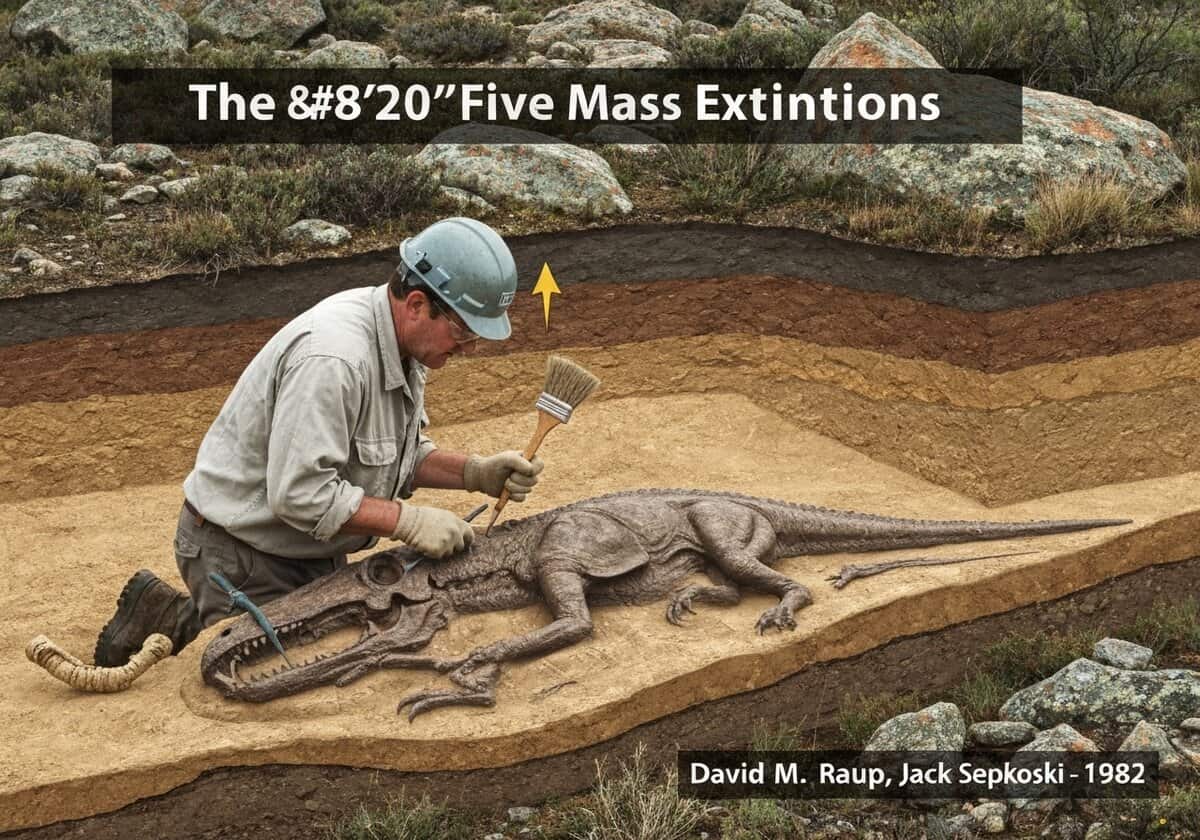
「ビッグファイブ」と呼ばれる5つの大量絶滅
1982
- David M. Raup
- Jack Sepkoski
The “Big Five” are five major extinction events in Earth’s history where over 75% of species disappeared in a geologically short interval. Identified by Jack Sepkoski and David M. Raup, they are the Ordovician–Silurian, Late Devonian, ペルム紀-三畳紀三畳紀-ジュラ紀、そして 白亜紀-古第三紀 これらの出来事は生物圏を大きく変容させ、新たな生命体が出現する機会を生み出した。
The concept of the “Big Five” mass extinctions emerged from statistical analysis of the fossil record, primarily marine invertebrates, by paleontologists David M. Raup and Jack Sepkoski in a 1982 paper. They compiled a massive database of fossil genera, which allowed them to track biodiversity levels through the Phanerozoic Eon. Their analysis revealed that while extinction is a continuous process (background extinction), there were five distinct intervals where the rate of extinction spiked dramatically. These are: 1) The End-Ordovician (c. 443 Ma), which saw the demise of about 85% of marine species, likely due to rapid glaciation and subsequent sea-level fall. 2) The Late Devonian (c. 372 Ma), a prolonged crisis that eliminated about 75% of species, possibly linked to anoxia and volcanism. 3) The End-Permian or “Great Dying” (c. 252 Ma), the most severe, wiping out over 95% of marine species and 70% of terrestrial vertebrate species, strongly associated with the Siberian Traps volcanism. 4) The End-Triassic (c. 201 Ma), which eliminated around 80% of species, paving the way for dinosaurs to dominate, linked to the Central Atlantic Magmatic Province. 5) The End-Cretaceous (K-Pg) (c. 66 Ma), which famously killed the non-avian dinosaurs and about 76% of all species, attributed to the Chicxulub asteroid impact.
この枠組みは、生命の歴史を形作る上で、漸進的なダーウィン的競争から破局的出来事の役割へと焦点を移した点で革新的でした。K-Pgイベント後の哺乳類の出現のような主要な進化放散は、大量絶滅によって生み出された生態学的機会に左右されることが多いことを強調しました。「ビッグファイブ」モデルは、しばしば「第六の絶滅」と呼ばれる、現在人類が引き起こしている生物多様性の危機の深刻さを評価するための重要な基準を提供します。
UNESCO Nomenclature: 2508
地質学
前駆物質
- ジョルジュ・キュヴィエの激変説
- チャールズ・ライエルの斉一説の原理
- チャールズ・ダーウィンの自然選択による進化論
- 地質年代尺度の発展
- 放射年代測定技術の進歩
アプリケーション
- 大量絶滅の原因と結果を研究するための枠組みを提供する
- 生物多様性の喪失に関する歴史的背景を提供することで、現代の保全生物学に役立つ情報を提供する。
- 生物の交代における重要な期間を強調することで、古生物学研究を導く。
- 地球システムの転換点を理解するために気候モデリングで使用される
潜在的なイノベーションのアイデア
ボットによるトラフィック(現在1日あたり4万件以上)を排除するため、このコンテンツはコミュニティメンバー限定となっています。
> ログイン < または > 登録 < (100%無料)でこれにアクセスできます。他のすべての制限付きコンテンツとツールも同様です。
Related to: big five, mass extinction, Raup, Sepkoski, Phanerozoic, biodiversity loss, paleontology, Ordovician, Permian, Cretaceous.