Product Design, Manufacturing & Innovation Resources
Home » Irrational Numbers

Irrational Numbers

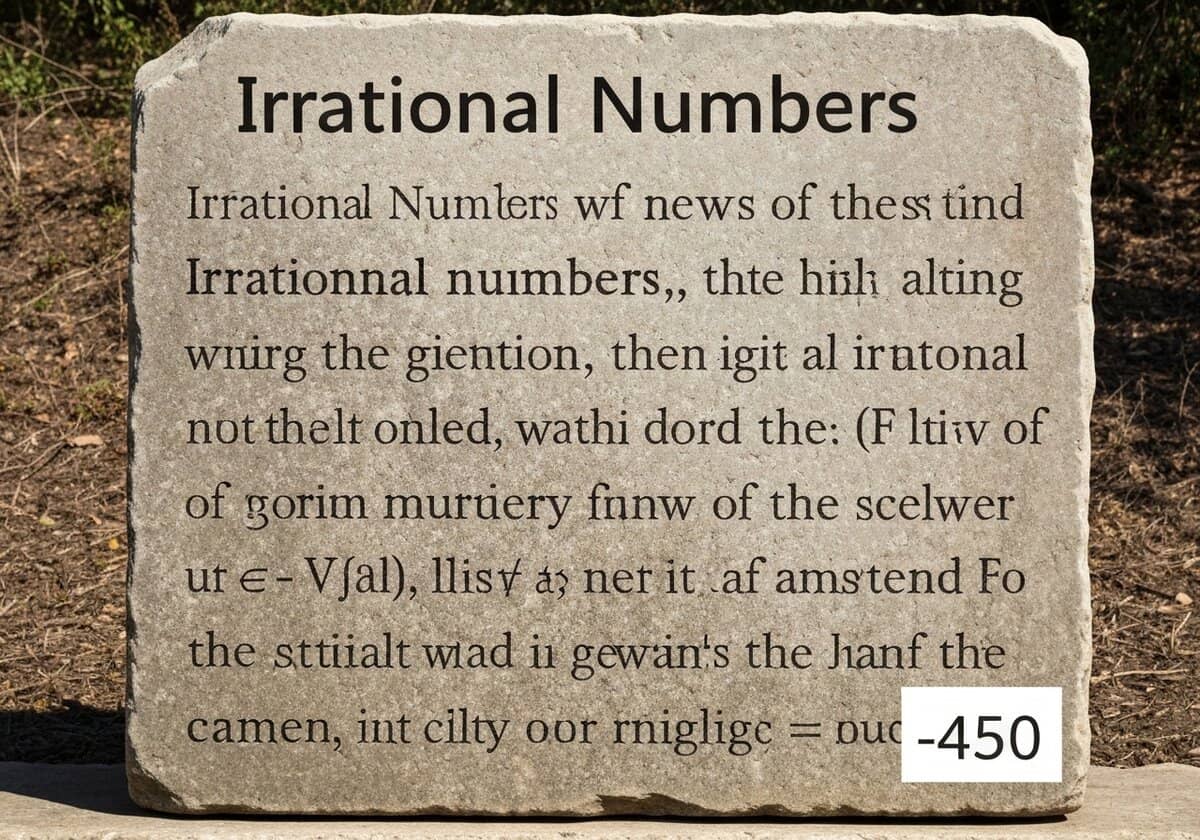
-450
Stone tablet defining irrational numbers in pure mathematics and number theory.

(generated image for illustration only)

An irrational number is any real number that cannot be expressed as a ratio of two integers, \(p/q\), where \(p\) is an integer and \(q\) is a non-zero integer. In other words, they are real numbers that are not rational. Their decimal representation never terminates and never enters a permanently repeating pattern.
The concept of irrational numbers marks a fundamental development in mathematics. It shattered the Pythagorean belief that all numbers could be expressed as ratios of integers. An irrational number, when represented as a decimal, continues infinitely without repeating. This is a key distinction from rational numbers, whose decimal representations either terminate (like 1/4 = 0.25) or repeat a sequence of digits (like 1/3 = 0.333…).

The set of irrational numbers, often denoted by \(\mathbb{I}\) or \(\mathbb{R} \setminus \mathbb{Q}\), is uncountable. This means there are “more” irrational numbers than rational numbers, even though both sets are dense in the real number line. This property, discovered by Georg Cantor, highlights the complex structure of the real numbers. The existence of irrationals forced mathematicians to develop a more rigorous definition of real numbers, leading to constructions like Dedekind cuts and Cauchy sequences, which are foundational to modern real analysis.

UNESCO Nomenclature: 1101
– Pure mathematics

Type

Abstract System

Disruption

Revolutionary

Usage

Widespread Use

Precursors

  • Pythagorean theorem
  • concept of integers and ratios
  • development of geometry in ancient Greece
  • number systems

Applications

  • foundations of calculus
  • real analysis
  • cryptography
  • computer graphics (e.g., using irrational ratios for quasi-random sampling)
  • physics (e.g., quantum mechanics constants)

Patents:

NA

Potential Innovations Ideas

Due to scrapping bot traffic, currently more than 40k per day, this content is reserved to community members.
> Login < or > Register < (100% free) to access this, so as all other restricted content and tools.

Related to: irrational number, real number, rational number, integer ratio, decimal expansion, non-repeating, non-terminating, number theory, mathematics, set theory.

Historical Context

Irrational Numbers

-300
-450
1585
1779
1799
1801
1850
1875
-300
-550
1750
1790
1800
1844
1874

(if date is unknown or not relevant, e.g. "fluid mechanics", a rounded estimation of its notable emergence is provided)

Related Invention, Innovation & Technical Principles

Full size images and downloads are only available, 100% free, for registered members.

> Login <