Product Design, Manufacturing & Innovation Resources
Home » In-Situ Chemical Oxidation (ISCO)

In-Situ Chemical Oxidation (ISCO)

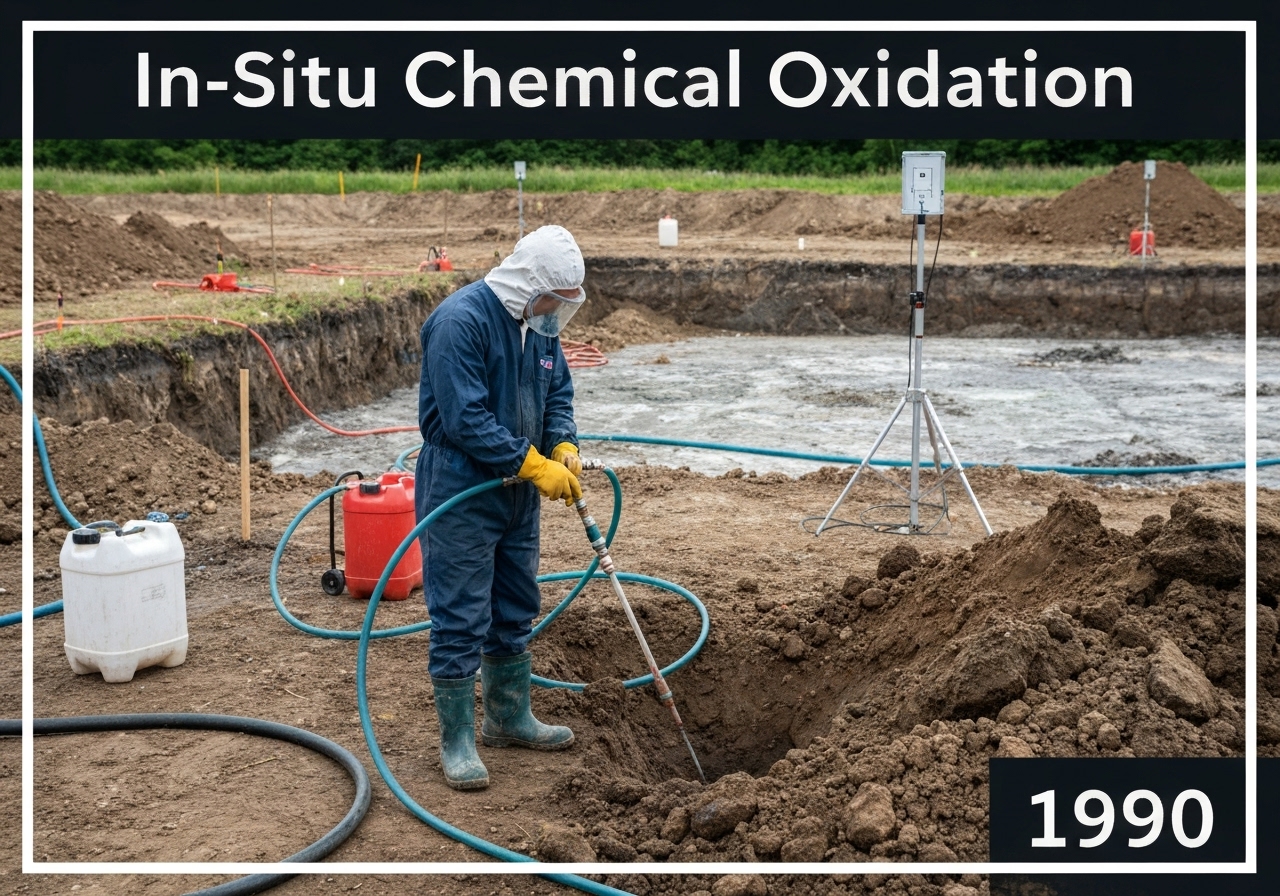
1990
Field technician performing in-situ chemical oxidation for environmental remediation of pollutants.

(generated image for illustration only)

In-Situ Chemical Oxidation (ISCO) is an aggressive remediation technology that involves injecting strong chemical oxidants directly into the contaminated subsurface to destroy pollutants. Common oxidants include permanganate, persulfate, hydrogen peroxide (Fenton’s reagent), and ozone. These chemicals react with contaminants, converting them into less toxic substances like carbon dioxide, water, and inorganic salts, without requiring excavation of the contaminated material.
ISCO is a powerful method for rapidly degrading a wide range of organic contaminants in both soil and groundwater. The selection of the oxidant is crucial and depends on the target contaminant, geochemistry of the site, and safety considerations. Potassium permanganate (\(KMnO_4\)) is effective against chlorinated ethenes like PCE and TCE but is less effective for petroleum hydrocarbons. Fenton’s reagent, a mixture of hydrogen peroxide (\(H_2O_2\)) and an iron catalyst, generates highly reactive hydroxyl radicals (\(\bullet OH\)) that can non-selectively destroy most organic compounds. Persulfate (\(S_2O_8^{2-}\)), activated by heat, high pH, or iron, is more stable than Fenton’s reagent and can travel further in the subsurface. Ozone (\(O_3\)) is a gas that is typically sparged into the subsurface to treat both saturated and unsaturated zones.

A major challenge in ISCO is achieving effective delivery and distribution of the oxidant to the target contamination zone. The subsurface is often heterogeneous, and the oxidant can be consumed by non-target reactions with natural organic matter or minerals in the soil, a phenomenon known as natural oxidant demand (NOD). This can significantly increase the amount of chemical required. Furthermore, ISCO reactions can be highly exothermic, potentially causing hazardous conditions, and can mobilize toxic metals like chromium by changing the redox conditions of the aquifer. Despite these challenges, ISCO is often chosen for its speed in reducing high contaminant concentrations in source areas.

UNESCO Nomenclature: 2506
– Environmental sciences

Type

Chemical Process

Disruption

Substantial

Usage

Widespread Use

Precursors

  • understanding of redox chemistry and reaction kinetics
  • industrial use of chemical oxidants in wastewater treatment
  • advances in drilling and injection technologies for subsurface access
  • development of analytical chemistry methods to monitor contaminant degradation

Applications

  • treatment of dense non-aqueous phase liquids (dnapls) like TCE
  • remediation of petroleum hydrocarbon plumes
  • destruction of pesticides and herbicides in soil and groundwater
  • cleanup of sites contaminated with polycyclic aromatic hydrocarbons (pahs)
  • rapid source zone treatment to reduce contaminant mass

Patents:

NA

Potential Innovations Ideas

Due to scrapping bot traffic, currently more than 40k per day, this content is reserved to community members.
> Login < or > Register < (100% free) to access this, so as all other restricted content and tools.

Related to: ISCO, in-situ chemical oxidation, remediation, groundwater, soil, Fenton’s reagent, permanganate, persulfate, contaminant destruction, oxidant.

Historical Context

In-Situ Chemical Oxidation (ISCO)

1980
1980
1982
1990
1990
1990
1990
1978
1980
1980
1982
1990
1990
1990
1993

(if date is unknown or not relevant, e.g. "fluid mechanics", a rounded estimation of its notable emergence is provided)

Related Invention, Innovation & Technical Principles

Full size images and downloads are only available, 100% free, for registered members.

> Login <