Product Design, Manufacturing & Innovation Resources
Home » HEPA and ULPA Filtration

HEPA and ULPA Filtration

1940
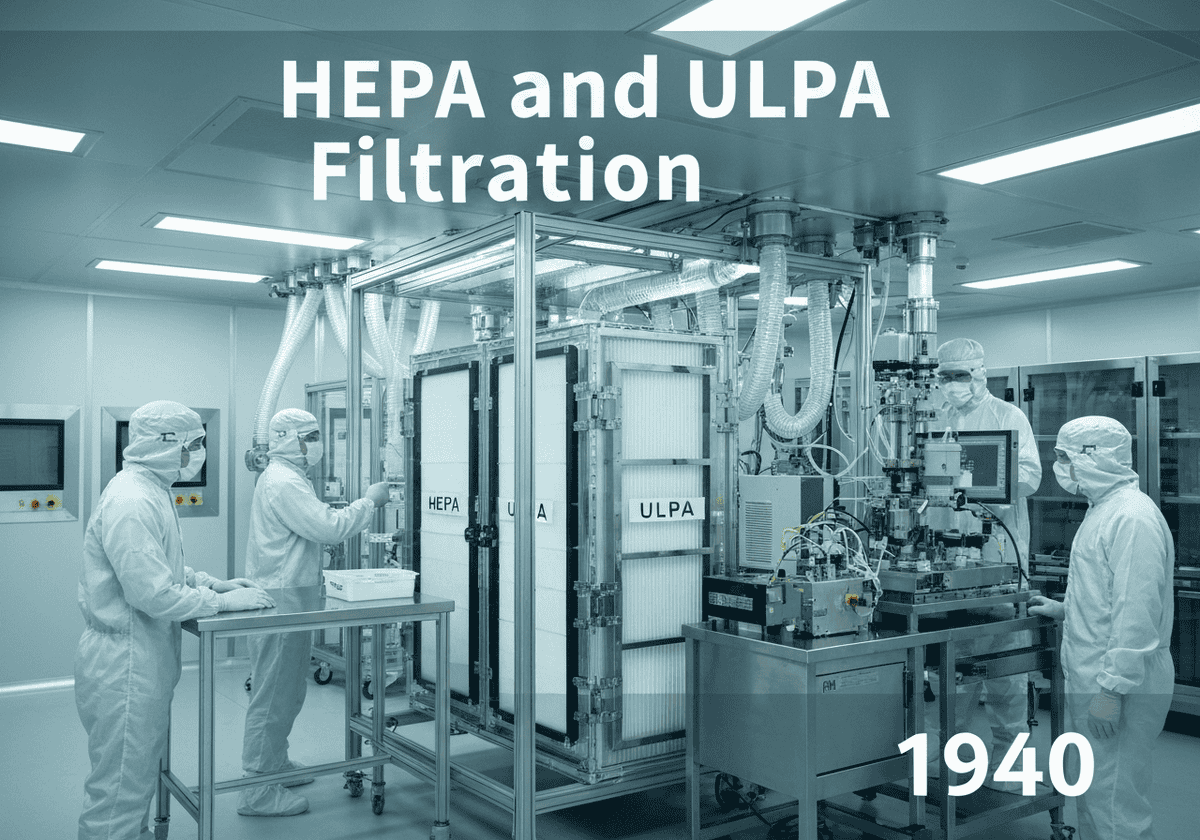
HEPA and ULPA filtration system in a cleanroom for environmental engineering applications.

(generated image for illustration only)

High-Efficiency Particulate Air (HEPA) and Ultra-Low Particulate Air (ULPA) filters are critical cleanroom components. A HEPA filter must remove at least 99.97% of airborne particles 0.3 micrometers (µm) in diameter. An ULPA filter is even more efficient, removing 99.999% of particles 0.12 µm or larger. They work via a combination of interception, impaction, and diffusion.

The effectiveness of HEPA and ULPA filters is defined by their performance at their Most Penetrating Particle Size (MPPS). For HEPA filters, this is typically 0.3 µm. Particles larger than the MPPS are trapped primarily by inertial impaction (colliding with fibers due to their inertia) and interception (getting stuck on fibers as they follow the airstream). Conversely, very small particles (typically <0.1 µm) are trapped by diffusion, where their random, erratic Brownian motion causes them to collide with filter fibers. The 0.3 µm size represents a ‘valley’ in efficiency where none of these three mechanisms are dominant, making it the most difficult particle size to capture. Therefore, a filter’s rating is based on its worst-case performance at this MPPS.

ULPA filters are an extension of this technology, designed for even more stringent contamination control. They target an MPPS around 0.1-0.12 µm and achieve efficiencies of 99.999% or greater. These filters are constructed from a dense mat of randomly arranged borosilicate glass fibers. The air velocity, fiber diameter, and packing density are precisely controlled during manufacturing to achieve the desired performance. In a cleanroom, these filters are installed in terminal housings or as part of a fan-filter unit (FFU), and their seals are critical. Regular testing, such as Dispersed Oil Particulate (DOP) testing, is performed to verify the integrity of the filter media and the seal to ensure no contaminated air bypasses the filter.

UNESCO Nomenclature: 3307
– Environmental engineering

Type

Physical Device

Disruption

Foundational

Usage

Widespread Use

Precursors

  • research into gas masks during World War I
  • the Manhattan Project’s need to filter radioactive particles
  • advances in glass fiber manufacturing
  • understanding of aerosol physics and Brownian motion

Applications

  • cleanrooms for manufacturing and research
  • biological safety cabinets
  • hospital operating rooms and isolation units
  • nuclear facilities
  • high-end vacuum cleaners and air purifiers

Patents:

NA

Potential Innovations Ideas

Due to scrapping bot traffic, currently more than 40k per day, this content is reserved to community members.
> Login < or > Register < (100% free) to access this, so as all other restricted content and tools.

Related to: HEPA, ULPA, filtration, air filter, particle capture, contamination control, MPPS, cleanroom technology.

Historical Context

HEPA and ULPA Filtration

1930
1930
1930
1940
1940
1940
1940
1930
1930
1930
1934
1940
1940
1940
1940

(if date is unknown or not relevant, e.g. "fluid mechanics", a rounded estimation of its notable emergence is provided)

Related Invention, Innovation & Technical Principles

Full size images and downloads are only available, 100% free, for registered members.

> Login <