Product Design, Manufacturing & Innovation Resources
Home » Anthropometry in Ergonomic Design

Anthropometry in Ergonomic Design

1940
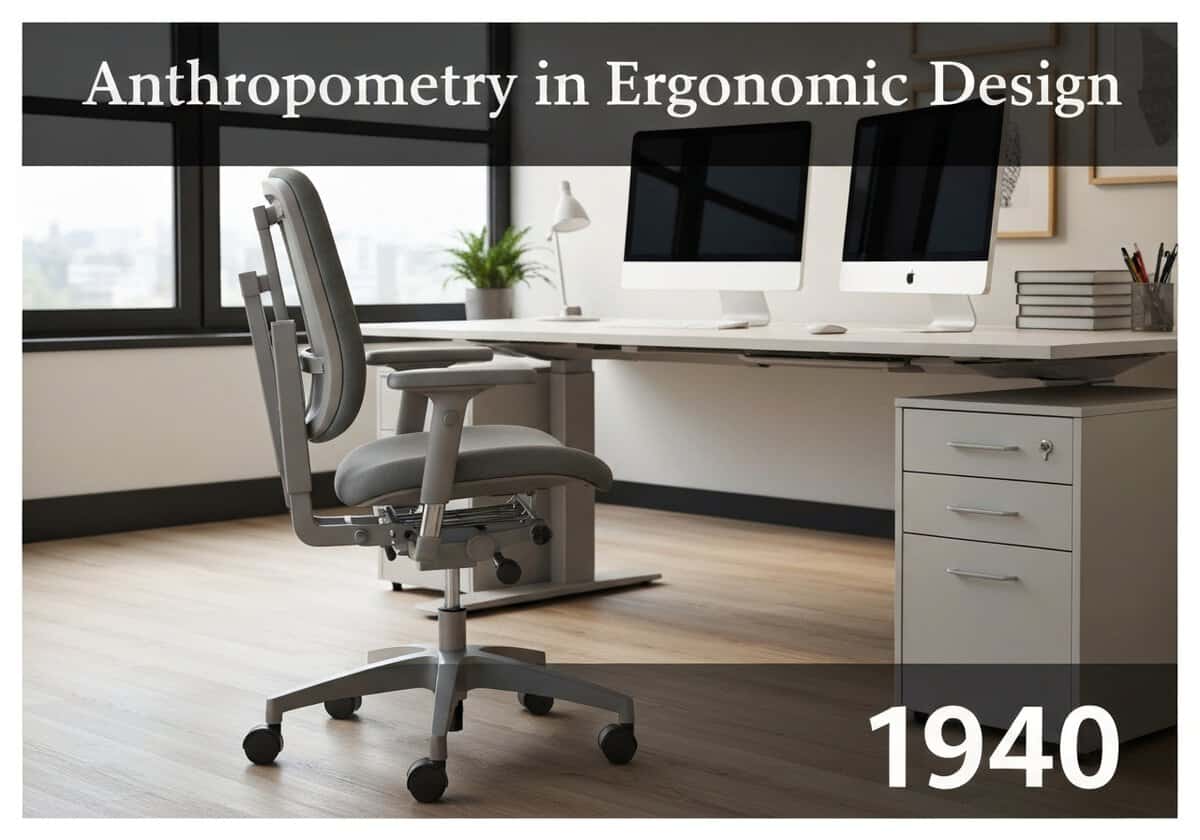
Ergonomic office workspace with adjustable chair and desk based on anthropometric principles.

(generated image for illustration only)

Anthropometry is the scientific study of the measurements and proportions of the human body. In ergonomics, anthropometric data is crucial for designing workspaces, equipment, and products that fit the user. Designs typically accommodate a specific range of the population, often the 5th to 95th percentile, to ensure that the majority of users can interact with the design safely and efficiently.


The core principle of applying anthropometry is ‘fit the task to the person,’ not the other way around. To achieve this, designers use large datasets of human body measurements, which are often specific to age, sex, and ethnicity. These datasets include static measurements (taken when the body is in a fixed position, e.g., height, arm length) and dynamic or functional measurements (taken during movement, e.g., reach envelope). A critical concept is designing for the appropriate population range. Designing for the ‘average’ person (the 50th percentile) is often a mistake, as it may fit no one well. Instead, designers use percentiles to accommodate a wider range. For example, a doorway’s height might be designed to accommodate the 95th or 99th percentile male height to prevent taller individuals from hitting their heads. Conversely, an emergency shut-off button’s reach distance might be designed for the 5th percentile female reach to ensure the smallest users can access it. This statistical approach allows for the creation of products and environments that are usable by the vast majority of the target population, enhancing comfort, safety, and performance.

UNESCO Nomenclature: 3307
– Industrial engineering

Type

Abstract System

Disruption

Foundational

Usage

Widespread Use

Precursors

  • The Vitruvian man by Leonardo Da Vinci, an early study of human proportion
  • Alphonse Bertillon’s system of criminal identification using body measurements (bertillonage)
  • statistical methods developed by Adolphe Quetelet, who studied the ‘average man’
  • large-scale anthropometric surveys of military personnel during world war i and ii

Applications

  • design of adjustable office chairs and desks
  • layout of vehicle interiors, including driver seats and controls
  • sizing of clothing and personal protective equipment (ppe)
  • design of hand tools and kitchen utensils
  • architectural design of spaces like doorways and counter heights

Patents:

NA

Potential Innovations Ideas

Due to scrapping bot traffic, currently more than 40k per day, this content is reserved to community members.
> Login < or > Register < (100% free) to access this, so as all other restricted content and tools.

Related to: anthropometry, human body measurement, ergonomics, design, percentile, human factors, user-centered design, workspace design, product design, reach envelope.

Historical Context

Anthropometry in Ergonomic Design

1940
1940
1940
1940
1940
1940
1948
1934
1940
1940
1940
1940
1940
1945-01-01
1949

(if date is unknown or not relevant, e.g. "fluid mechanics", a rounded estimation of its notable emergence is provided)

Related Invention, Innovation & Technical Principles

Full size images and downloads are only available, 100% free, for registered members.

> Login <