Failure Mode and Effects Analysis (FMEA)
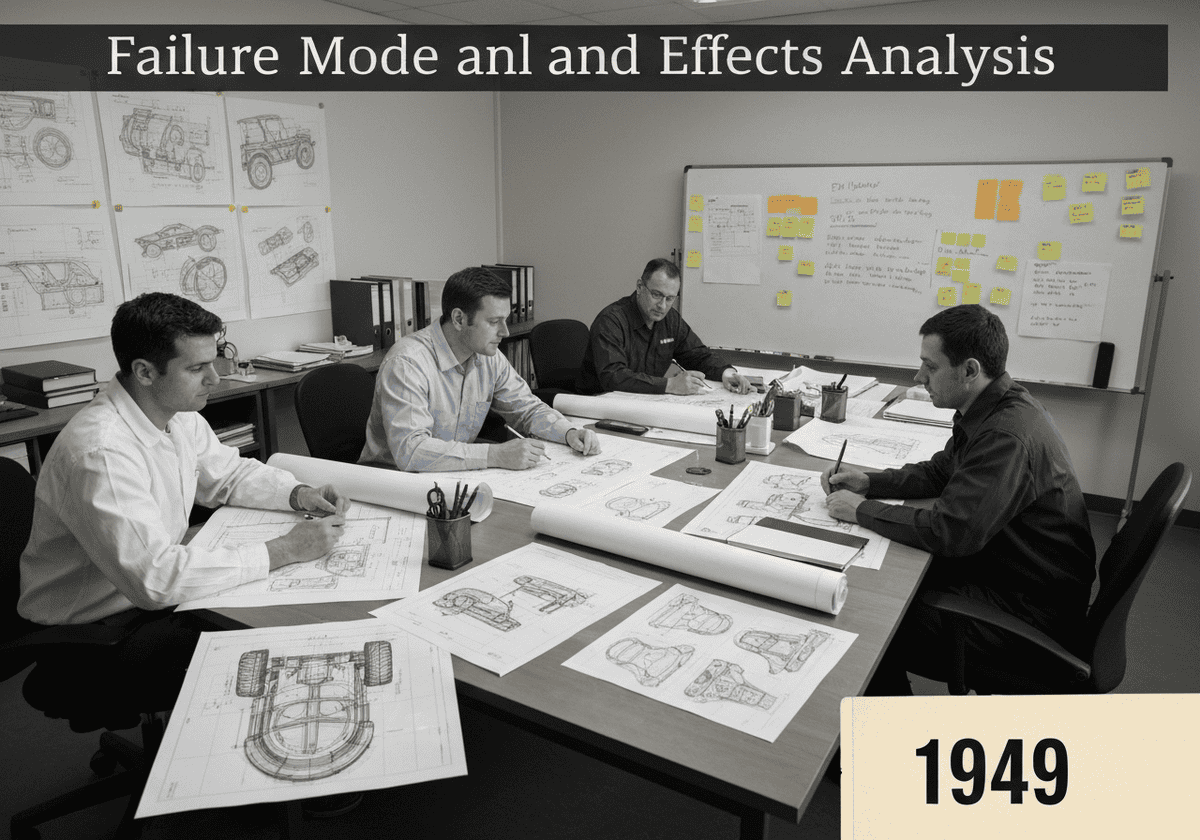
FMEA is a systematic, bottom-up, inductive method for identifying potential failure modes in a system, product, or process. For each failure mode, it assesses the potential effects or consequences, their severity, likelihood of occurrence, and the ability to detect them. The goal is to prioritize and mitigate high-risk failure modes before they occur.
FMEA is one of the first structured reliability analysis techniques. It involves a cross-functional team brainstorming all conceivable ways a component or process step could fail (the failure modes). For each mode, the team identifies the potential effects on the system, the customer, or the environment. Three factors are then typically rated on a scale (e.g., 1 to 10): Severity (S) of the effect, Occurrence (O) likelihood of the cause, and Detection (D) probability of finding the failure before it reaches the customer.
These three scores are multiplied to calculate a Risk Priority Number (RPN), where [latex]RPN = S \times O \times D[/latex]. A high RPN indicates a high-risk failure mode that requires immediate attention. The team then develops and implements corrective actions to reduce the RPN, typically by improving the design to lower the Occurrence or by adding controls to improve Detection.
A key variant is the Failure Mode, Effects, and Criticality Analysis (FMECA), which extends FMEA by including a quantitative criticality analysis based on the probability of the failure mode and the severity of its consequences. FMEA is a living document, continuously updated as designs change, new data becomes available, or processes are improved.
UNESCO Nomenclature: 3307
– Industrial design and technology
Precursors
- u.s. military’s need for improved reliability of munitions in the 1940s
- early quality control techniques from Shewhart and Deming
- brainstorming techniques
- root cause analysis methods
Applications
- automotive industry for design and manufacturing process improvement (sae j1739)
- aerospace design to prevent catastrophic failures
- medical device development to ensure patient safety
- food industry to identify and control potential hazards (haccp)
Potential Innovations Ideas
Due to scrapping bot traffic, currently more than 40k per day, this content is reserved to community members.
> Login < or > Register < (100% free) to access this, so as all other restricted content and tools.
Related to: fmea, fmeca, failure mode, risk priority number, rpn, bottom-up analysis, quality control, process improvement.