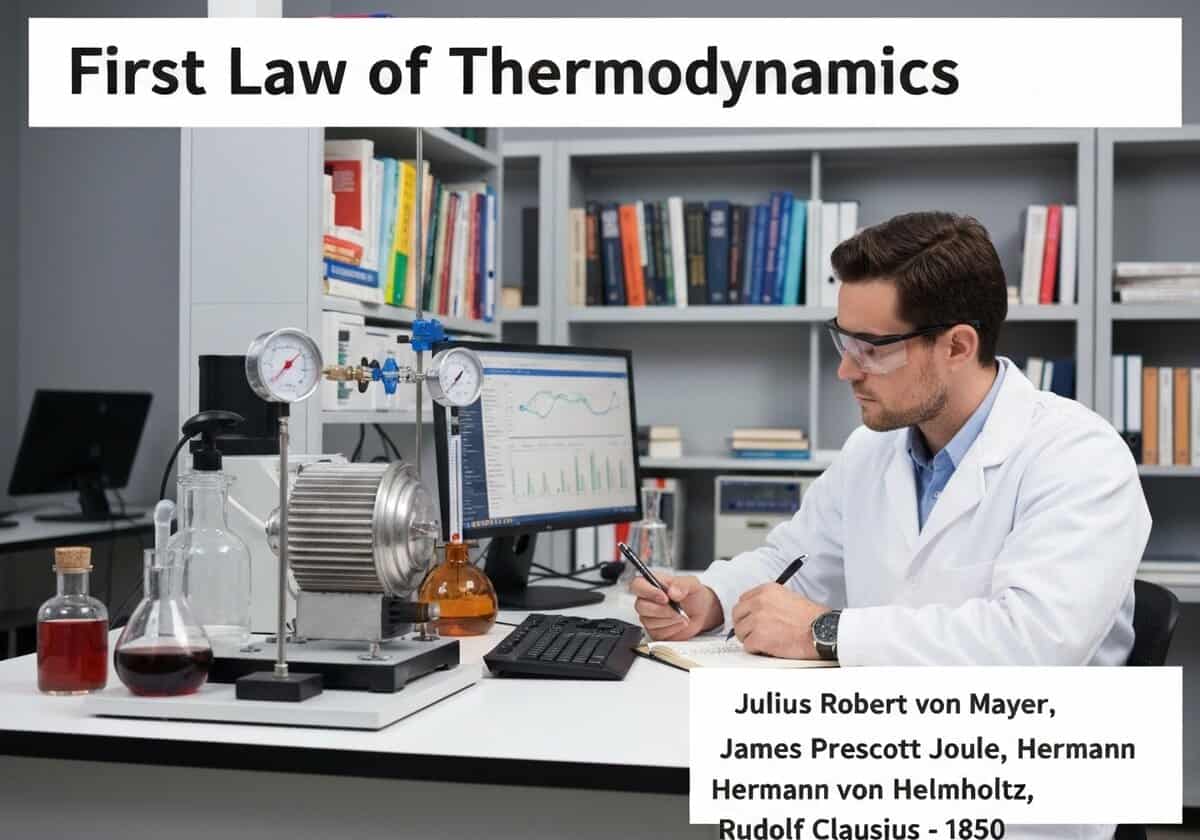
First Law of Thermodynamics
1850
- Julius Robert von Mayer
- James Prescott Joule
- Hermann von Helmholtz
- Rudolf Clausius
The First Law is a statement of the conservation of energy. It posits that the change in a closed system’s internal energy (\(\Delta U\)) is equal to the heat supplied to the system (\(Q\)) minus the work done by the system on its surroundings (\(W\)). The governing equation is \(\Delta U = Q – W\). This law links heat, work, and internal energy, establishing heat as a form of energy transfer.
The First Law of Thermodynamics generalized the principle of conservation of energy, which was previously known in mechanics, to include heat. Its formulation was a major step in physics, as it definitively refuted the prevailing caloric theory, which considered heat a weightless fluid. Experiments by James Joule in the 1840s, which demonstrated the mechanical equivalent of heat, were crucial in establishing that heat and work are mutually convertible.
The law introduces internal energy (\(U\)) as a state function, meaning its value depends only on the current state of the system, not on how it got there. In contrast, heat (\(Q\)) and work (\(W\)) are path-dependent process quantities. The law’s differential form is \(dU = \delta Q – \delta W\). For a cyclic process, where the system returns to its initial state, the change in internal energy is zero (\(\Delta U = 0\)), so the net heat supplied equals the net work done. This principle is the basis for all heat engines. The law also implies the impossibility of a perpetual motion machine of the first kind—a machine that produces work without any energy input.
UNESCO Nomenclature: 2212
– Thermodynamics, statistical physics, and condensed matter
Precursors
- Sadi Carnot’s analysis of heat engines and thermodynamic cycles
- James Joule’s experiments on the mechanical equivalent of heat
- rejection of the caloric theory of heat
- principle of conservation of energy in mechanics as formulated by Leibniz and others
Applications
- heat engines (internal combustion, steam turbines)
- refrigerators, air conditioners, and heat pumps
- chemical reaction analysis (enthalpy calculations)
- power plant design and efficiency analysis
- nutritional calorimetry for calculating food energy (calories)
Potential Innovations Ideas
Due to scrapping bot traffic, currently more than 40k per day, this content is reserved to community members.
> Login < or > Register < (100% free) to access this, so as all other restricted content and tools.
Related to: first law, conservation of energy, internal energy, heat, work, thermodynamics, enthalpy, closed system, state function, perpetual motion.