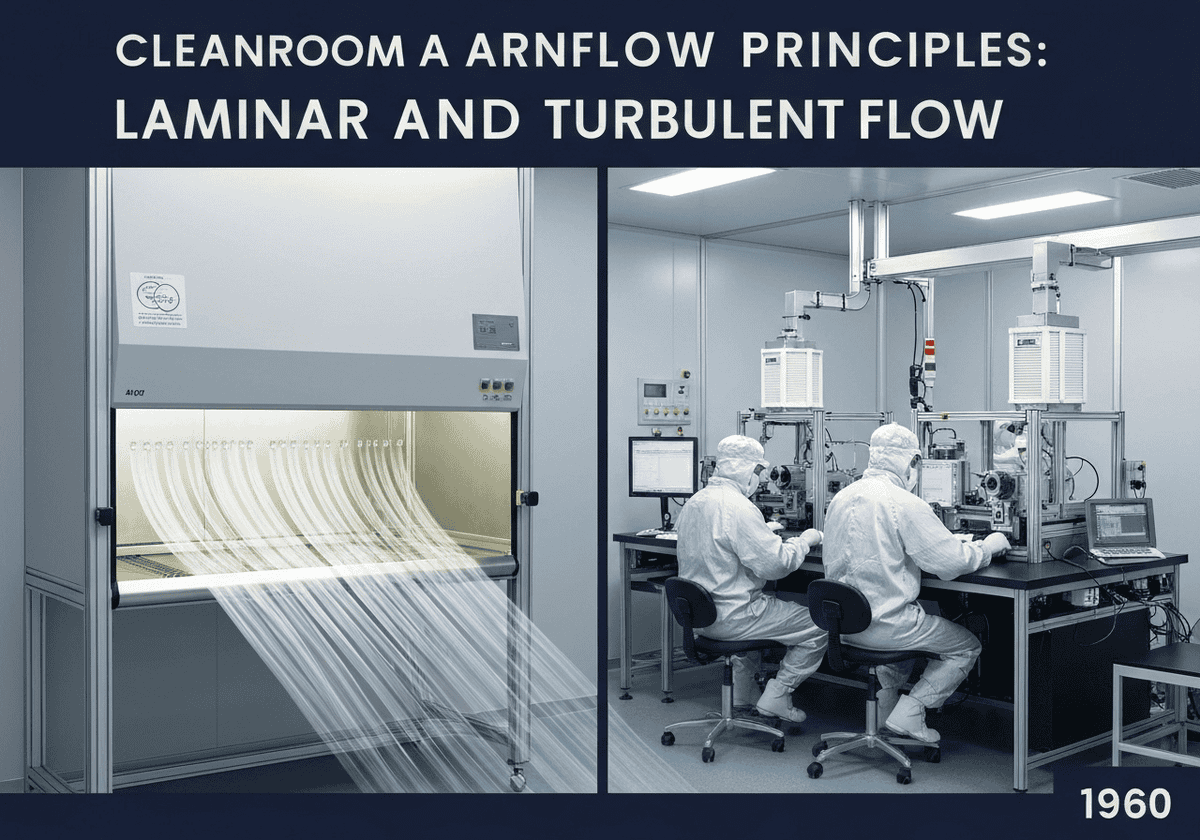
洁净室利用两种主要气流原理来控制污染。紊流(或非单向)涉及混合气流,适用于不太严格的等级(ISO 6-9)。层流(或单向)气流采用平行、恒速气流将颗粒从环境中排出,对 ISO 1-5 等高纯度应用至关重要,可防止交叉污染并确保快速清除颗粒。
The choice between turbulent and laminar airflow is a fundamental design decision in cleanroom engineering, driven by the required cleanliness level and cost constraints. Turbulent flow rooms, the more conventional design, supply HEPA-filtered air from ceiling-mounted diffusers. The air enters the room, mixes with the existing air, and removes contaminants as it exits through low-level exhausts. While effective for many applications, the random air currents can create eddies where particles may linger or settle.
In contrast, laminar flow, also known as unidirectional flow, creates a predictable, uniform movement of air. In a vertical laminar flow room, the entire ceiling is composed of HEPA or ULPA filters, and the air travels straight down to a perforated raised floor, acting like a massive, slow-moving piston that pushes particles out. This design provides the highest level of air cleanliness by minimizing the time a particle can remain airborne and preventing lateral movement of contaminants. Horizontal laminar flow systems are also used, where air moves from a filtered wall to an exhaust wall. While significantly more expensive to build and operate due to the large filter area and high air-change rates, laminar flow is non-negotiable for processes like microchip fabrication where a single sub-micron particle can destroy a device.