Product Design, Manufacturing & Innovation Resources
Home » Chemical Electromotive Force

Chemical Electromotive Force

1890
  • Walther Nernst
  • Josiah Willard Gibbs
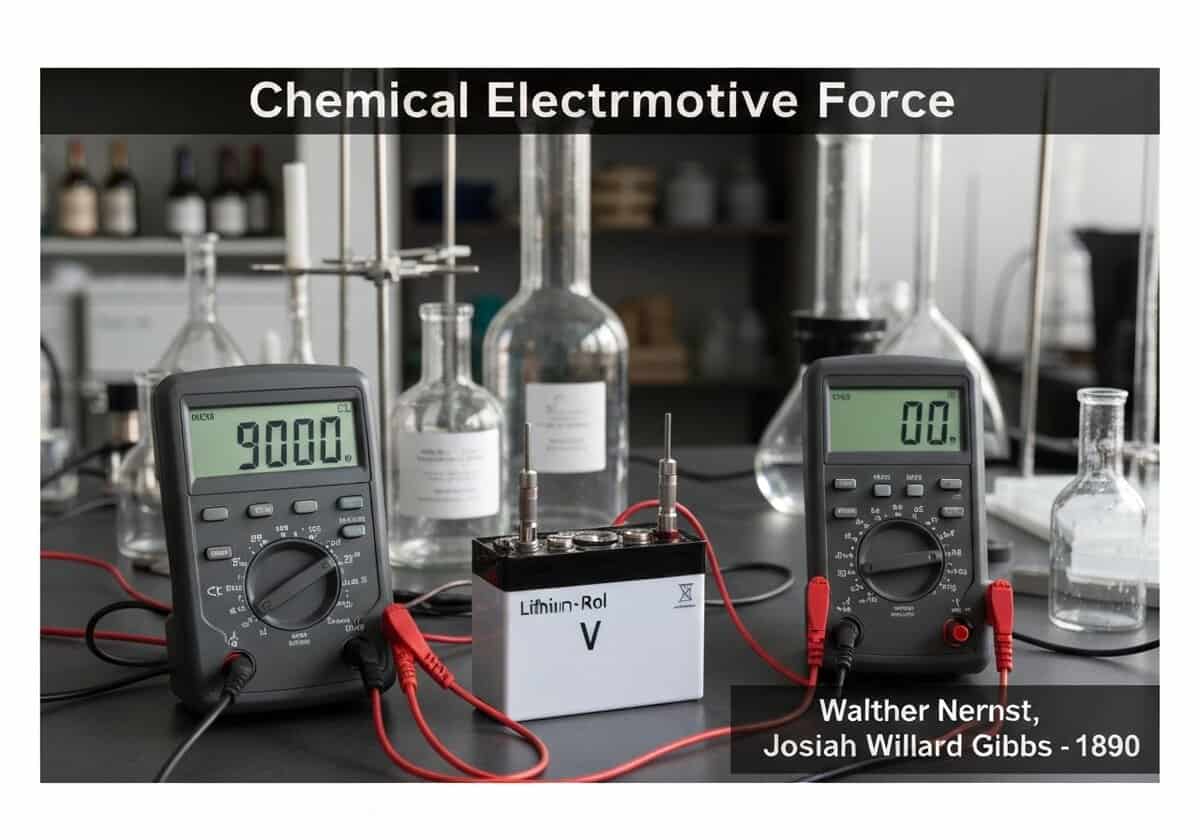
Lithium-ion battery testing in electrochemistry laboratory.

(generated image for illustration only)

In electrochemical cells like batteries and fuel cells, EMF is generated by chemical reactions. The separation of charge is driven by oxidation and reduction reactions occurring at two different electrodes. The maximum EMF of a cell is related to the change in Gibbs free energy (\(\Delta G\)) of the reaction by \(\mathcal{E} = -\frac{\Delta G}{nF}\), where \(n\) is moles of electrons and \(F\) is the Faraday constant.


The electromotive force in a chemical source arises from the potential energy difference of electrons in different chemical species. In a galvanic cell, two dissimilar metals (electrodes) are placed in an electrolyte, creating two half-cells. At one electrode (the anode), an oxidation reaction occurs, releasing electrons. At the other electrode (the cathode), a reduction reaction occurs, consuming electrons. This creates an electrical potential difference between the electrodes. The chemical reactions effectively act as a “charge pump,” doing work on the electrons to move them from a lower potential energy state to a higher one, thus establishing the EMF.

The theoretical maximum EMF is determined by the thermodynamics of the reaction, specifically the change in Gibbs free energy (\(\Delta G\)), which represents the maximum non-expansion work that can be extracted from a thermodynamically closed system. The Nernst equation further refines this by relating the EMF to the standard electrode potential and the concentrations (or activities) of the reactants and products, showing how the cell’s voltage changes as the reaction proceeds and concentrations vary. This thermodynamic basis is fundamental to designing batteries with specific voltage outputs and energy densities, and for understanding processes like electrolysis, where an external EMF is used to drive a non-spontaneous chemical reaction.

UNESCO Nomenclature: 2203
– Electro-chemistry

Type

Chemical Process

Disruption

Revolutionary

Usage

Widespread Use

Precursors

  • Luigi Galvani’s experiments with frog legs
  • Alessandro Volta’s invention of the voltaic pile
  • Michael Faraday’s laws of electrolysis
  • Josiah Willard Gibbs’s development of chemical thermodynamics

Applications

  • batteries (alkaline, lithium-ion, lead-acid)
  • fuel cells
  • electrolysis
  • corrosion prevention (cathodic protection)
  • electroplating

Patents:

NA

Potential Innovations Ideas

Due to scrapping bot traffic, currently more than 40k per day, this content is reserved to community members.
> Login < or > Register < (100% free) to access this, so as all other restricted content and tools.

Related to: electrochemistry, battery, galvanic cell, Gibbs free energy, Nernst equation, electrode, electrolyte, redox reaction.

Historical Context

Chemical Electromotive Force

1885
1887
1889
1890
1890
1895
1895
1884
1887
1888
1889
1890
1890
1895
1895

(if date is unknown or not relevant, e.g. "fluid mechanics", a rounded estimation of its notable emergence is provided)

Related Invention, Innovation & Technical Principles

Full size images and downloads are only available, 100% free, for registered members.

> Login <