Product Design, Manufacturing & Innovation Resources
» 화학 기전력

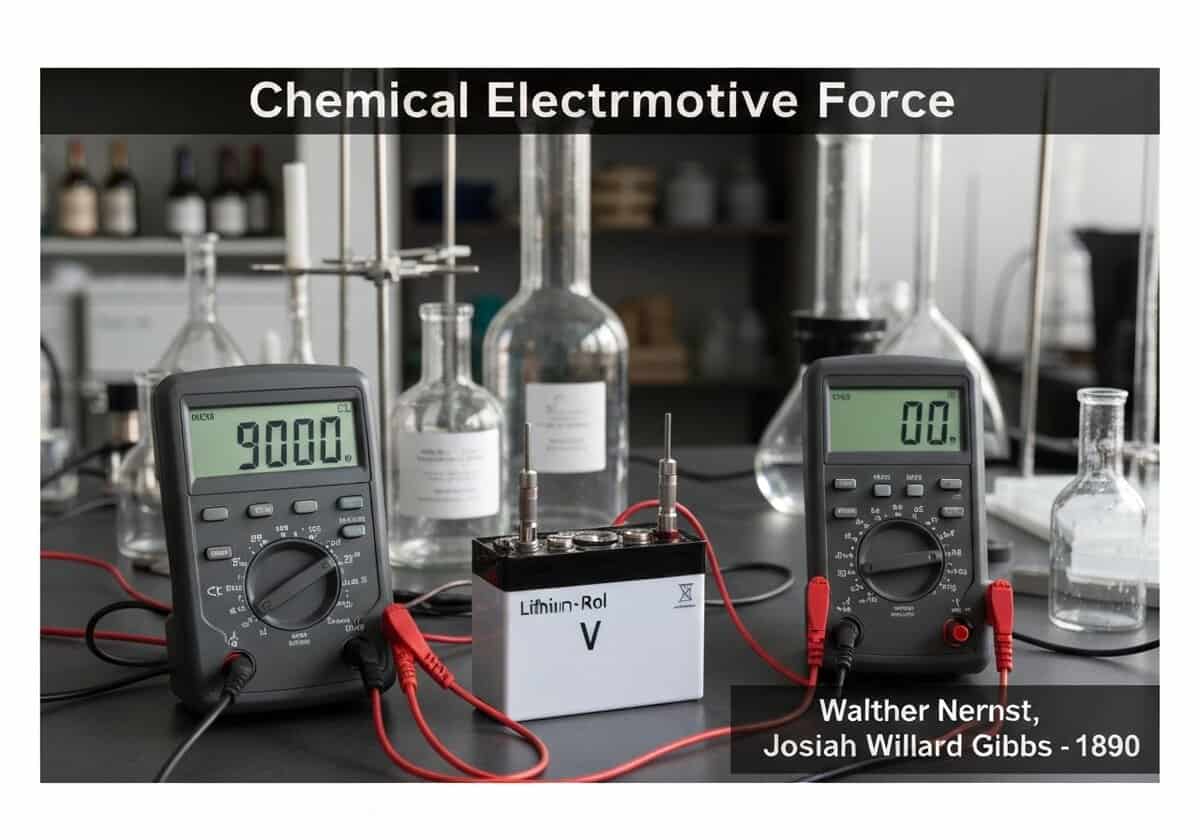
화학 기전력

1890
  • Walther Nernst
  • Josiah Willard Gibbs
전기화학 실험실에서 리튬 이온 배터리 테스트.

(설명을 위한 생성된 이미지입니다)

In electrochemical cells like batteries and fuel cells, EMF is generated by chemical reactions. The separation of charge is driven by oxidation and reduction reactions occurring at two different electrodes. The maximum EMF of a cell is related to the change in Gibbs free energy ([latex]Delta G[/latex]) of the reaction by [latex]mathcal{E} = -frac{Delta G}{nF}[/latex], where [latex]n[/latex] is moles of electrons and [latex]F[/latex] is the Faraday constant.


The electromotive force in a chemical source arises from the potential energy difference of electrons in different chemical species. In a galvanic cell, two dissimilar metals (electrodes) are placed in an electrolyte, creating two half-cells. At one electrode (the anode), an oxidation reaction occurs, releasing electrons. At the other electrode (the cathode), a reduction reaction occurs, consuming electrons. This creates an electrical potential difference between the electrodes. The chemical reactions effectively act as a “charge pump,” doing work on the electrons to move them from a lower potential energy state to a higher one, thus establishing the EMF.

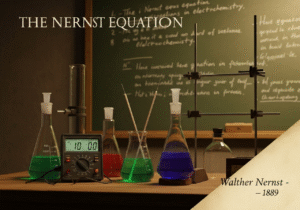
The theoretical maximum EMF is determined by the thermodynamics of the reaction, specifically the change in Gibbs free energy ([latex]\Delta G[/latex]), which represents the maximum non-expansion work that can be extracted from a thermodynamically closed system. The Nernst equation further refines this by relating the EMF to the standard electrode potential and the concentrations (or activities) of the reactants and products, showing how the cell’s voltage changes as the reaction proceeds and concentrations vary. This thermodynamic basis is fundamental to designing batteries with specific voltage outputs and energy densities, and for understanding processes like electrolysis, where an external EMF is used to drive a non-spontaneous chemical reaction.

UNESCO Nomenclature: 2203
– Electro-chemistry

유형

화학 공정

분열

혁명가

용법

널리 사용됨

전구체

  • Luigi Galvani’s experiments with frog legs
  • Alessandro Volta’s invention of the voltaic pile
  • 마이클 패러데이의 전기분해 법칙
  • Josiah Willard Gibbs’s development of chemical thermodynamics

응용 프로그램

  • batteries (alkaline, lithium-ion, lead-acid)
  • 연료 전지
  • electrolysis
  • corrosion prevention (cathodic protection)
  • 전기 도금

특허:

NA

잠재적 혁신 아이디어

현재 하루 4만 건이 넘는 봇 트래픽을 차단하기 위해 이 콘텐츠는 커뮤니티 회원만 이용할 수 있습니다.
> 로그인 < 또는 >등록 < 이 콘텐츠를 비롯한 모든 제한된 콘텐츠와 도구는 (100% 무료로) 이용할 수 있습니다.

Related to: electrochemistry, battery, galvanic cell, Gibbs free energy, Nernst equation, electrode, electrolyte, redox reaction.

역사적 맥락

화학 기전력

1885
1887
1889
1890
1890
1895
1895
1884
1887
1888
1889
1890
1890
1895
1895

(날짜를 알 수 없거나 관련이 없는 경우, 예를 들어 "유체역학"의 경우, 주목할 만한 등장 시기를 대략적으로 추정하여 제공합니다.)

관련 발명, 혁신 및 기술 원칙

고화질 이미지 및 다운로드는 등록된 회원에게만 100% 무료로 제공됩니다.

> 로그인 <