Product Design, Manufacturing & Innovation Resources
Maison » Brushless DC (BLDC) Motor

Brushless DC (BLDC) Motor

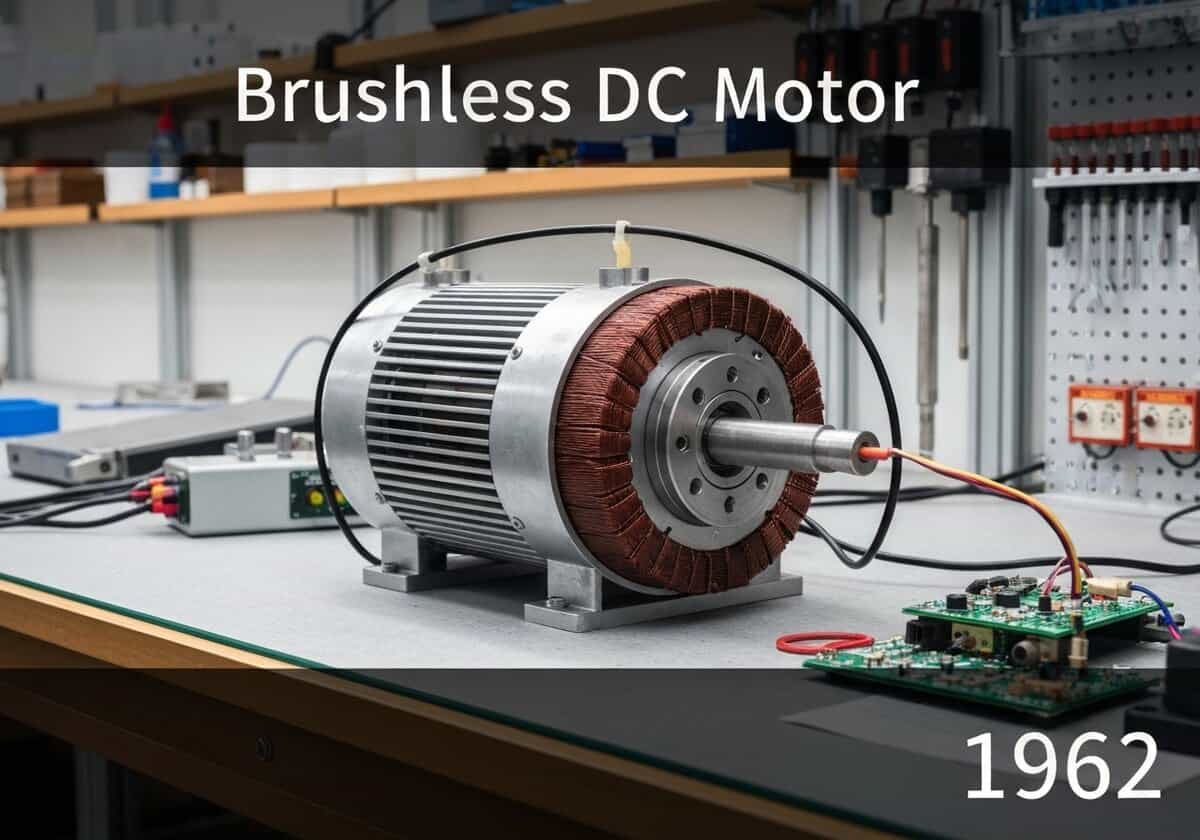
1962
    Moteur à courant continu sans balais avec contrôleur électronique dans un laboratoire d'ingénierie électrique.

    (Image générée à titre d'illustration uniquement)

    Un moteur CC sans balais (BLDC) moteur is a synchronous motor that uses an electronic controller instead of mechanical brushes and a commutator to switch current in the windings. It typically features a permanent magnet rotor and a wound stator. The controller uses sensors (like Hall effect sensors) or sensorless algorithms to determine rotor position and energize the windings sequentially, creating a rotating magnetic field.

    BLDC motors were developed to overcome the limitations of traditional brushed DC motors, such as brush wear, sparking, and electrical noise. By replacing the mechanical commutation system with solid-state electronics, BLDC motors offer higher efficiency, longer durée de vie, less maintenance, and better speed-torque characteristics. The motor’s basic construction is ‘inside-out’ compared to a brushed motor; the permanent magnets are on the rotor, and the windings are on the stationary stator. This configuration improves heat dissipation, as the heat-generating windings are on the outer casing.

    Le contrôleur électronique est le cerveau du moteur BLDC. Pour générer la rotation, il doit connaître la position du rotor afin d'alimenter les enroulements du stator appropriés au moment opportun. Ceci est souvent réalisé grâce à trois capteurs à effet Hall intégrés au stator, qui détectent le passage des pôles magnétiques du rotor. Le contrôleur lit ces données de position et commute le courant vers les enroulements selon une séquence spécifique, créant ainsi un champ magnétique statorique toujours en avance sur les aimants du rotor, les entraînant dans son mouvement. Des contrôleurs sans capteur plus avancés déduisent la position du rotor en surveillant… champ électromagnétique inverse dans les enroulements non alimentés, ce qui réduit les coûts et la complexité.

    UNESCO Nomenclature: 2205
    - Génie électrique

    Taper

    Dispositif physique

    Perturbation

    Substantiel

    Usage

    Utilisation généralisée

    Précurseurs

    • Invention of the transistor et l'électronique à semi-conducteurs
    • Développement de matériaux magnétiques permanents à haute résistance (par exemple, la ferrite, néodyme aimants)
    • Principles of the brushed DC motor
    • Invention of the Hall effect sensor

    Applications

    • computer hard drives and cooling fans
    • drones and rc aircraft
    • outils électriques sans fil
    • electric bicycles and scooters
    • robotics and cnc machines
    • hvac systems

    Brevets:

      Idées d'innovations potentielles

      • 3d-printed bldc motors with integrated cooling channels and optimized magnetic circuits
      • biodegradable bldc motors for single-use medical devices
      • bldc motors with embedded ai chips for predictive maintenance and self-tuning
      • fully encapsulated bldc motors for operation in harsh chemical or vacuum environments
      • bldc motors using novel magnetic materials for higher power density
      • integrated motor-drive systems where the controller electronics are built directly into the motor housing
      • sensorless control algorithms based on machine learning for improved low-speed performance
      • bldc motors designed for direct integration into robotic joints
      • ultra-high-speed bldc motors for dental drills and turbo-compressors
      • bldc motors with built-in regenerative braking for energy harvesting in portable devices
      Related to: BLDC motor, brushless DC, electronic controller, Hall effect sensor, permanent aimant, synchronous motor, sensorless control, commutator, efficiency, robotics.

      Contexte historique

      Brushless DC (BLDC) Motor

      1960
      1960
      1960-05-16
      1962
      1963
      1964
      1968
      1960
      1960
      1960
      1961
      1962
      1963
      1965
      1970

      (si la date est inconnue ou non pertinente, par exemple « mécanique des fluides », une estimation arrondie de son émergence notable est fournie)

      10e année anniversaire

      Les images en pleine résolution et les téléchargements sont uniquement disponibles, et 100% gratuits, pour les membres inscrits.