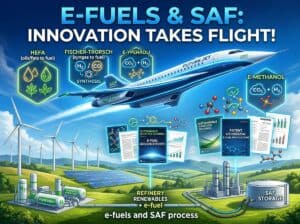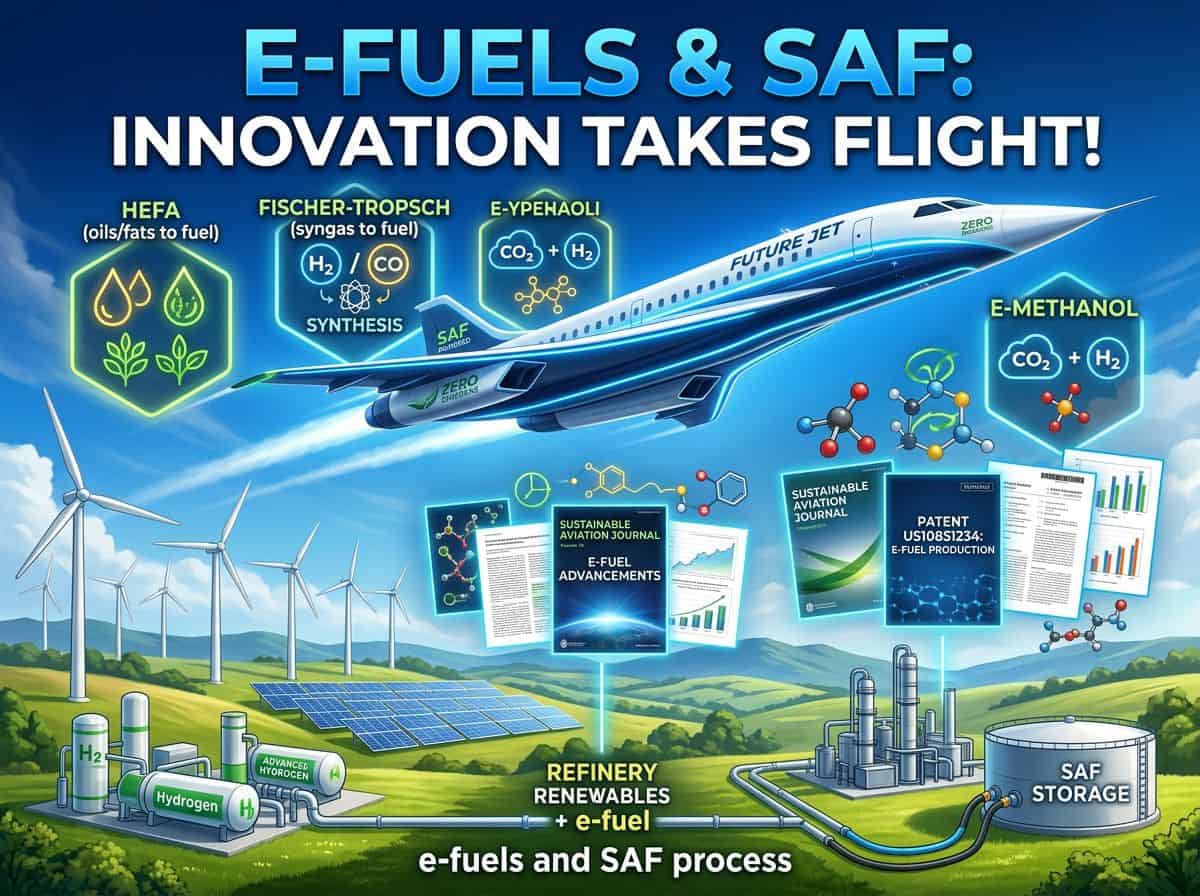

Les e-carburants sont des hydrocarbures synthétiques et des vecteurs chimiques produits à partir d'électricité renouvelable, d'eau et de dioxyde de carbone capturé. L'électrolyse fournit d'abord l'hydrogène, qui est ensuite combiné au CO₂ par la réaction inverse du gaz à l'eau et la synthèse Fischer-Tropsch, ou par la synthèse du méthanol suivie de sa conversion en kérosène. Les carburants d'aviation durables (SAF) incluent également des procédés biosourcés tels que l'HEFA, la conversion d'alcool en kérosène et la gazéification de la biomasse. Ces deux familles de carburants sont compatibles avec les moteurs et infrastructures existants.
L'efficacité énergétique et le coût demeurent les enjeux principaux. Chaque étape de conversion engendre des pertes d'énergie ; par conséquent, le rendement global de la conversion d'électricité en liquide est nettement inférieur à celui de l'électrification directe, et le prix du carburant dépend fortement du coût de l'électricité et de l'approvisionnement en CO₂. La durabilité du catalyseur, l'intégration de l'électrolyse à oxyde solide, la gestion de la chaleur de procédé et la mise à l'échelle augmentent les risques d'ingénierie. La certification selon la norme ASTM D7566 et les réglementations telles que ReFuelEU Aviation structurent le marché. Les publications et brevets répertoriés ci-dessous traitent des voies de synthèse, des catalyseurs, des réacteurs, de la capture du CO₂, de la qualification des carburants et de l'analyse du cycle de vie.
L'aviation dispose de peu d'options électriques pour les longs trajets, c'est pourquoi les carburants liquides à base de CO2 et d'hydrogène sont au centre des préoccupations. Les matières premières sont en cours d'approvisionnement. hydrogène vert et captage direct de l'airLe côté avion est sur aéronautiqueUne comptabilité carbone honnête est nécessaire analyse du cycle de vie.
Voici notre dernière sélection de publications et de brevets internationaux en anglais sur les e-carburants et les carburants d'aviation durables (SAF), issus de nombreuses revues scientifiques en ligne, classés et axés sur les e-carburants, la conversion d'énergie en liquide, la conversion d'énergie en X, les carburants d'aviation durables, le kérosène synthétique, la synthèse Fischer-Tropsch, la réaction inverse du gaz à l'eau, l'hydrogénation du CO2, l'e-méthanol, la conversion du méthanol en kérosène, la conversion de l'alcool en kérosène, les esters et acides gras hydrotraités, l'HEFA, l'e-ammoniac, la synthèse de l'ammoniac, l'électrolyse à oxyde solide, la gazéification de la biomasse, les carburants de substitution, la certification des carburants et la norme ASTM D7566.
Processes for use of ammonia synthesis catalysts and related systems
Patent published on the 2026-10-29 in WO under Ref WO2026226822 by COPERNIC CATALYSTS INC [US] (Ramkrishnan Aruna [us], Grose Jacob [us], Radaelli Guido [us])
Abstract: Methods and related systems for producing ammonia are described. The methods and systems may include use of a base metal catalyst (e.g., containing substantially no platinum group metals). The base metal catalyst may facilitate production of ammonia at relatively high conversion percentages and/or capacities at relatively low temperatures and/or pressures. In some instances, a preliminary reactor (e.g., a bolt-on interstage reactor), which may include the base metal catalyst in some instances, i[...]
Our summary: Methods for ammonia production utilize base metal catalysts for high conversion rates at low temperatures. Preliminary reactors may be used upstream of primary reactors to enhance efficiency. The systems described minimize the use of platinum group metals.
ammonia synthesis, base metal catalyst, conversion efficiency, reactor systems
Patent
Energy-saving and high-efficiency biomass gasification and catalytic conversion device
Patent published on the 2026-10-28 in EP under Ref EP4831265 by BEIJING APTBLAZE TECH CO LTD [CN] (Zhang Yanguo [cn], Zhou Hui [cn], Bie Xuan [cn], Chen Xuan [cn])
Abstract: The present disclosure discloses an energy-saving and high-efficiency biomass gasification and catalytic conversion device, and is used to solve the problems of complex process, low conversion efficiency, and thermal energy waste in biomass gasification in existing technologies. The gasification and catalytic conversion device of the present disclosure comprises a feeding unit, a gasifier, a high-temperature dust removal bag, a decomposition furnace, and air distribution components. The discharg[...]
Our summary: The device improves biomass gasification efficiency and reduces thermal energy waste. It includes a feeding unit, gasifier, high-temperature dust removal bag, and decomposition furnace. The design addresses complex processes and low conversion efficiency in existing technologies.
biomass gasification, catalytic conversion, energy efficiency, thermal management
Patent
Coral-reef-like bifunctional catalyst for biomass gasification to produce green hydrogen with simultaneous decarbonization, and preparation method and
Patent published on the 2026-10-08 in US under Ref US20260307057 by SOUTHEAST UNIV [CN] (Zhang Huiyan [cn], Lu Qiuxiang [cn], Su Yinhai [cn], Xiao Rui [cn])
Abstract: A coral-reef-like bifunctional catalyst for biomass gasification to co-produce green hydrogen and achieve decarbonization. Active metal site regulation optimizes the matching between active phases and supports to enhance catalytic activity and stability. The unique coral-reef-like structure builds a confined space for bond cleavage and CO2 conversion. Dual active sites respectively drive directional bond cleavage for high-purity green hydrogen production and in-situ CO2 adsorption and conversion[...]
Our summary: A coral-reef-like bifunctional catalyst enables biomass gasification for green hydrogen production and decarbonization. The structure enhances catalytic activity through active metal site regulation and bond cleavage. The catalyst demonstrates excellent stability and efficiency in producing high-purity syngas with CO2 conversion.
bifunctional catalyst, biomass gasification, green hydrogen, decarbonization
Patent
Catalysis aids for direct co2 hydrogenation to methanol, methods and products thereof
Patent published on the 2026-10-08 in WO under Ref WO2026207616 by VOLTA ENERGY INC [CA] (Zou Fenglou [ca], Singh Gursaran [ca])
Abstract: The present application relates to CO2 utilization. More specifically, the present application relates to catalysis aids for direct CO2 hydrogenation to methanol and methods using the same. Included is a catalysis aid for use in a catalytic CO2 hydrogenation, the catalysis aid comprising at least one component selected from superabsorbent polymers, silica gels, clay-based absorbents, cellulose-based materials and hydrogels.[...]
Our summary: The application focuses on catalysis aids for direct CO2 hydrogenation to methanol. It includes various materials such as superabsorbent polymers and silica gels. The methods aim to enhance CO2 utilization and improve product yield.
Catalysis, CO2 hydrogenation, methanol production, superabsorbent polymers
Patent
Ammonia production apparatus
Patent published on the 2026-10-01 in WO under Ref WO2026204931 by IDEMITSU KOSAN CO [JP] (Jia Qingxin [jp], Matsumoto Hiroto [jp], Yabukami Minoru [jp], Gong Bo [jp], Shinohara Yuki [jp])
Abstract: The purpose of the present disclosure is to provide an ammonia production apparatus capable of efficiently producing ammonia and suppressing production cost. The present disclosure relates to an ammonia production apparatus comprising: an anode chamber which has an anode electrode having a water electrolysis catalyst and to which water is supplied; a cathode chamber which has a cathode electrode having an ammonia synthesis catalyst and to which gaseous nitrogen is supplied; a diaphragm provided [...]
Our summary: The ammonia production apparatus efficiently synthesizes ammonia using a water electrolysis catalyst and an ammonia synthesis catalyst. It features an anode chamber for water supply and a cathode chamber for nitrogen supply. A diaphragm separates the chambers, and a drying mechanism is included for the cathode electrode.
Ammonia production, electrolysis, synthesis catalyst, cost efficiency
Patent
Process for preparing a catalyst for the production of syngas by the reverse water-gas shift reaction
Patent published on the 2026-09-30 in EP under Ref EP4813513 by CO2CO S R L [IT] (Milanese Marco [it], Rizzo Alessio [it], De Risi Arturo [it])
Abstract: [0001] The present invention relates to a catalyst comprising stainless steel elements, to the process for preparing said catalyst and to the catalyst obtainable by said process. In particular, the catalyst is generated on the surface of stainless steel elements through a thermochemical process at 850°C, by interaction with cerium oxide nanoparticles (ceria, CeO) under a flow of CO, capable of modifying the surface elemental chemical composition and the specific surface area, thereby maximising[...]
Our summary: The invention describes a catalyst made from stainless steel elements for syngas production via the reverse water-gas shift reaction. It is prepared through a thermochemical process at 850°C using cerium oxide nanoparticles. The process enhances the catalyst s performance and selectivity by modifying its surface composition and area.
catalyst preparation, syngas production, reverse water-gas shift, cerium oxide
Patent
Feasibility and Characteristics Study on Direct Ignition of High-Temperature Biomass Gasification Syngas with Ambient Air
Published on 2026-01-29 by Yao Xu, Yejian Qian, Yu Zhang, Taotao Zhou, Juye Wan, Ming Zhai @MDPI
Abstract: To advance the engineering application of the fusion decoupling combustion technology previously proposed by our research group, this work focuses on its second stage—the high-temperature syngas combustion stage—and specifically addresses the critical issue of whether high-temperature gasified syngas can achieve direct and stable ignition when mixed with ambient air. For this purpose, a high-temperature syngas combustion experimental system was established, utilizing [...]
Our summary: This study investigates the direct ignition of high-temperature biomass gasification syngas mixed with ambient air. A high-temperature combustion experimental system was established to analyze the effects of syngas temperature and composition on ignition limits. Results show that increased syngas temperature and H2 content broaden the ignition range, while CO narrows it, confirming the feasibility of direct ignition for engineering applications.
Biomass Gasification, Syngas Combustion, Ignition Limits, Reaction Kinetics
Publication
Electro-Reforming of Biomass Gasification Tar with Simultaneous Hydrogen Evolution
Published on 2026-01-27 by Umberto Calice, Francesco Zimbardi, Nadia Cerone, Vito Valerio @MDPI
Abstract: In this study, an electrochemical valorization strategy on liquid byproducts from hazelnut shell gasification was developed to couple waste remediation with energy-efficient hydrogen production. The aqueous phase, rich in organic compounds, is processed in an anion exchange membrane (AEM) cell, where pure hydrogen evolved at the cathode while organic pollutants are oxidized at the anode. First, the feedstock is thoroughly characterized using gas chromatography–mass spectrometry (GC[...]
Our summary: This study presents an electrochemical method for valorizing liquid byproducts from hazelnut shell gasification while producing hydrogen. The process utilizes an anion exchange membrane cell, optimizing conditions with Nickel oxide-hydroxide electrodes. Results show significant organic compound reduction and efficient hydrogen generation at low energy consumption.
Electro-Reforming, Biomass Gasification, Hydrogen Production, Anion Exchange Membrane
Publication